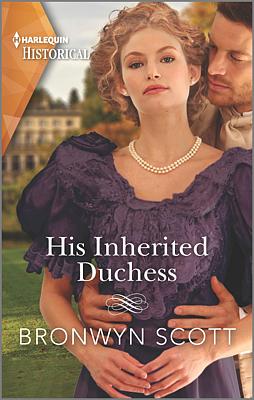

His Inherited Duchess
highlight_author
Bronwyn Scott
highlight_reads
17.4K
highlight_chapters
22
An exciting, passionate Victorian romance. His unexpected inheritance? The dowager Duchess! With his promotion to Duke of Darlington after his cousin's strange passing, carefree rake Logan Maddox must bear the responsibility of a new household shrouded in mystery… And no one is more mysterious than the newly widowed duchess, Olivia de Lacey. Uncovering the truth about his dukedom is one thing — unraveling Olivia is a challenge Logan never anticipated but cannot resist!
Chapter One
Logan James Montfort Maddox, Fifth Viscount Hailsham, was the epitome of his age. Society’s most sought after contradiction; the Responsible Rake, the titled gentleman who lived lavishly and flagrantly in the moment as if he hadn’t a care beyond the day while privately shouldering the enormous concern of his family’s well-being for the present and securing it for generations into the future. He was a man for whom the concepts of dissipation and dependability lived cheek by jowl with one another.
To the untutored debutante straight from the schoolroom it made him an enigma, layers of handsome masculinity wrapped in an intriguing mystery. To their mamas, however, it made him something much more: eligible; marriageable. Preferably sooner rather than later now that he came with the extra caveat of possibly being the next Duke of Darlington. Such an enticing combination of wealth, lineage and dedication to family didn’t come on the Marriage Mart often. When it did, people were bound to pay attention, to the man and his circumstances, because when something was too good to be true, it quite often was. Best one knew before one married into it.
Such considerations were the precise reasons he and his mother, the viscountess, were tucked into the well-sprung but utilitarian Maddox family travelling coach, hurtling over the weather-rutted roads of late winter toward Darlington Hall in Surrey with all haste possible. Logan, having ignored the initial summons two weeks ago, had now received word in no uncertain terms that such disregard for his situation was growing less possible to maintain as was his fate. Every day that passed seemed to indicate he would indeed be the duke.
‘I haven’t been to Darlington Hall since the old duke was alive and you were small. You must have been four.’ His mother tried for a smile. It came out small and tremulous. No one had smiled for weeks. The news had stunned them all with its suddenness coming swiftly on the heels of Christmas, its repercussions continuing to shock and shape them in the unfolding weeks. ‘Do you remember nothing of that visit? You and your cousin, Adolphus, played soldiers in the nursery.’ He did remember that visit, although he wisely said nothing. It wasn’t polite to speak ill of the dead. Adolphus had been a bully and when he’d not got his way he’d punched him.
His mother’s smile, not strong to begin with, faltered. ‘And now...’ Her voice trailed off, the rest unspoken. Now Adolphus was dead along with his father, Logan’s father and Logan’s brother, Griffin. The male limbs of the family tree pruned down to Logan and his younger brother, Rahnald, a prospect that had once been so improbable to consider that Logan had never dwelled on the idea.
It was that improbability that had been a source of significant anxiety of late. The old duke had died of natural causes a few years ago as had Logan’s father, who had died when Logan had been fifteen, preceded by his own son Griffin’s death when Logan had been thirteen. But now Adolphus was dead. What the cause of his death was had not been imparted to Logan, but whatever it was, it was not natural. There were, in fact, few natural causes that would fell a healthy thirty-six-year-old, which was why there would be speculation.
The one silver lining in all of this, Logan supposed, was that speculation would run its course during the imposed social isolation of winter with most families tucked up in their country manors before Society returned to Town in the spring. Other things would run their courses, or not, much sooner, in the next few days, if the solicitor could be believed. Soon, they would know if he’d be the duke, and the solicitor felt he should be on hand when the determination was made. There was only one person who stood between him and the dukedom now: Adolphus’s widow. Olivia Maddox, née DeLacey, a woman Logan had met once at her London wedding to his cousin five years ago. He did not know her well and barely recalled her except that she’d been quite young, a debutante fresh from the schoolroom with an ancient name who’d snared a ducal heir within weeks of being out.
‘You are most likely the duke already.’ His mother’s sea-glass eyes met his, serious with intention. ‘It is unlikely that she’s with child after so many years of nothing, and even if she was, what are the chances the child would be male?’
‘One out of two, actually,’ Logan replied drily, his tone sharper than he meant it to be. Adolphus had done his duty in wedding and bedding, but he’d failed to leave behind an heir of his body. Hence Logan hurtling to Surrey with his mother. She was the widowed half of a mostly happy marriage, and a mother to two living sons, although she’d conceived seven children. She knew about loss, not just the loss of a husband, but the loss of children, of possibility and what might have been.
His mother would know what to say when Her Grace of Darlington officially discovered she was not with child, that all chance of Adolphus leaving a direct heir was gone, that she would now, as a result, be dispossessed of her home and security. Logan did not envy the duchess. His mother’s words would put a touch of soft femininity on what he viewed as nothing short of a barbaric, insensitive ordeal the solicitors and the law were putting the widowed duchess through at a time when so much else was on her mind: grief and the uncertainty of what life held for her without the umbrella of her husband’s protection. He could not spare the young widow that ordeal, but he could allow his mother to soften it. She was good with emotions; he was not.
‘I do not know what I wish for, Mother,’ Logan confessed as the wide, sandstone facade of Darlington Hall came into view, its gothic spires soaring into the grey winter sky. ‘That she is with child and that it is a son, perhaps for her own comfort and for mine. A child means my life does not have to change, nor does hers. I never expected to be duke and she never expected to not be the Duchess of Darlington. She can continue as duchess here at the estate until her son is old enough to marry and manage on his own.’ Logan gave a wry smile. The duchess wasn’t the only one who could go on as usual. As for himself, he could continue his rather immersive pastime of managing his carriage racing syndicate and running the Hailsham holdings. ‘On the other hand, perhaps it would be best, if there’s not to be a son, to rip the bandage off the wound immediately and get on with it.’ He could not imagine the agony for anyone involved of waiting another nine months if the duchess was indeed expecting.
‘Well, either way, we’re about to find out. Here we are.’ His mother offered a smile of encouragement as the carriage came to a halt. ‘For better or for worse.’
‘I’m glad you’re here, Lord Hailsham. I trust your journey was not too onerous?’ The solicitor took his seat behind the desk in the estate office of Darlington Hall. There was a certain relish to the man’s movements that said he was enjoying the temporary appropriation of the last duke’s desk. Pompous little prick, Logan thought uncharitably, but what else was to be expected of a man so dedicated to the letter of the law that he thought nothing of commanding a viscount, a peer of the realm, to wait upon him at immediate convenience while demanding a grieving widow keep him informed of the intimate details of her body. All so that paperwork could be satisfied.
‘You will be wanting to go over the inheritance, of course.’ The solicitor tapped a sheaf of papers on the desk’s surface, aligning the edges in an annoying show of fastidiousness.
‘No, actually,’ Logan said in part to be contrary and in part because the solicitor’s dry callousness toward the situation offended him. A man had died, by God. A young man in the prime of his life, and that death had disrupted multiple lives. A moment of humanity would not be amiss before getting down to the business of inheriting a dukedom. ‘My cousin is dead and while your notes were quite thorough in what that entails going forward, there has been no mention of how he died.’ Logan speared him with a strong stare meant to intimidate. He did not want this petty little man being the gatekeeper of his family’s private business.
The man cleared his throat nervously. The stare had done the trick. ‘I did not think the details appropriate for a letter, my lord.’ No, but the poor duchess’s condition had been fair fodder for one.
‘Well? Now I am here, so those details can be imparted.’ Logan offered a cold smile and sat back in his chair to indicate he was settling in for the duration. He was regretting leaving these particular details alone for so long. Ledgers could keep, but somebody somewhere knew how his cousin had died, and if they spread the story first Logan would lose his ability to control tonnish gossip come spring.
The solicitor favoured him with a single word. ‘Pistols.’ He leafed through his stack of papers and pushed one forward. ‘This is the coroner’s report, the one used for the death certificate.’
Logan scanned the sheet, his eyes landing on the reason for death. ‘Misadventure?’ He grimaced. The word connoted a variety of unpleasant implications. Misadventure suggested an accident but was often used as a genteel lie to cover up death by suicide or perhaps by duelling or other unsavoury and dangerous activities that lived on the illicit edges of tonnish life. Dear heavens, the gossips would have a heyday once they linked pistols with misadventure.
‘You will have to do better than that, I’m afraid,’ Logan warned. ‘My cousin was a crack shot.’ As were all the Maddox males. Shooting was in their blood. ‘No one would believe he accidentally shot himself most fatally. The wound was where?’ Logan scanned the sheet again and quirked a brow in challenge. ‘His inner thigh? Very difficult to shoot oneself there, I think.’
‘As you say, my lord. I am sure the coroner would be able to satisfy any of your questions on that account far better than myself.’
Logan let the silence stretch between them in the hopes the solicitor would be more forthcoming. When he was not, Logan pressed on. ‘Where did it happen?’ Perhaps there would be a clue to his cousin’s death in the location.
‘An estate called the Grange, outside of London near Hampstead Heath. I understand he was hosting a gentleman’s weekend.’
‘Do we know who was there?’ That seemed odd, a gentlemen’s weekend coming so quickly on the end of Christmas, when people were still with their families. It was an awkward and unlikely time to be away.
The solicitor looked put out by the question. ‘I am not privy to that sort of information, my lord. Ledgers, accounts, holdings, investments, that is what I know.’
Ah, so the pompous man hadn’t been in Adolphus’s social confidence, only financial. Logan rose, leaving the man no choice but to rise with him. ‘Thank you for your time. I’ll look over the books and let you know if I have any questions. Until then, please make free of the comforts of the inn in the village. We’ll expect you tomorrow afternoon for the reading of the will.’ He could not make a dismissal any clearer. It was an eviction, really. If the solicitor couldn’t shed any further light on his cousin’s death, he had little more usefulness. But perhaps the duchess could. Knowledge was the key to preparation, and he would need to be prepared. People would talk when a young man died under curious circumstances. There would be rumours. But he’d wait until the rumours came to him. If he was too proactive in combatting them, people would assume there was something to hide, and he’d risk giving those rumours credence by addressing them prematurely. For now, he preferred to take the high road, and let sleeping dogs lie.
She’d lied about everything: what her marriage had really been like; what her husband had been like. She’d even lied about the possibility of a child. She’d needed time. And now time had run out. The month was up in all ways.
Olivia backed away from the curtains and the hall window overlooking the driveway. She was the duchess no more except for the courtesy of a title that no longer meant anything. Now that the heir and her courses were here, arriving within hours of each other, neither of them a surprise, both of them inevitable, she was Olivia DeLacey once again for all intents.
Her stomach cramped as she made her way down the hall to her chambers. All she wanted was a lie-down. She did not want to send her maid to that pompous solicitor with the news he’d been craving since his arrival—that there was no heir, that he could hand the dukedom and her over to Adolphus’s male successor. What she wanted instead was to send her maid for a hot water bottle. Her chambers. Her maid. Those pronouns were a temporary courtesy, on loan to her as were the items they attached to. The maid would stay with the estate, as would her jewellery, as would the art and book collections she’d spent the past years curating in her short tenure as duchess. All her efforts weren’t truly hers. Her efforts belonged to the Darlington Dukedom. She resented that.
Olivia opened the door to her rooms and slipped inside with a grateful sigh. She’d made it to her chambers without any interference. Sanctuary at last. Perhaps the heir would be with the solicitor long enough for her to have that lie-down before she was summoned. If she was lucky, she might escape notice until supper. Her maid came out of the dressing room and took one look at her face. ‘Oh, Your Grace, they’ve come, haven’t they? I’m so sorry. Shall I fetch you some warm milk and a hot water bottle?’
She would miss Mary when she was gone from here. She might not grieve her husband’s passing but she did grieve the loss of all this. She’d liked being the duchess; she had purpose and agency, the ability to affect change, and Adolphus, who did not care for those things, had given her free rein in his long absences. It was an arrangement that had come to suit them both.
‘Yes, thank you.’ Olivia lay down on the bed, weary of it all. The past month had been agonising with the funeral, the paperwork, the questioning, the prying, the planning and the uncertainty of what came next for her, all of it demanding her attention against an emotional backdrop of grief, disbelief and relief that Adolphus was gone, an interesting and contradictory palette of feelings she’d barely begun to sort through.
‘And the solicitor, Your Grace? Shall I tell him?’
Olivia gave a nod. There was no sense in perpetuating the lie further. She’d had her month’s reprieve; it was time to move on, ready or not.
She closed her eyes as the door shut behind Mary. Who would she be if she was not the active duchess of Darlington? She was far too young to truly be a dowager, but the viscount would marry and have his own duchess. The estate and the new duke had no use for her now. She should celebrate that. She was at liberty to redefine herself, perhaps discover herself for the first time since she’d turned eighteen or maybe ever.
Being a duchess and a wife had been thrust on her before she’d experienced the world. She’d been married within weeks of her debut for her name, old and as distinguished as the Conqueror himself. Before she’d been the duchess, she’d been the living embodiment of all the DeLacey lineage stood for, a line of greatness designed to cloak the shortcomings that lay behind the Darlington wealth so that none would guess the secrets Adolphus kept.
It was a trade she’d been naively happy to make five years ago. ‘I will keep your family from want. Your sisters will have matches worthy of their name,’ Adolphus had promised. ‘And in return, I ask only that you keep my secrets.’ Her family had needed that promise. Her sisters needed their own debuts; her father needed funds for the estate. There’d been nothing left to sell but her and the DeLacey name. When the chance had come, she’d done her part, which had not been all that difficult when approached by a handsome ducal heir.
In her naivete, she’d not been concerned when Adolphus had asked for her promise. What could such a dashing man have to hide? She thought perhaps it might be an illegitimate child. She could live with that if her family might be safe. She laughed now at the innocence of that girl who could imagine nothing worse, who hadn’t believed that a handsome visage might harbour a multitude of sins.
Mary returned with a tray. ‘Thank you.’ Olivia gratefully took the hot water bottle and placed it on her belly, the heat immediately soothing. ‘Did you tell the solicitor?’
‘No, I could not, Your Grace.’
‘Could not? I know it’s difficult, Mary, to discuss such personal things with that man, but he must be told so things can be settled.’ Olivia sighed. She, too, found the idea of reporting to the solicitor humiliating even though the law required it. How ironic that for the estate to be settled, its duchess, the woman who had been its caretaker, must be unsettled.
Mary shook her head. ‘No, Your Grace. It’s not that. I couldn’t tell him because he’s not here. Lord Hailsham, the heir, has sent him packing to the inn in the village. I could not tell him because he was not here to be told.’ There was a gleam of satisfaction in Mary’s usually calm gaze.
Olivia sat up against her pillows. ‘You saw the viscount, then?’ She ought to have referred to him as His Grace. He was more than a viscount now. He was Darlington.
‘I did see him, just for a moment in the hall. He’s brought his mother. Mrs Aldrich and Moresby are seeing them settled.’ Mary paused before adding, ‘He sends a message, Your Grace. He would like your company at supper if you felt up to it.’
She would feel up to it. She must. ‘Let me rest, Mary. Wake me in time to dress for supper and let the viscount know I’d be pleased to join him.’ If she hid away now, she would send the signal that she was weak and unimportant. That would not do. The viscount would have questions about the estate, about Adolphus. If she was not on hand to provide answers, he would go to others. She did not want that. She needed to control the information. Her family’s financial security depended on it.
Keep my secrets, the ghost of Adolphus whispered. It was what he’d asked of her the night he’d proposed and the last words he’d written to her, left with a ledger that had arrived by post, wrapped in brown paper the day before he died. It was full of names of fictional characters from literature, and while those names meant nothing to her, it obviously had meant something to him or he would not have sent it into her keeping. He also would not have sent it if he had not felt the ledger was in danger.
He’d thought there was a chance he would die.
It prompted several questions about just what had happened at the men’s weekend. Whatever that ledger represented, people had felt they could not put their own names to it. That never boded well. It also prompted other fears, more personal ones: What had she unwittingly got herself into when she’d made her reckless promise? Before the journal had arrived, the secrets she had thought she was keeping had been more of a private nature, something just between the two of them, between a husband and a wife. But then the journal had arrived, full of names, indicating that there was a secret that went beyond their bedroom door, a secret she’d never known about. Reading the names had made the idea of secret-keeping a reality, and along with it had come the reality that she’d been complicit in something she’d had no idea about all along.
She would keep Adolphus’s secrets. She had no choice in the matter. She would keep them because they were her secrets, too, and had been since the moment she’d married him. Her family’s continued security depended on her word, and Adolphus was reaching past the grave to make sure she kept it.