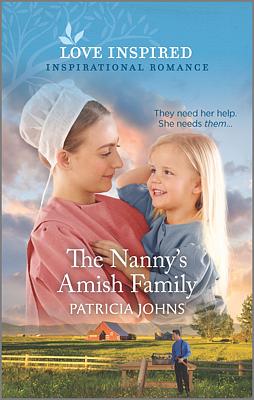

The Nanny's Amish Family
highlight_author
Patricia Johns
highlight_reads
19.2K
highlight_chapters
15
They need her help. She needs them… An Amish bachelor. A motherless child. Can she turn them into a real family? Schoolteacher Patience Flaud longs for a family of her own — but knows it can never happen. At least she can help Amish bachelor Thomas Wiebe with his small Englisher daughter. As she settles the child into Amish life, Patience begins falling for the bewildered new father and his heartbroken little girl. But is love enough to make them a permanent family?
Chapter One
Thomas Wiebe pushed himself to his feet and headed toward the side door to look out at the warm August evening. Low, golden sunlight washed over the grass, and birds twittered their evening songs. His jittery nerves didn’t match the peaceful scene. The social services agent who had come by the night before had said that they’d be here by seven, and it was a quarter past already.
“Stop fussing, Thomas,” Mammi said, pulling a boiling kettle from the woodstove. Her crisp, white kapp was a shade brighter than her white hair. “She’ll come.”
Thomas glanced back at his family in the kitchen. They weren’t all blood relatives, but this was as close to family as he had left in the community of Redemption, Pennsylvania. His older brother, Noah, sat with a glass of lemonade in front of him, his straw hat on the table. Thomas and Noah were both old enough to be married with families of their own by now, but not having found the right wife meant that they stayed here with Uncle Amos—an honorary uncle, not a biological one—and his elderly grandmother. It was a house filled with men, as Mammi described it.
And any minute now, Thomas’s daughter would be joining them... His daughter. He’d known about her, but he’d never been given the option to be in her life. Thomas had made a mistake with an Englisher girl on his lengthy Rumspringa, and the breakup had been messy. Tina wanted nothing more to do with him. It wasn’t that he forgot about his daughter, but he’d accepted that heartbreak as part of the consequences for his mistakes. Coming back home to Redemption four years ago was supposed to be his new start. But when a social services agent came to his house last night and told him of a fatal car accident that killed his daughter’s mother, everything had changed.
His daughter, Rue, was now coming to live with him after never having met him even once in her young life. Would she hate him just a little? He wouldn’t blame her. But at the age of four, he wasn’t sure how much she’d even understand about her new situation.
Outside, a car rumbled up the drive, and Thomas pulled open the screen door and stepped out onto the raised patio next to the house. A clothesline full of men’s pants and shirts flapped in a warm breeze.
Thomas waited while the car stopped, the door opened and the social services agent from yesterday got out. She shot Thomas a smile and waved. She was an older woman, plump and pleasant. Tanya Davis, she’d said.
“Good evening, Mr. Wiebe!” Tanya called.
Thomas would do just fine, but he didn’t trust himself to speak just yet. He came down the steps toward the car and glanced back to see Noah and Amos in the door. Tanya opened the back door to the car and leaned in, undoing the buckles from a children’s car seat. Then she backed out again, followed by a small, frail child.
The little girl stood there, a teddy bear clutched in front of her. She wore a pair of pink pants and a ruffled purple T-shirt. Her hair was stringy and blond, and she looked around herself with large, frightened blue eyes. She reminded him of a bedraggled bird.
Thomas came closer, unsure if he’d scare her or not.
“Hello,” he said in English. He wasn’t very eloquent in English... But then he wasn’t very eloquent in German, either.
The little girl looked at him, silent.
“I’m your daet, it would seem,” he said slowly. Then he realized she might not know the word. “I’m your...father.”
“Hello, Mr. Wiebe.” Tanya held out a hand and Thomas shook it. “Shall we go inside? Maybe you’re hungry, Rue,” Tanya said quietly, smiling down at the girl, then glancing up at Thomas.
“Yes, Mammi has made some sticky buns. She thought you might like that,” Thomas said.
He turned around and led the way to the house, feeling that strange distance between himself and that little girl behind him. Rue had never met him, but he’d also never had a chance to even see her... He’d been a daet, but until this very moment, it had been theoretical. How was he supposed to do this—be a daet to an Englisher child? There was a time he thought he could be an Englisher himself, but that was when he was young and foolish, and he’d forgotten that it wasn’t possible to change what a man was born to.
Tanya brought Rue indoors, and introductions were made. Amos. Noah. Mammi. Mammi’s name was Mary Lapp, but she was never called Mary in this house. Rue stared silently around the room, looking stricken. Thomas sank down to his haunches in front of her.
“Hello, Rue,” he said quietly.
“Hello...” she whispered.
“This is all very new, isn’t it?” he said.
“Yes. I want my mommy...” Tears welled in her eyes, and Thomas reached out and patted her shoulder.
“Have you had a...daddy...before?” He hesitated over the English word. Had Tina moved on with another Englisher man? That was what he was asking.
“No, never,” she whispered. His heart clenched. How much wrong had he done in that woman’s life? He’d known better, and he wouldn’t ever completely forgive himself for the way he’d conducted himself in that relationship.
“You’ll call me Daet,” he said softly. “And I’ll take care of you. You’ll be safe and happy here, yah?”
Rue wiped her eyes on her teddy bear and looked hesitantly around the kitchen again. Her bright pants and T-shirt were in stark contrast to their plain clothing.
“Where’s the TV?” Rue whispered.
“We don’t have a TV,” he said.
“How come?” She frowned, peering past him as if he were hiding it somewhere, and Thomas couldn’t help but smile.
“Because we’re Amish, Rue. You’ll get used to our ways.”
It didn’t seem to be the right thing to say because Rue’s eyes filled with tears again, and he looked helplessly toward Amos and Noah. He wasn’t quite so comforting for the little girl as he’d hoped, and he didn’t know how to cross that divide.
“Thomas, pick her up,” Mammi said, waving a hand at him. “She’s just a tired little thing, and she needs to be held.”
Thomas looked hesitantly around, and when Tanya nodded her approval of the idea, he gently picked Rue up and rose to his feet. She was light and small in his arms, and when he gathered her close, she leaned her little head against his shoulder and exhaled a shaky sigh. It was then that he felt it—that wave of protective love.
“All right, then,” he murmured. “All right, then.”
“Are you all set up for Rue to stay?” Tanya asked.
“Yes, she’ll sleep in a little bed in Mammi’s bedroom,” Amos said, speaking up. “Mammi—” He hesitated. “That is, Grandma to us. So the child won’t be alone.”
“I’ll take care of her with the washing and dressing and such,” Mammi said. “She’ll be well cared for.”
“And we have another young woman coming to help,” Amos added. “She’ll arrive in a few minutes to meet Rue.”
“It sounds like you’re prepared, then,” Tanya said. “I’ll go get Rue’s suitcase from the trunk.”
The older woman disappeared out the door, the screen clattering back with a bang.
“So, the new schoolteacher said she’d help?” Thomas asked, shooting Uncle Amos a questioning look.
“She did,” Amos replied. “I’m sorry, I meant to tell you. She’s a nice young woman, too. You should take note—with a child, it’s high time you get a wife.”
As if Thomas could even think about courting right now. He looked down into Rue’s pale little face. The delicate skin under her eyes looked almost bruised from lack of sleep, and he reached up and brushed her hair away from her forehead. He was still taking her in, looking her over, trying to see himself in that little face. He could see her mother there—the hair, the eyes. Was he there, too? He must be, but it was hard to tell.
There was a tap on the door and Amos went to push open the screen. Thomas looked up, expecting to see the social services woman again, but this time a young Amish woman stepped inside. She wore a purple dress, and her apron was gleaming white. Her hair was golden—the part he could see before it disappeared under her kapp—and she smiled hesitantly, looking around the kitchen.
“This is Patience Flaud,” Amos said. “She’ll be teaching school here starting in September, and she’s staying with the Kauffmans.”
Hannah and Samuel Kauffman lived on the next acreage over, and Hannah and Mammi were good friends—they had coffee together at least twice a week and they’d been known to help each other out with canning and washing days.
Patience, however, was distinctly younger than old Hannah Kauffman...and prettier. Thomas swallowed.
“You asked me to help out?” Patience said.
“Yah,” Thomas said, stepping forward with his daughter in his arms. “We haven’t met yet. I’m Thomas Wiebe, and this is my daughter, Rue.”
Patience smiled at the girl, cocking her head to one side. “Ruth, is it?” she asked in German.
“No, Rue. She’s Englisher.” As if her clothing wasn’t glaring enough. Thomas felt heat flood his face. “It’s...a long story. She doesn’t know German. But she’s mine, and I’ll need a woman’s help.”
“Besides me, of course,” Mammi said. “I’m not as young as I used to be, and I’m not sure I could chase down kinner if the need arose. Safety, you know.”
“Rue, then,” Patience said, switching to English, and her gaze flickered up to Thomas, sharpening slightly. She’d have questions, no doubt. Everyone would, and his reputation as a good, Amish man looking for a wife was officially tarnished. He’d now be the Amish man with an Englisher child looking for a wife—very different.
“Hello, Rue. I’m Patience,” she said softly and she glanced over to the table where the older woman had set down a pan of cinnamon buns. “Are you hungry? Mammi has some sticky buns.”
Rue lifted her head from Thomas’s shoulder and looked toward the table.
“Have you ever had a grandmother before?” Patience asked.
Rue shook her head.
“Well, you have one now. This is Mammi. Mammies are kind and sweet and they cook the best food...” Patience bent down conspiratorially. “I’m glad to meet your new mammi, too!”
Mammi smiled. “Come now, Rue,” she said gently. “I think you’ll like my sticky buns.”
Thomas put Rue back down and she went toward the table, sidling up next to Mammi like a hurt animal looking for protection. Mammi bent down to talk to her, and Thomas heaved a sigh.
“She looks very sweet,” Patience said, and Thomas glanced over. Patience met his gaze with her clear blue eyes, and for a moment, he felt all the words clam up inside him. Why did the schoolteacher have to be so distractingly pretty?
“Yah,” he said after a moment. “I’ve just met her, myself.”
“How did that—” Patience stopped and blushed. “I mean, this is the first you’ve met her?”
“I had a rebellious Rumspringa,” he said quietly. “One I learned from. I’m not proud of that.”
In fact, he’d meant to keep the secret for the rest of his days, if he could. What use was it to the community to advertise his weakness? But that secret was no longer possible, and his mistakes were about to be very public.
“I’m not judging,” she murmured.
But she was. Everyone would. Thomas would, too, if he were in their place. What did she think of him now?
The door opened again, and the social services woman came inside with a suitcase, and things turned official once more. There was discussion of dental visits, doctor’s appointments and counseling for the family to help with the transition if they should feel the need.
“No,” Thomas said, shaking his head. “We have our ways, and if there is one thing our people do, it’s raise kinner. She’ll be loved...dearly.”
Emotion choked off his voice, and he forced a smile as he shook Tanya’s hand in farewell.
“Congratulations, Mr. Wiebe,” Tanya said. “You have a beautiful daughter.”
“Thank you,” he said.
That was the first anyone had congratulated him yet. Noah, Amos and Mammi had reassured him, but that was a different sentiment. In this community, Rue was a shock. Not only did Thomas have to confess to a rather large mistake in her conception, but he was bringing an Englisher child into their midst. The Amish understood the trouble he’d brought to everyone, and one did not congratulate a mess.
“I’m going to give you my phone number, and some information to help you in this transition,” Tanya went on, and for the next few minutes, he attempted to grasp all that she was saying. The Englishers had their ways, but the Amish would pull together and deal with this the way they always had—with community. He accepted the pamphlets and brochures that she handed to him before walking out the door.
There were always consequences—to his own household and to the community. The Amish protected their boundaries for a reason—there were other young people who could be influenced. Their way of life was not only an act of worship, it was a wall between themselves and the world. He’d just brought a piece of the outside world into their midst in the form of his tiny daughter. There would be strong opinions, he had no doubt, and he couldn’t blame his neighbors if they voiced them.
This was precisely why a man needed to behave himself before marriage, and now he must shoulder those consequences. Thomas stood there by the door for a moment as he listened to the social services agent start her car.
Gott, guide me, he prayed silently. I know I went wrong out there in the world, but she’s just a little mite, and... She’s mine.
He was Rue’s daet. Nothing would ever be the same again.
Patience went into the kitchen and opened a cupboard, looking for the plates. Mammi stood at the table, slicing the cinnamon buns apart with a paring knife, but she’d need plates to serve them on. This was Patience’s role in any Amish home—to help out in the kitchen. She didn’t need to be asked, and she didn’t need permission. She found the plates in the second cupboard that she checked, and she glanced over at the table to do a quick head count.
Thomas stood beside the table, and his gaze was trained on her. He was a good-looking man—tall with broad shoulders and dark eyes that could lock her down... But he didn’t seem to see her, exactly. He seemed more to be deep in thought. And could she blame him? His life had just turned upside down.
Patience brought the plates to the table, and Mammi used the tip of the knife to pry up a cinnamon bun and plop it onto a plate. When she gave the first plate to Amos, he slid the cinnamon bun in front of Rue instead, and a smile lit up the girl’s face.
The men were served first, so she accepted a cinnamon bun from Mammi and angled her steps around the table and over to where Thomas stood.
“For you,” she said, holding out the plate.
“No, no...” Thomas shook his head. “You eat it.”
Patience held the plate but didn’t take a bite. “Are you all right, Thomas?”
He roused himself then. “Yah. I’m fine.”
She followed his gaze to the little girl. Rue looked so out of place in her Englisher clothes. Pink and purple. And pants on a girl, too—it wasn’t right. But all the same, Rue was such a slender little thing—her head looking almost too big for her body.
“She needs some dresses,” Patience said.
“Yah.” Thomas brightened. “The social services woman left all these Englisher clothes, but when we get her some proper Amish dresses, it will be better, won’t it?”
“Yes,” Patience said with confidence she didn’t exactly feel. “I think so, at least.”
Thomas relaxed a little. “Amos said you’d agreed to help us.”
“It’s no problem,” she said. “For a week or two, at least.”
Thomas nodded. “I’m grateful. This was a pretty big shock for me, so I’m not ready for...any of it.”
“Understandable,” she said.
“Would you be willing to do some sewing?” he asked, lowering his voice. “Because Mammi doesn’t see as well as she used to—”
“I can sort out some girls’ dresses,” she replied with a small smile. “They’re quick enough to sew.”
“Rue doesn’t know our ways, at all,” Thomas said. “Rue’s life, up until now, has been entirely English. I’m not even sure that her mamm told her who I was. Tina—Rue’s mamm—didn’t want me in her life, and I didn’t have a whole lot of choice. I was coming home to rededicate my life to our faith, and Tina hated me.”
So he had known of his daughter...
“Why did she hate you?” Patience asked, then she felt the heat hit her cheeks. This wasn’t even remotely her business.
“Because I wanted to go home, and I didn’t want the life she did.” Thomas looked away, pressing his lips together. He’d probably already told her more than he wanted to.
She had so many questions, but none of them were appropriate to pose. She’d been asked to come help, not to put her nose into another family’s affairs.
“How can I help?” Patience asked quietly.
“I need my daughter to learn to be plain,” he said. “And the sooner the better. I’ll show her what I can, but she needs a woman to show her how an Amish woman acts. Mammi is getting old, and she can’t chase down a four-year-old if she decides to bolt. I need Rue to know how to be one of us.”
“That’s a lot to ask,” Patience said softly.
“I know. You’re not here for this. You’re here to teach school—” he began.
“No, I mean, it’s a lot to ask of her,” Patience said with a shake of her head. “She’s very young, and only just lost her mother. We’re all strangers to her, and she doesn’t even speak our language. Teaching her to be Amish might be too much to ask of her. Right away, at least.”
“What are you suggesting, then?” Thomas asked.
“That we just teach her that she’s loved,” Patience said. “The rest will come with time.”
Thomas met her gaze, and his shoulders relaxed.
“Is that enough, do you think?” he asked.
“For now, yes.” For as much as her opinion counted in this.
“And you would know kinner, wouldn’t you?” he said. “How long have you been teaching?”
Patience dropped her gaze, suddenly uncomfortable. “This will be my first position. I might not be much of an expert.”
“Oh...” Thomas eyed her a little closer.
“I love kinner, though, and I really needed a fresh start.”
“Why?”
It was a loaded question, because everyone knew that a girl didn’t grow up longing to teach school. She grew up planning for her own husband and houseful of children. A girl didn’t plan her life around a job—she planned her days around a home. And at twenty-three, Patience was very nearly an old maid. But she’d asked a few probing questions of her own, so she supposed she owed him an answer.
“There was a proposal,” she admitted. “That I could not accept, and... It was better to come away, I thought.”
“Oh...” He nodded. “I’m sorry.”
Mammi approached with another plate, and Patience stepped back to allow the older woman to press the plate into Thomas’s hands.
“Eat now,” Mammi said, patting his arm gently. “It is what it is, Thomas. You still need to eat.”
It was the same thing that Patience’s mother had said when Patience had turned down Ruben Miller’s proposal. Ruben’s proposal had seemed quite ideal—he was widowed with five children of his own, all under the age of thirteen. And if Patience could be his wife, she could help him raise his kinner—a ready-made family. But when Ruben proposed, he’d spoken rather eloquently about the future babies they’d have together.
“Does it matter so much?” Patience had asked. “If you have five children already, do more babies mean so very much to you?”
“Babies are blessings!” he’d said. “Patience, what is a marriage without kinner to bind you? You’ll see—you’ll want to have kinner of your own. And the kinner will want babies to play with, too. You’re young. We could have another seven or eight before we’re done.”
Ruben had said it all with such a smile on his face that any other girl would have been swept off her feet in anticipation of all those babies, the children to raise, the family to grow. Patience’s secret had been on the tip of her tongue, ready to reveal why the babies were a worry for her...
And she didn’t tell him. She should have told him, perhaps. But she didn’t.
“Eat,” Mammi said, turning her attention to Patience, and the old woman tapped her plate meaningfully.
Patience peeled a piece of cinnamon bun and popped it into her mouth. Mammi was right, as was Patience’s own mother. No matter what came a person’s way, they were obligated to eat and keep up their strength. Because there was still work to be done—always more work.
“It will be better, Thomas,” Mammi said, lowering her voice, even though she was speaking in German and Rue wouldn’t understand. “When you marry and have more children, she’ll be one of many. More children will nail her down properly. You’ll see.”
More children—yes, that was very likely the solution for Thomas Wiebe. If he got a good Amish wife and had more children, then Rue would grow up in a proper Amish household. She’d be an older sister. Responsibilities helped a child to feel like they belonged.
Hadn’t that been Ruben’s solution to any marital difficulties? And he wasn’t alone. Amish people wanted children. Their lives and their faith revolved around the home. Even the rules of the Ordnung were set in place to keep families close together. Parents and children were the center of their lives.
Patience turned away from Thomas and Mammi, who continued to talk together, their voices low. She took another bite of the buttery, sweet cinnamon bun. She should have told Ruben the truth when he proposed—told him that she could not have any children of her own—because marrying a man who needed a mamm for his children was the perfect solution, if that man could be happy with no more babies. If she’d told Ruben the truth about the surgery to remove the tumors and how it left her infertile, would he have still married her? Patience hadn’t been sure, and when faced with the older man’s hopeful gaze, the words had died on her tongue.
Patience would never be a mamm to her own children. She’d never be pregnant or have babies. And she’d wanted nothing besides a family of her own since she was a girl. So she was grieving all that she was losing, too, and she hadn’t had the strength to walk Ruben through it all. That surgery to remove the tumors might have saved her life, but it had ended any chance she had at living the life she longed for.
But work helped her not to think too much about the things she could not change, and teaching was supposed to provide that distraction for her. Until the teaching started, she could distract herself with this little Englisher child—there would be work enough to go around.
“Tomorrow, if you could find me some fabric, I could start making a dress or two for Rue,” Patience said, turning back.
“Our carpentry shop is right next door to the fabric store,” Thomas said. “I’ll bring you with us to work in the morning, and you can choose whatever you need. Then I’ll drive you both back.”
“Thank you. That would work well.” She glanced back at the men at the table, the old woman seated next to Rue, already coaxing a few smiles out of her. “Unless you need me for anything more, I could let you and your family have some privacy.”
Sewing some little dresses would not be difficult, and it would be good for the girl to wear some looser, more comfortable clothing. And it would also be good for Patience to keep her fingers busy. Work made the hours pass by and brought meaning to the daylight hours.
It was the evening that she dreaded, when the work was done and she crawled alone into her bed at night. It was then that she faced all the things she longed for but would never have.
Like children of her own.