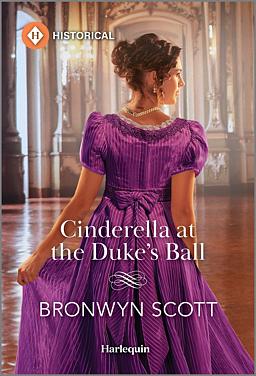

Cinderella at the Duke's Ball
Author
Bronwyn Scott
Reads
16.2K
Chapters
24
Will this Cinderella get just one night or forever with the duke of her dreams? Find out in this spicy Regency fairy tale! An extraordinary dress to change her ordinary life! Cora has one Season to find a husband and save her family from poverty! So, when her modest dress order is accidentally replaced with an above-her-station gown, she grabs the opportunity to wear it. The Duke of Harlow's ball is ideal for meeting a perfectly nice gentleman. Until the duke himself asks her for the first dance! Their connection is undeniable, but she knows Declan must "marry well," and she doesn't reach the high echelons expected of his position. As the clock strikes midnight on their time together, will this Cinderella get her happy-ever-after…?
Chapter One
In the Season of 1826, Cora Graylin, twenty years old, and fresh from the sheep-ridden Dorset countryside, knew these truths to be self-evident: that life began with a dress and all subsequent success depended on it being the right dress. Every significant milestone of a woman’s life was marked by a dress—a baptismal gown to mark her entrance into the community of the Anglican church, the letting down of her hems to presage her entrance into Society, a dress for presentation at Court to mark her entrance into that Society, a debutante’s white ball gown, and, ultimately, the wedding gown that heralded the pinnacle of a woman’s achievement—to marry well.
Dresses marked every hour, every second of a woman’s life. Morning gowns, afternoon gowns, tea gowns, evening gowns, dressing gowns, night gowns, travelling dresses and riding habits. The list was as endless as the variation on the theme. The dress did more than mark time. The dress was a gatekeeper, determining who one met and who one could meet. Every mama and eager young girl—descending on London with hopes of snatching the right husband—believed in the absolute truth that the right dress could even determine the course of a life.
Anyone who doubted this wisdom had only to look at the first appointment in a woman’s diary upon arrival. It was not with the patronesses of Almack’s, although they ranked a strong second—after all, a dress had to be seen in order to be useful—nor with a best friend not visited in a year. No, the first appointment was with the dressmaker.
Beginning in March, the needles of London’s twenty thousand dressmakers began to sew feverishly. For the first time in years it was acceptable to travel to the Continent, to borrow fashion from the French, and there were—saints be praised—men, a commodity that had been in alarmingly short supply during the long years of the war, to see that fashion. Waists had come down to an almost natural level, skirts had become fuller, and the concept of presenting a fashionable triangle was all the rage.
Appointments were made months in advance and one defaulted on that appointment on pain of social death. The visit to the dressmaker’s was the beginning of rounds of shopping, of being seen. And for girls like Cora and her sister, it was the beginning of hope, predicated on the belief that everything could change with a stitch, with the right swath of fabric against the right complexion. A fairy tale to be sure.
A part of her wanted to believe it was true, that such miracles were possible. This part of her had kept her awake most of the night, although her sister’s snoring may also have contributed. Cora stifled the tiniest of yawns as she pored over fashion plates at Madame Dumont’s. But the thrill of hope—optimistically and stubbornly rippling through her since the onset of this mad adventure—was still undeniably there. All the realism in the world had been unable to subdue it. She indulged that hope for a moment, closing her eyes and letting herself bask in the knowledge that she was in London and she had an appointment with a Bond Street dressmaker—or nearly so, give or take a few blocks.
For the first time in the two years since Mama passed, there was a thread of hope and that was more than she’d had for a long while. With the right dress, who knew what that thread might be woven into if she dared to grasp it? Cora suppressed a longing sigh. The daring was harder than one might think. She’d learned the painful lesson that when one had been deprived of hope before, it was difficult to trust in hope again. Hope was a precious promise for the future. Lost hope was a promise broken, a future denied. But what choice did she have but to believe? She had to try, for her family’s sake.
Cora held a swatch up to her sister’s cheek. ‘Elise, this yellow muslin with the white flowers would look wonderful on you.’ Elise had inherited their mother’s blonde good looks and their father’s warm brown eyes. Cora had no doubts that, with the right gowns and their aunt’s connections, Elise would make a fine match. She hoped so. She’d promised Mama she’d take care of the girls and Elise deserved more than the wilds of Dorset. It would be a relief to have one sister settled, one part of her promise kept, even if it meant missing Elise desperately when a husband swept her off to parts unknown.
There was an approving nod from Aunt Benedicta over the yellow fabric. ‘You’ve a good eye, Cora.’ Her aunt smiled before returning to the fashion plates. ‘The yellow is perfect for Elise. But don’t forget about yourself. The blue would bring out your hair.’
‘Yes,’ Elise added her enthusiasm. ‘Choose the blue, Cora. We are here for you, too.’ A bit of her initial excitement surged, exerting itself over reality’s brief intrusion into this happy occasion. She would choose the blue, Cora decided. And the green with the white sprigs as well. She smiled to herself, indulging in a luxurious moment of joy. How wondrous it was to think of having new clothes and in such pretty colours! No more blacks and dull browns.
Being here in London, buying new clothes, was like having her life begin again. It was a heady realisation to wake up to each morning in the townhouse off Curzon Street. Every rumble of a carriage past her window, every hawking cry of a vendor reminded her she was in London. This life of leisure, of shopping and paying calls, had taken some getting used to after years of nursing Mama and running the house, seeing to her little sisters’ education. Then she had lost Mama, only to realise she’d lost Papa as well, as he had taken Mama’s death hard, which meant the parish burdens had fallen into her lap, too.
She’d been so busy in Dorset caring for others, making opportunities for others, that her own chances at a life had slowly slipped away. She was going to have her chance now though. There’d been a rescue from the mundane sameness of her life when she’d least expected it. Aunt Benedicta and Uncle George had been unlooked-for angels, sweeping into Papa’s rectory and inviting her and Elise to spend the Season in London with them. She and Elise hadn’t believed their good luck. It had seemed unreal, like a fairy tale. But Papa’s resistance had seemed real.
He’d argued with his brother, the Baronet, reluctant to let Cora go. Who would run the house? Who would care for the girls? Who would organise the parish? Papa would be helpless without her. With a sinking heart, and desperate to save at least Elise’s chance for London, Cora had offered to stay behind. It had taken hard persuading on Aunt Benedicta’s part to convince Papa both of them must come.
‘Alan,’ Aunt B had said, fixing their father with a stern eye, ‘there are only two fates for these girls if they stay in Dorset—marriage to farmers or spinsterhood. And you have three other girls to marry off in addition. The kind of help you need cannot be found here. The girls must go to London.’
Aunt Benedicta had been relentless in her truths. Elise and Cora were pretty, lively girls who could do better than a Dorset sheep farmer. Better for themselves and better for the family. Who would bring out the younger girls if their older sisters weren’t poised to help them? Aunt Benedicta had stopped short of highlighting the genteel poverty Cora’s family flirted with all too often, and Papa’s own inability to help himself.
As a vicar with a small living, her father wasn’t set up to raise five daughters and provide for them. Dowries and Seasons were beyond him, even more so now that his beloved spouse was gone. Thankfully, Aunt Benedicta’s arguments had been enough. They were here, poring over fashion plates and selecting from an array of fabrics, which bordered on dizzying after years of loss and deprivations that had made Cora something of an expert in counting pennies and pounds. She knew the cost of a gown down to the trim of its lace and the price of its buttons.
Cora fingered the green muslin she’d selected with its dainty print. Even now, she didn’t dare let herself get entirely carried away. It wasn’t all furbelows and fairy tales. She was practical enough to understand that. There was work to be done.
‘Alan, give them a Season, give them a chance,’ Aunt Benedicta had argued. ‘Good matches for them will set the other three up.’
That last argument had resonated strongly with Cora, giving her the fortitude to leave her sisters and Papa. The family was counting on her and Elise. She was twenty, Elise eighteen. Both of them were old enough to marry. The enormity of that made her pause.
Beneath the thrill of dressmakers and debuts was a numbing reality. In the next twelve weeks she was expected to meet and marry a man she would spend the rest of her life with. It cast the words ‘until death do us part’ in a rather ominous context. There was so little time in which to make such a large commitment. Her family was counting on her—the words came again, a refrain that had become a constant litany in her mind over the last weeks. More than that, she was counting on herself.
These next twelve weeks would decide her life. If she didn’t find a husband in London, she’d return to Dorset and become a spinster by default, her days spent caring for her family, for her father who seemed unlikely to suddenly acquire the skills to care for himself, or the grit to pull himself out of the depression that had plagued him since her mother’s death. And caring for the parish in the absence of her father’s ability to do more than preach on Sundays and perform ceremonies.
Even without those burdens to detract from marriage, there wasn’t anyone who appealed. Aunt Benedicta was right in her arguments. A baronet’s nieces needed more than what a sheep farmer could provide. Cora had experienced that first-hand. She knew what was on offer back home—the likes of dour John Arnot with his fifty acres, one hundred head of sheep and three children in need of a mother. He wanted a cook, a housekeeper and governess all rolled into one, whom he didn’t have to pay. She wanted something slightly more than what he offered.
Yet, despite the pressure to wed within weeks, she still harboured hope that she might find a man who at least respected her as something more than a servant. She was realistic, though. She did not expect romance. A whirlwind romance was overrated and romantic love had its limits. Love wasn’t enough to make a marriage, to conquer problems. She’d seen that with her own parents. She would be happy with a man who had the potential to grow to love her, and she him. Surely, that wasn’t too much to ask. Otherwise, it would make for a long fifty years.
The shop assistant assigned to them approached. Aunt Benedicta gave instructions for the muslin day dresses before turning to the girls. ‘Now, for some evening wear.’
Ball gowns. The flicker of hope burned a bit brighter at the announcement. Cora’s mind couldn’t help but quietly sing with cautious joy. They were going to get ball gowns! She felt Elise squeeze her hand, as excited as she was. They exchanged a secret look of joy. The Season was indeed serious business, but there was no denying it was also a fairy tale come to life. Somewhere between the two lay reality.
The shop assistant led them to a clutch of chairs gathered about a low table, upon which was spread copies of fashion magazines accompanied by a tray of lemonade and biscuits. ‘Please, enjoy a drink and I’ll be back shortly with fabrics.’ The assistant left them and Cora sipped at her lemonade, letting her mind contemplate the materials the clerk might be assembling behind the curtain. She imagined silks and satins in primrose, and poppy, maybe a cerulean or hortensia. Oh, what she’d give for a cerulean gown.
Cora was envisaging herself waltzing across a chandelier lit ballroom in a gown of cerulean silk when the bell over the door tinkled. Three women entered, two older, one younger—a blonde Cora’s age who was conversation-stoppingly beautiful. The whole trio was turned out in the first stare of fashion, from the tips of their dyed-to-match kid leather boots to the brims of their elegant bonnets. Cora did a quick calculation. The lace on the young woman’s gown alone would buy meat for a month.
Aunt Benedicta’s posture went ramrod straight, her eyes following the newcomers in measured recognition. ‘The Duchess of Colby and her daughter,’ she mouthed.
The whisper had scarcely crossed Aunt Benedicta’s lips before Madame Dumont herself emerged into the showroom, a parade of assistants behind her, and a maid bearing a tray of iced glasses of champagne. No tepid lemonade for these guests. Madame Dumont made a curtsy. ‘Your Grace, it is an honour to have you visit our salon.’
The Duchess of Colby gave a cool, polite smile that suggested she agreed with Madame Dumont’s assessment. ‘Madame Devereaux recommended you. She is overrun with business at present and time is of the essence.’ Cora thought she saw a slight tightening of Madame’s smile as if a hidden message had been expressed.
The Duchess nodded towards the beautiful blonde. ‘My daughter, Lady Elizabeth Cleeves, requires a ball gown for the Harlow Ball, which as you know is next week.’
Oh... Cora nearly sighed. The Harlow Ball—to which she and Elise had not been invited given they were merely nieces to a baronet, with a respectable but moderate address by Mayfair standards—was all anyone had talked about at Aunt Benedicta’s at-homes.
At the mention of the ball, Madame Dumont gave a clap of her hands, sending her assistants scurrying off to gather bolts of cloth. Seven assistants to take care of one duke’s daughter. Just one assistant to care for a baronet’s two nieces. Cora refused to let the disparity ruin her day. She was still getting ball gowns, after all, and the thought was just as lovely as it had been a few minutes before.
Moments later, the curtain separating the back of the shop from the front was held open by the maid who was now sans champagne tray—the parade of fabrics began. Cora looked on wistfully as shades of azure and daffodil, rose and parma violet were marched towards Lady Elizabeth Cleeves. Cora’s curiosity piqued as each bolt passed. What had their assistant chosen for them? Perhaps more of the poppy, or the cerulean? Their assistant came last, bearing bolts of cloth to her chin. Cora fought the urge to rise and go to her aid.
The assistant set the bolts on the low table and Cora looked past her for another assistant. Perhaps the maid had been pressed into service to help, for surely there must be more fabric, because these were all white, every last one of them. Fine white linens and cottons, to be sure, but they were not colours and they were not silk. She’d hoped...well that was the problem wasn’t it? Hoping.
She’d let her hopes get ahead of her and that had led to an unwarranted disappointment. She never should have hoped on silks and satins to begin with. It was entirely ungrateful of her. It was no small expense to outfit not one but two girls for a Season and her uncle was generously footing the entire bill.
Cora schooled her features, trying not to let her disappointment show, her gaze sneaking one final glance at Lady Elizabeth Cleeves. The woman would look stunning in the cerulean. She would be the belle of the Harlow Ball. Cora could imagine it now—how conversation would halt when she walked into the room, deep sky-blue skirts swirling, gold hair piled high. Men would forget to breathe, women would turn green with envy. The young Harlow Duke would see her and ask her to dance... Cora felt the gentle press of her aunt’s hand on hers.
‘Lady Elizabeth Cleeves has been out for two Seasons,’ her aunt explained. The lady might dare some colour now that her debut was behind her. But this was Cora’s first Season and the expectation was white and pearls. A bit of the fairy tale faltered. If it were her second Season, Cora, too, might be allowed to venture a little colour, but she’d not get a second Season. It was this or nothing.
‘These fabrics are exactly what we need for the events we’ll attend.’ Aunt Benedicta selected a length of white roses on fine white cotton. ‘This would be lovely with bright blue ribbon for trim at the hem and the Brussels lace at the sleeves.’ It would be, Cora couldn’t argue with that. Nor could she argue with the practicality of it. Should the Season not reap results, the dress was not so highbrow it couldn’t be worn again for years to come, or altered and passed down to her sisters when they came of age. Coming of age in Dorset would not require fancy clothes or even new clothes for a girl destined to marry a sheep farmer.
No. She would not let it come to that. Not for her or for her sisters. John Arnot would have to look elsewhere for his indentured wife. She would find someone, she would.
But who? Cora let Aunt Benedicta make the selections while her own mind pondered the worrisome question. She knew who she wouldn’t meet—men who attended the Harlow Ball. Heirs to titles and fortunes. She wouldn’t meet the young Duke—young and needing to marry quickly, if the gossip pages could be believed.
It was no secret his mother was eager to see him wed and this ball was to be a culling of Society’s best so that he might pick his bride by Season’s end. She supposed that was one thing they had in common. They both needed to be wed in twelve weeks. Was he feeling the pressure, too? Did dukes feel pressure? Probably not. Everyone wanted to marry them. He simply had to choose. Men had it easier. She sighed.
Her aunt looked in her direction. ‘Are you happy with the choices, my dear?’
‘Oh, yes.’ She gathered herself, wishing she hadn’t sighed so loudly and given the wrong impression. She’d missed the discussion entirely. ‘They will be lovely. Thank you again, Aunt B.’
They rose and Aunt Benedicta made arrangements for fittings and delivery. ‘We’re off to the milliner’s now. Hats and then gloves and shoes, girls.’ She smiled cheerily as if she meant to reassure Cora. ‘All will be well,’ her aunt whispered as they passed the Duchess’s coterie. ‘The Duke isn’t the only eligible parti in Town, you’ll see. There are second sons, vicars with good livings, barristers, doctors, gentlemen with large estates and the income to match.’ Aunt Benedicta gave Cora a sly twinkling glance as they stepped out into the street. ‘Your uncle has friends. We might even find you a baronet if your heart is set on a title.’ Perhaps they would. Cora merely nodded. She understood her duty and she would do it.
Declan Locke, Duke of Harlow, knew his duty and he would see it done. He would not let the Harlow cradle go empty any longer than necessary. The year of mourning for his father was past. Protocol had been satisfied, now it was time to get serious about the future. Beyond himself, there was no obvious heir except a distant cousin he’d never met who lived in Upper Canada.
Unfortunately, the future meant facing the much-anticipated Harlow Ball. It hadn’t even started yet and he was already done with it. Over it. Declan poured himself a drink from the collection of decanters on the sideboard while his mother talked. And talked. And talked. About the ball. His ball. The place where he’d pick his wife.
The ball had been the obsession of London for weeks now, even before the Season began. The gossip pages had been leaking little details each week—the colour of the roses, the style of the decorations—all to tease the masses. He didn’t know who was anticipating the event more, his mother or the guests. Both parties were worked into a fevered pitch about it and there was still a week to go. With any luck, everyone would burn themselves to cinders in their excitement.
‘Shall we go over the list again?’ His mother reached for a sheaf of papers on her writing desk. It wasn’t really a question. They were going to go over the list despite his preferences. Declan took a swallow from his drink and looked out the window at the street below. It was crowded and busy and he’d give anything to be away from the noise, back at the family seat, riding his horses and fishing in his rivers. Had his father felt this way? Torn between duty and desire? The title meant his life was never truly his own, and yet his father had taught him that duty must always come first. He would honour that because he wanted to honour his father.
‘There’s Lady Mary Kimber, daughter of the Earl of Carys. She’s an excellent young lady. We’re lucky she’s still available. There was a chance she’d go to the Creighton Dukedom last spring. Fortunately, Creighton married his portrait painter instead.’ She waved a hand. ‘What a scandal that was, as if Devlin Bythesea wasn’t enough of a scandal on his own, son of a third son and an Indian woman.’
‘Bythesea’s mother is the daughter of a raja,’ Declan pointed out. ‘I like Creighton. I’ve met him at Travellers. He’s got a good head on his shoulders. He and the Duke of Cowden are business partners in the Prometheus Club.’ That was a club he’d like to join now that mourning was behind him and he was fully settled into the title. He had submitted an application for membership when he’d arrived in Town.
His mother’s eyes narrowed and she huffed. ‘The Creighton Dukedom is a cautionary tale as to what can happen when a man doesn’t fill his cradle with sons. We cannot risk waiting another year.’ She cleared her throat and returned to her list. ‘There’s also Lady Elizabeth Cleeves, the Duke of Colby’s girl. She’s been out for two Seasons, has good polish on her. She knows her duty and she’ll be keen to marry this year.’
Declan turned from the window, his temper bristling. He loved his mother and he knew she had his best interests at heart, but it did not make this discussion any more palatable. ‘You read that paper like it’s a racing sheet. These are real people, Mother. They are not fillies entering the lists at Newmarket.’ And he knew what that made him: a prime stud, nothing more. Something to be mated with the best bloodlines in order to produce yet another finely blooded thoroughbred.
It was a rather humbling realisation. He wanted to be so much more: a good father to his children as his own father had been to him, a father who played with them, who spent time with them. He wanted to be a loving husband, to be in partnership with his wife. He wanted to leave behind a legacy at Harlow Hall that positively impacted the quality of living for all those who depended on him. To perhaps build a school in the village, or improve farming so that the land was reliable, providing sustainable living far into the future.
He could do those things—but in the end no one would care about them if he didn’t put sons in the cradle. Strip it all away, and that was what was left. First and foremost, he was to stand to stud, and like the stallion covering the mare, it hardly mattered how he felt about the mare in question, only that she be worthy of his seed and produce an heir that was a credit to the bloodline.
‘How would you prefer I read the list, Declan? Like a fairy tale? Would you like me to sugarcoat it? Do you want me to pretend you can simply pick any girl you want to be your wife? Because that’s not how it works.’ His mother set the list down and fixed him with a hard, grey stare. ‘Let me remind you how I met your father.’
Declan took a long swallow. ‘I’ve heard this tale before. His parents selected five young women to attend a house party at Harlow Hall. You were one of them. Father spent the party with each of the five and at the end he held a ball and announced his engagement.’
His mother smiled. ‘Exactly so. The five of us were selected because we had the requisite pedigree, backgrounds, fortunes, and connections. And yet, there was a flare of the romantic to it. Two weeks to win a duke’s heart, to be plucked from the other contenders. And I won. When I waltzed with your father the night of the ball after our engagement was announced, I felt as if I was floating on air. I was that happy. Not because I’d fallen in love. I was not that naïve. There is no such thing as love at first sight, Declan. But I was happy because your father and I understood one another. I knew my duty, he knew his and we had done it. Together. Just as we navigated many things together in our marriage. And it was a good marriage. I do not regret it. I also know we were lucky. There is room for error when one only gives their son five women to choose from.’
She waved a hand. ‘You are being given far more than five girls to select from. You have more choice than your father did. Be thankful for that. I promised myself when I had children, and the time came for them to marry, I would lay the best of London at their feet and let them choose. You may pick anyone you like from the guests.’
This was his mother’s idea of being progressive, magnanimous even. ‘Thank you, Mother.’ It was meant sardonically as he drained his glass. He was thirty-one. He ran the estates, oversaw the Dukedom, paid the bills, sat in the House of Lords and voted his seat, making policy that governed the whole of the land. And yet despite all of that responsibility, he felt as if he were still tied to his mother’s apron strings.
‘You’re just nervous,’ his mother consoled. ‘This time next week, it could all be over.’
He knew what she meant by that and it did not soothe him. If he selected a bride at the ball and announced the engagement that night, it would be finished. The papers would love it. London would talk of nothing else all Season but how he’d swept his bride off her feet and married her forthwith.
He gave a dry chuckle. ‘But Mother, if I did that, what would become of the house party you’ve so carefully planned to follow the ball? I’d hate to see those efforts go to naught.’ The ball was his mother’s opening gambit, but the real bridal hunt was to be at Harlow Hall, an homage of sorts to his father’s own courtship. To Declan, the house party was both an annoyance and a type of reprieve. It offered him two more weeks to postpone the inevitable. Of course, he could always hope for a miracle, that somewhere on his mother’s guest list was a girl he could love, a girl who was more interested in him than she was the duchy.