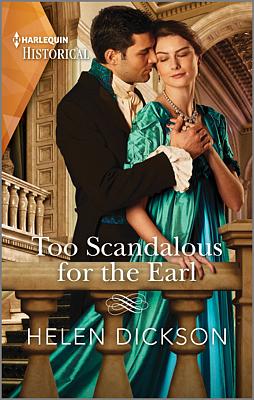

Too Scandalous for the Earl
highlight_author
Helen Dickson
highlight_reads
15,2K
highlight_chapters
13
Enter a captivating world of Regency scandal. From disastrous meeting… To explosive attraction! With her reputation ruined, Tilly must leave London! Only, her escape to Devon leads to a series of encounters with the insufferable yet dangerously handsome Earl of Clifton, Lucas. Though his first impression leaves much to be desired, time spent with the earl and his orphaned nephew reveals depths to Lucas Tilly never expected. But growing close to him comes with a price because it means revealing her scandalous past…
Chapter One
Self-willed, energetic and passionate, with a fierce and undisciplined temper, Tilly had a charm and wit and beauty that more than made up for the deficiencies in her character. She hadn’t a bad bone in her body and was just proud and spirited, so determined to have her own way that she had always been prepared to plough straight through any hurdle that stood in her path—but that was before she had made the dubious acquaintance of Richard Coulson.
Summoned to the drawing room by her brother Charles, who had been staying with friends in Sussex for the past month, an inexplicable premonition of dread mounted as she descended the stairs. When Tilly entered the drawing room, Charles was waiting for her.
He was still dressed in his travelling clothes, waiting impatiently by the fireplace, obviously in an angry mood. He had a handsome face—at least he would have been handsome had not a fierce scowl marred his features. The moment she closed the door behind her he embarked on a blistering tirade, denouncing her recent disgraceful behaviour.
‘There you are. Aunt Charlotte has filled me in with what you have been getting up to in my absence. Really, Tilly, will you never grow up? You are clever, quick thinking and sharp witted. You are also problematical and a constant headache. You test my patience at every turn. You live for the moment and notice nothing that is not to do with outdoor pursuits and horses. In short, you are hell-bent on self-destruction.’
Tilly sighed. Her brother was adamant when administering discipline. ‘I’m sorry, Charles, truly,’ she said, only mildly repentant, ‘for all the trouble I have caused. I never meant for this to happen. I didn’t know.’
‘There’s a great deal you don’t know.’
She nodded. ‘It would appear so,’ she replied, adopting a meek expression, although anyone who knew Tilly Anderson would know there was nothing meek about her.
‘It would seem the task of learning to be the lady our mother intended you to become is seemingly impossible.’
‘I am sure I must be a terrible disappointment to you, Charles, but I will try not to let you down in future. I will try harder, I promise.’
‘It’s too late for that. How could you let it happen? You haven’t a grain of sense in you. How could you have been so blind to propriety? Coulson saw you as easy prey. You should have known better than to become entangled with him. You are too young and inexperienced to take on a man of his ilk. He eats young women like you for breakfast. He’s played the field and gambled his way through his fortune. He’ll beggar his father before he’s done. Where did you meet him?’
‘In the park when I was out riding.’
‘Alone?’
‘Well...yes. Aunt Charlotte wasn’t very well...’
‘And you didn’t have the presence of mind to take a maid with you?’
‘Aunt Charlotte’s maids don’t ride—and you know I don’t like being confined in a carriage.’
Charles turned away in exasperation. Audacious and bold, Tilly could be a handful without any encouragement. ‘Excuses—nothing but excuses, Tilly. Aunt Charlotte does employ two grooms to take care of the horses.’
‘And one or the other has accompanied me on occasion.’
‘Not often enough. Coulson has ruined your reputation.’
‘No, he hasn’t. He didn’t dishonour me.’
‘He might as well have done.’
‘He—he did ask me to marry him.’
‘And you refused him, thank God. At any other time and with anyone whose character was not mired in decadence I would have insisted you marry him—but Coulson is a rake of the first order. He would lead you a merry dance and you would be downright miserable.’
‘I know. I didn’t want to marry him. But it’s very lonely for me sometimes with just Aunt Charlotte for company.’
‘That’s no excuse for what you’ve done. Friends have hastened to inform me of the scandal that is beginning to unfold concerning my own sister—a scandal that is entirely of your own making, if it is to be believed. It has already given you a certain notoriety—and I know perfectly well what happens to a young lady who falls short of society’s expectations.
‘I am incensed. Not in my wildest dreams did I imagine you would form a liaison with a man whose exploits are the talk of London. And where he is concerned, how dare he have the temerity, the effrontery to interfere with the half-sister of William, the Marquess of Elvington?’
William’s father had died when William was just eight years old, and one year later his mother had remarried Sir Edward Anderson. Charles and Tilly were the result of that marriage, and William cared deeply for his half-siblings. Tilly had the grace to lower her eyes and fix them on her hands folded in her lap. No doubt when William heard of this latest escapade he would be as incensed as Charles.
Of course, Charles was quite right. On her rides in the park, she had garnered the favours of several young beaux and Richard Coulson, who stood out from the rest with his raffish good looks and sense of fun, was much sought after. He had approached her when she had managed to shake off her accompanying groom, who despaired of trying to keep up with her since she could ride like the wind with the devil on her tail.
Richard had become enamoured of her and he had soon turned to putty under the assault of her large violet eyes and sweet smiles. It was all a game to Tilly, who had done it out of boredom. His possessive attitude she soon found irritating. He had even had the audacity to kiss her when she had found herself alone with him, which she had thought presumptuous of him, and had shocked her and was not to her liking anyway.
Having captured him completely, the game had turned sour along with what she had seen of society. The idea of a Season and marriage in general—which, after all, was what having a Season was all about—she decided was not for her and had sent the young man packing, blissfully unaware of the consequences of their liaison. Her naivety and inexperience had not prepared her for a young man of Coulson’s reputation.
‘I could kill Coulson for this,’ Charles said. ‘The gossip will soon be all over town and you can expect no mercy.’ Not to be made a fool of by an ignorant girl, Coulson had let his tongue loose to do its worse and turned the tables on Tilly, laughingly telling his friends that she was a game bird, an amusingly peculiar, pathetic little thing, and, if she was launched, he had no intention of plying his suit.
Charles looked to the door when a maid entered, carrying a letter on a salver.
‘A letter has just arrived for you, Mr Anderson,’ she said, bobbing a curtsy and leaving the room.
‘Thank you, Betty.’ Casting an eye over it, he shoved it inside his jacket unopened, turning his attention back to Tilly. Her head was bent, her shock of glossy black curls falling about her face. He sighed, shaking his head wearily.
‘You have much to learn about life, Tilly,’ he said on a softer note. ‘I will take time off from the Company to take you to Cranford. Perhaps William—and Anna—can instil some sense into you, although with your difficult and unyielding nature they will have their work cut out.’
Tilly remembered when she had first seen Cranford Park. It was unlike anything she had imagined. She had been mesmerised by its splendour—imposing without being austere. This was her half-brother William’s ancestral home. He had become the Marquess of Elvington on the demise of his grandfather six months earlier. When he had returned from India, he had insisted that his half-siblings made Cranford their home.
Employed by the East India Company in London, Charles resided at the Lancaster town house in Mayfair. Tilly flitted between the houses, recently spending a good deal of her time with Aunt Charlotte in Chelsea village as preparations were being made to launch her into society.
Adored by her family, Tilly had been petted and indulged outrageously by everyone all her life, but all the attention had left her unspoiled. Happy and always smiling, she had a warm and generous heart. Her greatest sorrow had been the loss of her father as a child and then later, on the death of her mother, something vital had gone from her life. She knew nothing of the harsh, cruel world that existed outside her own secure and comfortable existence.
Aunt Charlotte, her father’s sister, with her gentle guidance and common sense, had become a kindly presence in her life. Having lost the love of her life in a riding accident, she had never married. She wanted Tilly to have a grand London Season, to associate with fashionable people of note, to attend balls and soirées.
Tilly was always very much aware that the moment she appeared in a room all eyes turned to her and she was soon surrounded by dozens of people, most of them young men, who obviously thought they might have a chance with the Marquess of Elvington’s sister when she made her debut. She had a kind of aura about her that made her somehow unique, although she herself was quite unaware of this special quality.
Before her indiscretion with Richard Coulson she was given the distinction of being named as the most beautiful young woman who would grace the next London Season, that she would be the most desirable debutante to join the marriage mart, which was quite an achievement for any girl.
She wished she weren’t so attractive because people, especially the young bucks, behaved like complete idiots around her. Aunt Charlotte said that when she was ready, she hoped the man she chose would be right for her—one who would appreciate her free spirit and love her for what she was, not for what he could make her.
But an interesting fact to some was, upon her marriage, the man who married her would become the recipient of a dowry generous enough to elevate his status considerably.
Tilly had met rich men, she had met handsome men, but she had not fallen in love. Disheartened and thoroughly disenchanted with the opposite sex, she scorned them all, much to her Aunt Charlotte’s dismay, for she was eager for her to make a good marriage. She was certain that when the scandal had died a death and Tilly made her debut, there would be so many eager young males of good families posturing about that she would have the pick of the bunch.
The sun was sinking behind the gentle rise of the park when the coach carrying Charles and Tilly and Aunt Charlotte travelled along the stately drive to the house. Despite being the sister-in-law to Charles and Tilly’s mother, Aunt Charlotte had never visited Cranford Park. News of their unexpected arrival soon spread through the halls of the great house and it wasn’t long before they were ensconced in the drawing room with the tea things arranged on a low table in from of them.
Tilly glanced at William, who stood with Charles across the room. He was as handsome as he had always been, although he possessed a haughty arrogance which some people took for coldness. He was a caring and compassionate man at heart and his love for Anna, his wife, was evident to all. Their first year of marriage had been blessed with a healthy son, Thomas James Lancaster, Lord Lancaster. After proudly presenting him to their visitors, Anna had taken him to the nursery to put him down for his nap.
Aunt Charlotte was an arresting woman. Her hair was no longer the dark brown of her youth and was liberally streaked with grey. She wore it on top her head, which made her appear taller. Besides being quite striking, if not intimidating, despite being short of stature, she conversed with such zest and charm that she could not be ignored. Ever since her sister-in-law’s demise when Tilly was fifteen years old, she had stepped in to guide her beloved niece into adulthood.
Unfortunately, nothing had prepared her for the likes of Richard Coulson. With Tilly’s reputation about to be shredded before she’d been launched into society, she had agreed with Charles that they should leave for Cranford until the gossip had died and some other unfortunate girl had transgressed for the ton to focus their attention on. It was this matter that was being discussed now.
‘It was taken for granted that Tilly, a young woman with an impeccable reputation, would have a Season and make a brilliant marriage. It seems foolish to state the obvious,’ she said, shaking her head as she spoke, her coiffure wobbling precariously, ‘but she cannot do that now. It’s out of the question. The ton would never stand for it. She would be humiliated and miserable. It cannot happen. At present no one will speak to her, let alone receive her or acknowledge her.’
‘You’re quite right, Aunt Charlotte,’ Charles agreed. ‘Of course it can’t. Society will tolerate her because she is the half-sister of the Marquess of Elvington, but they will cut her dead whenever the opportunity arises. In short, she will be treated like a pariah.’
‘I’m afraid you’re right, Charles,’ William said gravely. ‘For my part I would like to tell the whole of society to go to hell, but that isn’t going to do Tilly any good.’
Charles nodded. ‘My feelings entirely. With any luck, next year this will all have blown over and she can be presented then.’
William, who had listened to what was being said with a deep regret, shook his head. ‘I blame myself for this. Our mother trusted me to keep Tilly safe, not only from rakehells like Coulson, but from any other dangers that may come her way.’ His voice was bitter as he added, ‘I was so busy at Cranford, sorting out my grandfather’s business affairs since my return from India, followed by his passing—and marrying Anna—that I failed to protect her.’
‘It was my responsibility too, William,’ Charles remarked. ‘I have been so damned busy of late that I took my eyes off what matters. But it is important that she has a Season—which was what Mother would have wanted.’
Tilly sat there, listening as all this talk about her went on as if she was absent. ‘What about me?’ she protested. ‘Does it not matter what I want? Who wants a Season anyway? From what I know of them they are a great bore—a gaggle of girls all doing the same thing, seeing all the same people at every event, all of them hoping to make the best catch.
‘It doesn’t appeal to me in the slightest—all that curtsying and bowing to goodness knows who and making empty conversation with beaus looking for a wife—the wealthier the better. All that time and effort for the sole purpose of procuring a husband. I hate all the restrictions of the social system that enslaves people like me. It all seems so silly,’ she said, sitting up straight and raising her nose to a lofty angle.
‘Be that as it may, Tilly,’ Aunt Charlotte said as she sipped her tea, ‘you will have a coming-out ball next Season. As the sister of the Marquess of Elvington you cannot hide yourself away indefinitely. With any luck this unpleasantness will have blown over by then.’
‘And if it hasn’t? What is to be done with me? I cannot impose myself on William and Anna indefinitely.’
‘Do I have to remind you,’ William said, ‘that this is your home too, Tilly? I told you when I returned from India that Cranford Park is for my entire family.’
‘I know—and I am indeed grateful—I do love being here, but I feel...’ She faltered, not really knowing what she felt or what she wanted to do.
‘You want more...excitement, perhaps?’ William said with a twinkle in his eye.
‘I suppose I do. But after what happened with Richard Coulson I’m confused as to what I do want to do now. I can’t sit twiddling my thumbs until next year when the Season is upon us once more. And my transgressions may not have been forgotten.’
William looked at his sister. Despite this setback with Coulson, with her free and generous spirit and steadfast gaze, he had never been more proud of her, nor loved her more. She had grown more beautiful as she had reached maturity. She might be a handful at times, but with her willingness to please and her exuberance for life, her moods of warmth and generosity redeemed her.
‘Perhaps I might make a suggestion,’ Charles said. ‘I’ve received a letter from our uncle’s lawyer—Uncle Silas who lived in Devon.’
‘Oh? What about? He’s dead, isn’t he?’
‘Yes. He died three months ago. Being much older than our father and Aunt Charlotte just a child when he left home to indulge himself in his travels abroad, we didn’t see much of him when we were growing up. He rarely got up to London. As you know, he died without issue and it would appear he’s left his house—Drayton Manor, and the land that goes with it—to me as next in line. I don’t know what to make of it—and I have neither the time nor the inclination to travel down to Devon to inspect it at this time.
‘In fact, the Company is considering sending me to India some time next year, I think, which I would like to do. You could go to Devon for me if you like, Tilly. And you, Aunt Charlotte. A change of scene at this time would be good for you. I believe it is close to the sea. A touch of sea air will benefit you no end.’
Tilly stared at him. ‘Devon?’
‘Why not? I think Uncle Silas left his home in good order, but it will be comforting to know I’m not inheriting a ruin. Although what I will do with it—a house miles away from London—I haven’t the faintest idea.’
All three looked at Tilly expectantly, waiting for her to make her decision. She didn’t feel grief and shock at her half-uncle’s passing. Silas Anderson was a man she had seldom met. She looked at Aunt Charlotte. ‘Would you go, Aunt Charlotte? Uncle Silas was your brother, after all.’
Charlotte, who vaguely remembered her older brother and had last seen him on one of his infrequent visits to London, had listened with great interest as he’d talked at length about his extensive travels and his home in Devon. She could not wait to see what he had so avidly described. There was a broad smile of anticipation on her face for the coming trip. ‘Yes—of course I would. Charles is right. The sea air might be good for both of us. Don’t you agree, Tilly?’
‘Oh, yes. It could be just what’s needed at this time.’
‘I doubt that,’ Charles replied with misgivings, but continued in a more affectionate manner. ‘When you look at me like that and smile that smile, I begin to understand why our parents and Aunt Charlotte—even you, William—spoiled and pampered you so outrageously. Hopefully there will be nothing in Devon to distract you.’
Tilly looked fondly at her brother and deeply regretted the disappointment he must feel. He was always the soul of discretion. Caught up in the grip of having betrayed her family, of having shamed the proud name she bore and that of William’s own, she was aware of the carnage she had wrought by her careless, reckless behaviour with Richard Coulson.
‘I meant what I said, Charles, I will do nothing to add to my disgrace.’
‘Gossip is mischievous, often cruel and easy to begin, but ruinous and hard to get rid of. It never goes away entirely. People tuck it away, but they don’t forget.’
‘I know. So, yes, Charles, I rather fancy a visit to the coast.’ Her eyes were alight with the spirit of adventure. ‘As I recall Uncle Silas never married and when he stopped travelling he became something of recluse. It will be interesting to see where he lived.’
‘Married or not, he did very well for himself, enjoying a long period of considerable prosperity with his many investments in Cornish mines and the like. The housekeeper and a caretaker have been kept on in anticipation of my journeying to Devon, so I expect the house will be in good order. I shall make all the arrangements. We can send a message ahead by one of the coaches going that way. Mrs Carstairs will have time to prepare for your arrival.’
The following days passed in a whirl of activity as they prepared for what could be a lengthy stay in Devon. William provided them with a splendid travelling coach drawn by six bay horses, a driver by the name of Dunstan and his son Graham, who acted as groom. Aunt Charlotte’s maid, Daphne, was to accompany them. The coach was loaded with boxes above and behind. Goodbyes were said, Tilly promising to write as soon as may be. Anna, holding baby Thomas in her arms, waved, and the coach moved off. Tilly strained from her seat to get the last glimpse of her two brothers. For a moment panic about leaving them threatened to sweep over her, but when Aunt Charlotte squeezed her hand reassuringly, she knew everything would turn out all right.
They reached Devon after an exhausting journey. The early summer days allowed them to keep going. William had sent them off with six of his own carriage horses so the journey did take a little longer to allow the horses to rest, instead of changing horses at coaching inns along the way, but he thought they might be useful when they reached Drayton Manor. Coach travel was not exactly comfortable or relaxing. The roads were frequented by highwaymen and, to alleviate the dangers of being held up, they always stopped for the night at a coaching inn before the light faded.
Tilly had never seen the sea before and she gazed at the vast expanse of water with wonder. Seldom did the English Channel disappear from sight. A warm wind blew off the sea, pushing the clouds inland. Never before had she seen anything like it. She watched in fascination as the waves swelled and rolled in, breaking on the rocky headlands.
They drove through a village which she would later come to know as Biddycombe, where cobbled streets with a jumble of cottages and rooftops cascaded down the hillside to a harbour. Small boats bobbed on the water in the horseshoe-shaped harbour. Two tall-masted ships heading east could be seen on the horizon and triangular-sailed fishing sloops returning with their herring catch were heading for the harbour.
Tilly turned her eyes inland, her attention caught by a large house in the distance. Medieval in its architecture, it was beautiful in its desolation, its stones aged and grey, its mullioned windows facing south. Great chimneys rose proudly to the sky in competition to the backdrop of stately beech and elms.
‘I wonder who lives there?’ she wondered aloud.
Aunt Charlotte, eager for the coach to reach its destination and a comfortable bed, fought a sneeze and coughed. She had spent the last couple of days dozing in the coach, complaining of a headache. Now she had developed a chill. Tilly and Daphne were concerned about her. Unfortunately, she seemed to be getting worse. Her eyes were bright and feverish.
‘I’m sorry you’re not feeling well, Aunt Charlotte. As soon as we reach the house you must go straight to bed. I’ll ask Mrs Carstairs to send for the doctor.’
Wiping her eyes, Aunt Charlotte looked too poorly to argue. ‘I shall not be sorry to go to bed. I do hope the housekeeper has a room ready.’
Dusk had fallen when the heavy travelling coach eventually came to a halt outside the front door of Drayton Manor. The house was set slightly back from the majestic coastal cliffs in a sheltered valley, its origins dating back two centuries. It was certainly not Cranford Park, Tilly thought, with its stately, well-balanced design, but it was charming in its prospect and appearance, with ivy clinging to its grey stone walls.
Dunstan jumped down from the box and rapped on the door. It was opened by a woman Tilly assumed to be Mrs Carstairs. She was wiping her hands on her apron and wisps of grey hair escaped her white mob cap.
‘Welcome to Drayton Manor,’ she said. ‘We are expecting you.’
‘Thank you,’ Tilly replied. ‘It’s a relief to be here at last.’
‘Come—come inside. Everything is in readiness for you.’
‘This is Aunt Charlotte, Uncle Silas’s sister. She isn’t feeling well and really must go to bed.’
‘Of course,’ Mrs Carstairs said, casting a sympathetic eye over Aunt Charlotte as she tried to suppress another sneeze. ‘There is a fire in the drawing room and the beds are aired.’
Mrs Carstairs ushered them inside. They were met by the welcoming scent of beeswax, and rosemary and lavender and other scented flower petals in a china bowl in the centre of a round table. With a brief glance, Tilly noted there were pictures of coastal areas and portraits of deceased strangers lining the wall of the curving staircase.
Mrs Carstairs bustled about, showing them into the drawing room and leaving to fetch refreshment. She was a friendly local woman who had been housekeeper at Drayton Manor for a good many years. Tilly sat in a high back chair before the fire while Daphne accompanied Aunt Charlotte to her room.
Gazing about the room with interest, Tilly thought that this would be where Uncle Silas had sat, drinking his brandy, all summer and winter long, listening to the wind sweeping in from the sea as he entertained company.
Mrs Carstairs showed Tilly the room she had selected for her, a pleasant room, aired and polished and the bed dressed with fresh linen. It offered a splendid view of the trimmed and scythed flower-filled garden. It also faced south and, Mrs Carstairs assured her, had an abundant supply of sunlight during the summer months.
‘You don’t have your own maid?’ Mrs Carstairs asked.
‘No. Aunt Charlotte and I will share Daphne, but it’s not beyond me to take care of myself.’
‘Very well, but should it prove too much for her we have maids who are familiar with the work. They come from Biddycombe daily to help with the chores.’
‘Thank you, Mrs Carstairs. I’ll bear that in mind.’
Later, when Tilly had changed in her room, she went to look in on Aunt Charlotte.
‘How is she, Daphne?’
‘Sleeping. I think a good night’s sleep will put her on the mend.’
‘I do hope so. If not, I’ll ask Mrs Carstairs to send for a doctor to take a look at her in the morning.’
Downstairs, Tilly ate a solitary dinner. It was a lovely, simple meal and excellently cooked.
Afterwards, with a growing interest about her temporary home, she familiarised herself with the house, impressed by the quality of the furnishings and the library Uncle Silas had built up over the years. Drayton Manor was a house that gave one a feeling of permanence and importance, but Tilly could not see Charles living here, so far away from the bustle and excitement of London and his work at the East India Company.
As she looked out of the library window, in the far distance in the bright moonlight the tall chimneys of the house that had caught Tilly’s attention earlier could be seen rising above the trees.
‘Who lives in that large house, Mrs Carstairs?’ she asked when the housekeeper appeared. ‘It looks impressive and rather grand.’
‘And so it is,’ she said, coming to stand beside her. ‘It belongs to the Kingsley family, the Earl of Clifton—Lucas Kingsley. He’s the largest landowner in these parts, although he’s been absent for the past twelve months. I believe he’s kept on a skeleton staff and he employs a bailiff to administer the working of the estate, but apart from that no one knows where he’s gone—although they have their suspicions.’
‘But the bailiff must know where he is?’
Mr Carstairs shrugged. ‘If he does, he isn’t saying. I suppose the Earl will turn up one of these days.’
‘So the house is empty—no other family living there.’
‘Sadly, no.’
‘You said everyone had their suspicions. What do they suspect?’
‘The Earl has a sister—Cassandra. Everyone calls her Lady Cassie. She ran off—followed the man she was enamoured of to the Peninsula when he went off to fight Bonaparte.’
A romantic at heart, Tilly stared at her, her interest piqued. ‘That was a brave thing for her to do, Mrs Carstairs.’
‘Reckless, her brother will say. He has a temper. I’ve no doubt he was furious. Truth to tell, Miss Anderson, I think he’s gone after her to bring her back.’
‘Goodness me! Do you think he will? Bring her back, I mean.’
She shrugged. ‘Only time will tell. If Lady Cassandra doesn’t want to come back, she won’t.’
‘What is she like?’
‘Very much like her brother—not just in looks, but in other ways, too. As wild as the countryside and the sea in the sense that is where she has been raised. She’s like a bright light among the gentry—too spirited to be tied down. She’s inclined towards downright rebellion, a wilful girl, determined to have her own way, becoming truculent when it’s denied her.
‘There are no conventions that restrict her mind and spirit as they do other young ladies up in London—hence her falling for someone whose spirit is as wild as her own. Lord Clifton often came over to spend time with Mr Anderson, who was a learned man. They would sit together long into the night, talking about things clever people talk about.’
Tilly could well imagine the scene. She looked around the room, at the cabinets full of fine china, beautiful surfaces polished to a shine over the years, the thickly textured carpets and even a harpsichord. Uncle Silas had made this room his own and on occasion invited the Earl of Clifton to share it with him. How she would have loved to have known Uncle Silas better.
The following morning, after looking in on Aunt Charlotte and relieved to hear she was feeling better and wouldn’t hear of summoning a doctor, Tilly left the house, wearing a pale yellow dress and a wide-brimmed bonnet of the same colour atop her dark hair, to take a look at the gardens. They were well-kept with beautiful shrubs and flowers in full bloom.
Having looked at the gardens and unable to resist the pull of the sea, she followed a path that took her in the direction of the beach. Wild flowers sprang up everywhere and woodbine and sweet briar grew in tangles along the wayside, but dominating it all was the sea, glinting through the trees, forever beckoning. Breathing deeply of the air and with the taste of salt on her lips, she decided there and then she would be happy to spend the rest of her life within its sight.
She paused on the edge of a low cliff. Before her was a luminous expanse of jewel-bright sea, shading to darker green as it met the rocks jutting out to the water. Several fishing boats bobbed on the water and a sailing ship, its sails billowing as it caught the wind, could be seen further out.
Stepping on to the soft sand, shimmering from the heat, she walked towards the water lapping the shore, pausing to watch the activity on board the large vessel that was anchored some way out. A man climbed over the side into a rowing boat, where another man was manning the oars. A woman followed and when she was settled other items were lowered down to them.
The boat began to approach the shore. Lifting her hand to shield her eyes from the glare of the sun, Tilly watched the boat as it came closer to the shore. Who were these people? Curious, Tilly continued to watch, thinking it strange that the boat hadn’t put in at the harbour she had seen the day before.
It took a while for the boat to reach the shore, time enough for a carriage to appear on the smooth wet sand, which told Tilly whoever was in the boat was expected. Ignoring the flutter in her chest, from a respectful distance she watched the tall, lean yet muscular gentleman climb over the side with an agility that bespoke his fitness, his boots landing in the shallow water. Wearing a dark green frock coat and a pair of black leather boots, his black breeches were snug, hugging his thighs.
He then lifted the woman out, placing her down out of reach of the lapping water. A well-rounded, buxom young woman, her skirts were full and a blue bonnet covered her brown hair. When she swayed suddenly, placing her hand over her mouth, Tilly assumed she might be ill. She thought the woman to be in her mid-twenties. She stood on the sand while the gentleman returned to the boat.
He moved with the assurance and lazy grace of a cat, lithe and arrogant. She sensed a tightly coiled strength in the lean body. His thick black hair was untied and waved freely about his dark face, giving him a feral, untamed air.
Extracting a couple of large leather bags and a wicker basket from the boat, he passed the bags to the driver of the carriage and the basket to the woman before turning to address the driver. The woman suddenly placed it on the sand and disappeared behind the carriage, where she noisily relieved her stomach of its contents.
The dark-haired gentleman took an impatient glance in the direction of the young woman, an expression of amused contempt on his face, then carried on talking to the driver, as if she was of no account.
Having seen the woman’s distress, it would be unacceptable for Tilly to simply turn and leave without offering her assistance. Without considering her actions, out of concern she headed towards them, her attention focused on the young woman. The gentleman and the driver ceased talking as she approached. Going to the back of the carriage, she handed the young woman a handkerchief, placing her hand on her shoulder.
‘Can I be of help?’ she said softly.
‘Florence is not a good sailor,’ a voice said sharply. ‘She has been indisposed since she boarded the boat at Le Havre. Get in the carriage, Florence. Now your feet are on terra firma you should soon start to feel better.’
Tilly stiffened and faced him squarely. His absolute disregard for the young woman’s weakened state made her cheeks burn. ‘And you, sir, might have the consideration to allow her a moment to compose herself before subjecting her to further discomfort.’
The stranger seemed momentarily stunned by her elegant speech and haughty manner. Then a sudden glow began to grow in his eyes as he stared at the proud young woman, whose disdain for him was only too obvious. She possessed a certain dignity that impressed him.
‘I would thank you not to interfere in what is no concern to you, young lady. There is nothing wrong with Florence that dry land will not cure. Now, if you would be so kind as to step aside, we will be on our way. Well?’ he said, when she failed to obey. ‘Are you deaf as well as dumb?’
Tilly had to keep a close rein on her temper, for she had never before been spoken to so rudely. He had a hard mouth that curved grimly, if rather mockingly, up at one corner. His eyes darkened as she squinted up at him.
‘I can speak and I can hear very well without you resorting to discourtesy. How can I help hearing when you don’t have enough self-control to lower your voice?’ She stood her ground and looked him contemptuously in the eye. ‘You must forgive me if my concern to see someone in such distress seems out of place, but my concern is well meant. If you are an honourable man, you will see she is taken care of in a proper and considerate manner,’ she said, appealing to his sensibility.
Any argument the stranger would have raised was silenced by her quiet rebuttal and her refusal to be cowed. He raised one dark brow, a gleam of humour in his eyes as he glanced at the driver.
‘Devil take it, Brownlow. It would seem I am being accused of dishonourable conduct.’ With his elbows akimbo, he looked down at Tilly from his superior height. ‘I see you and I perceive Florence’s situation differently. Just to set your mind at rest,’ he said, his patience beginning to wear thin with this unexpected delay and wanting to be on his way, ‘be assured that Florence will be given all due care and consideration at my disposal. Now,’ he said, looking at Florence, ‘please get into the carriage, Florence.’
‘Yes, sir,’ the woman whispered meekly, wiping her mouth with a handkerchief. ‘I’m so sorry.’
Tilly turned her head to look at the gentleman. A frown of displeasure creased his brow. His voice was perfectly level, but it had a harsh, metallic quality that reminded her of steel. His face was expressionless, yet he nevertheless seemed far more formidable. He exuded an aura of hard ruthlessness that made her blood run cold. He was handsome, darkly so, and there was something undeniably fascinating about his piercing light blue eyes in a face burned brown by a hot sun. Black brows arched sharply above, brows that flared at the corners.
When Florence stumbled and reached for the carriage for support, on hearing an impatient tut from the stranger Tilly glared at him. ‘Give her a moment—or perhaps a hand up would be appreciated.’ Her voice was so authoritative that the arrogantly confident gentleman was momentarily stunned. Feeling a hand on her arm, she turned to find the young woman looking at her appealingly.
‘It’s all right—truly. I can manage quite well.’
‘There you are, you see.’ The stranger’s soft tongue masked what was in danger of becoming outright anger. ‘Now, for the last time, get into the carriage, Florence.’
The young woman obeyed him in silence, too much in awe of him and his authority to utter a word. She bowed her head, and Tilly was sure she glimpsed the sheen of tears in her large brown eyes. Picking up the basket, the driver handed it to her. She placed it carefully on the seat beside her. Only then did she look at Tilly.
‘You are most kind,’ she said softly, ‘but please don’t concern yourself. I do not travel on sea well. It’s good to have my feet on dry land that is not moving up and down like a bucking horse. I shall soon feel better.’
‘There, what did I tell you?’ the man said, turning to Tilly. ‘Florence is a robust young woman. Her discomfort will soon pass.’
Tilly glared at him defiantly, suspecting he was accustomed to total obedience, a tyrant who relished his power over others. She’d already decided that she disliked him immensely. ‘Then I will detain you no longer.’
He looked at her, those piercing light blue eyes moving over her, taking in everything, betraying nothing. He raised one thick, well-defined eyebrow, watching her for every shade of thought and emotion in her. His lips lifted at one corner in a faint curl. Did those eyes linger on her face, her body? Was there a flicker of interest in their depths?
She stood back as he hoisted himself up into the carriage. He continued to stare at her boldly, a cool smile tugging at the corners of his mouth. Tilly found herself tensing and unconsciously took another step back, wishing she wasn’t alone. Why she felt that way, she could not have said, but there was something in the expression in those piercing ice-blue eyes that warned her that he was no more impressed by her than she was with him.
After he instructed Brownlow to drive on, Tilly saw a feral gleam enter his eyes and realised she had made an enemy out of this ill-tempered man. Of course, that irritated her and she put an unusually haughty expression on her lovely face and her attractive nose firmly in the air. Not that she cared one way or the other for his opinion of her. Her sole concern was for Florence and how unfortunate it was for Florence to be ordered about by such a dreadful man.
Without more ado, she turned on her heel and began walking away in the opposite direction. Only then did she hear the whimpering and the cry of an infant. Spinning round, she watched the carriage make its way across the smooth wet sand, realising what had been in the basket.
A baby! It was the cry of a baby.
Tilly continued to walk along the shore, looking down at the waves lapping her boots while she thought of her encounter with the stranger. He was of good breeding, handsome, too. Handsome enough to tempt any woman. That thought confused her and angered her also because she wanted to feel nothing but the satisfaction of knowing Florence would be taken care of.