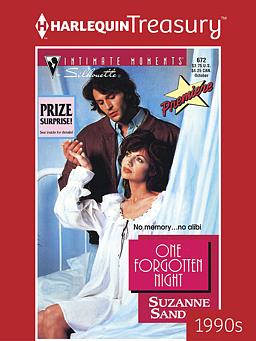

One Forgotten Night
Autor
Suzanne Sanders
Leituras
17,8K
Capítulos
13
She Had No Past Nina Dennison awoke to find herself a stranger. Her memory was gone, and the only person she could turn to was Detective Mike Novalis — the man who had saved her life. His determination to help Nina uncover her past, however, was not as unselfish as she believed. But She Could See the Future Then Nina realized the flashes she'd been experiencing weren't her memory returning but visions of events to come. Yet confiding in Mike could lead to more than the truth. Because if what Nina was "seeing" was real — it could mean the end for them both.
Chapter 1
Even before she opened her eyes she knew that something was wrong. Her head ached dully, and she was lying on a surface that was much too hard to be a bed. She lifted heavy eyelids and blinked at the dazzle of a bright light overhead. Beyond the light was darkness, a windy void that she knew was the night sky. Cool air blew across her face. Suddenly she realized that she was lying outdoors, on concrete. What was going on?
Someone knelt next to her. She wanted to sit up, but her body felt heavy and very, very tired. It would be so much easier just to lie there.... She struggled to turn her head, to look around, but her muscles refused to obey. Panic welled up. Then a hand rested firmly but gently against the side of her face, and strong, sure fingers moved along the line of her jaw to the fluttering pulse in her neck. A man’s voice said, “Hang on, sweetheart, you’re going to be fine.” The voice was deep and reassuring. Her panic ebbed. The unknown speaker continued to talk to her in a soft, comforting voice. She was cold, an aching cold that seemed to reach outward from her very bones, but the place where his hand touched her throat was warm. She let her trembling eyelids fall shut: she was not alone.
Then she felt, rather than heard, a bustle of new arrivals. Someone wrapped a blanket around her; she was being lifted. “You’re all right, it’s okay,” a new voice, a woman’s, said in a tone that was at once soothing and professionally impersonal. “There’s been an accident. We’re taking you to the hospital.”
An accident. Going to the hospital. She was dimly aware that there was something...something you were supposed to do if you had an accident, something you were supposed to remember. Dizzily she groped through the fog that threatened to swallow up her senses. Aha! That was it; she remembered now. Gathering her fading strength she whispered hoarsely, “I hope I’m wearing my good underwear.”
Just before she passed out she heard a short, surprised laugh somewhere behind her.
* * *
Mike Novalis watched the flashing red ambulance lights recede down the street. A couple of blue-and-whites had pulled up, and uniformed officers were taking names and witness statements from the small crowd that had gathered. Novalis grimaced: even at one o’clock in the morning, even in a deserted and decaying part of town, there was always a crowd. Flashing lights, sirens, the hint of violence or danger—it brought them out of the woodwork, hungry for a cheap thrill. And you’re right here with them, Novalis told himself. Is there really that much difference? It was a question he’d asked himself before. Lately it was getting harder to answer.
He shivered. It was cold, and he had left home in a hurry, throwing on his jacket over a T-shirt. Now he wished he’d grabbed a sweater. There was a damp rawness in the night air and a halo of mist around the streetlight at the end of the block. Turning up his jacket collar, he headed for his car, beckoning to one of the uniforms.
The cop hurried over. He was a young black man, with short-cropped hair and an air of barely suppressed excitement. Novalis sighed. The kid had to be a rookie. He hadn’t been on the force long enough to discover that shootings were routine. “What do you need, Lieutenant?” the younger officer asked eagerly.
Novalis checked the cop’s name tag and then cocked his head at the little crowd, which was beginning to disperse. “Anything good, Simms?”
“Not so far,” Simms said. “Mostly people who showed up when the ambulance came. But we’ve got the guy who called 911. My partner’s getting his statement now.”
Novalis hesitated for a moment, leaning against his car. Nothing here required his attention. He could go home, crawl back into bed—turn off his police radio this time, damn it—and try to get some sleep. But something bothered him. He thought of the woman in the ambulance. He’d found her lying in the street like a broken doll, one of those old-fashioned dolls with delicate porcelain skin.... He shook his head impatiently to dislodge that oddly touching image. He’d seen too much in his years on the force to start getting sentimental. Still, she hadn’t looked like a hooker, or like an uptown yuppie cruising for drugs or excitement. What had she been doing on this street? His instincts told him that something in the picture didn’t quite fit.
Instincts? jeered a voice inside his head. Remember what happened the last time you trusted your “instincts”? Novalis quelled the mocking voice, pushing his self-doubt deep down where he couldn’t hear it. He realized that his jaw was clenched and that his hands had balled into fists; he forced himself to take a deep breath, wondering if Simms had noticed. Simms probably knew about Novalis’s private nightmare. They all knew. Nobody talked about it, though—at least not when he was around. He glanced at Simms, saw only bright-eyed attentiveness.
“I’m going on to the hospital,” he decided. “Call me there with the statements and whatever you get from forensics.” He clapped Simms on the shoulder and climbed wearily into his car. Only when he started to drive away did he notice the dark stain of her blood on his fingers.
* * *
The next time she woke it was in a hospital room. The antiseptic odor, the echo of long hallways and the white acoustic ceiling tiles told her at once where she was, but she wasn’t alarmed. Her body felt warm and light, and she floated in a pleasant, unconcerned haze. A woman in a nurse’s uniform was snugging a blanket over her. She noticed idly that the nurse wore an engagement ring. A nice little stone, she thought drowsily. Just under a carat, the cut’s nothing special but the color is good....
“Ah, you’re awake,” she heard a man’s voice say, and a white-coated doctor stepped up to the side of the bed. “How are you feeling?” The bed moved, jogging her up into a sitting position. Suddenly her senses prickled. Like an animal that senses someone’s near, she felt eyes were watching her. Craning her neck, she saw that there was a fourth person in the room.
He sat unobtrusively in a corner by the head of the bed. He wore a beat-up brown leather aviator’s jacket over a wrinkled blue T-shirt and jeans, and his shaggy black hair was overlong; he certainly didn’t look like a doctor. His thick dark brows were drawn sharply down into a V, and he looked impatient. As he intently watched her the dreamy lassitude that had enveloped her began to melt away. Heat invaded her body as, with a tingle of heightened awareness, she reacted to the intensity of his gaze. He was waiting for something. For her. Deep inside she trembled at the thought.
“How are you feeling?” the doctor asked her again, and she dragged her gaze back to him.
“Fine, I guess. What happened?” Her voice sounded strange and weak. Like a dark cloud on the horizon, moving swiftly nearer, her feeling that something was terribly wrong was growing stronger by the second. She just couldn’t pin down what it was.
“You had a minor injury—” The doctor paused and glanced toward the dark-haired man. “That is to say, you suffered a slight head wound. But don’t worry, you’re going to be fine.”
“A head wound? How?”
The dark-haired man rose from his chair in a single lithe motion and stood beside the bed. He was several inches taller than the doctor and more athletically built, with broad shoulders and a muscular, long-limbed frame. He looked down at her for a moment, and in his eyes was a flicker of some expression that she could not quite read. “Someone shot at you,” he said.
“Shot!” Her voice cracked on the exclamation. “How—? What—?” Her confusion was so vast that she couldn’t finish either question. He was still looking at her, and despite the bizarre unreality of the circumstances she couldn’t help noticing that his eyes were a fathomless blue, several shades darker than the faded T-shirt that was stretched tight over his chest. His gaze was watchful but guarded, as though he wished to give nothing away. “Who are you?” she asked.
In a gesture eerily familiar from movies and television, he pulled a leather folder from inside his jacket and flipped it open to show her a gleaming badge. “Detective Lieutenant Mike Novalis,” he said crisply, and she felt a pang of loss. It was totally irrational, she knew, but for some reason she’d been sure that this man was someone she knew, someone close to her.
“I’d like to ask you a few questions,” he said. “Did you see the person who shot you?”
There was that horrible word again. Shot. This couldn’t be happening. Every instant she grew more certain that something was badly wrong. If only her head would stop hurting for a minute she could figure out what it was. She put her hand to her forehead and felt something stiff and smooth. A bandage.
“It’s all right,” the doctor said comfortingly, with an irritated sidelong glance at the policeman. “The bullet just grazed your temple. You have a tiny crease—it probably won’t even leave a scar.”
The policeman stood waiting. Novalis, that was his name. His name! Suddenly she knew what was wrong, and the knowledge was as shocking as a blow. She felt sick and dizzy, as though she were standing on the brink of a deep, dark cavern that could swallow her up if she made one false step.
She looked at Novalis, the doctor and the nurse, and then, in a voice that shook despite her desperate effort at control, she said, “Who am I?”
There was a moment of startled silence. Detective Lieutenant Novalis broke it. “You’re saying you don’t remember anything about the shooting?” His voice was carefully neutral, but she thought his gaze sharpened.
“That’s exactly right. I don’t. I don’t remember anything!“ She heard the rising shrillness in her voice and fell silent, afraid to give in to the sick terror she felt. She pressed her lips together to stop their trembling and, to keep panic at bay, forced herself to focus on the silvery stethoscope around the doctor’s neck. She felt as if she were trapped in a dream. A bad one.
“If you don’t mind, Detective?” The doctor took her hand and felt for her pulse.
“Sure, Doc,” Novalis said. “You take over. I’ll just sit here until you get this sorted out.”
Novalis retreated to his chair. But she was conscious of his brooding gaze as she sat stiffly upright, trying to still the clamor of her thoughts while the doctor looked into each of her eyes in turn. Then the doctor handed her a black leather shoulder bag. “Your name is Nina Dennison,” he told her gently. “This bag is yours. It has your identification in it. Does that name sound familiar?”
She clutched the bag to her; its soft leather felt cold to her touch. She mouthed the syllables of the name—her name—several times. “No. It doesn’t. What’s wrong with me?”
“Well, Nina, as I told you, you have a minor head injury. You’re perfectly all right physically—we’ve taken X rays already and there’s no damage. But sometimes these injuries can cause memory loss.”
“Amnesia,” Nina said. She felt stunned. The word seemed so—so dramatic. Not the sort of thing you ever expected to happen to you. But then you never expected to get shot, either.
“Exactly. You appear to be suffering some form of amnesia. There’s no need to panic, but let’s find out how serious this is. What’s the first thing you can remember?”
“Waking up just now—no, wait, I remember waking up once before. I was lying on the ground. They were taking me to the hospital, I think,” she said slowly. “Yes, and someone laughed.”
Novalis cleared his throat. “That was me, I’m afraid.” He leaned forward. “I was first on the scene when the shooting was called in.”
“And you laughed at me?” she said indignantly.
“No, not at you.” He seemed uncomfortable. “It was—well, you said something funny.”
“What?” Then she remembered. Joking about her underwear, of all things. She must have been in shock. “Oh, never mind,” she said hastily. Novalis grinned as he leaned back against the wall, and she all but gaped in surprise. His grin was a minor miracle; it transfigured his face, making his stern features look almost boyish. One thick, dark brow angled playfully, and light sparkled in the blue depths of his eyes. She found herself smiling back at him as though they’d just shared a secret.
At that moment Nina remembered something else from her first awakening. An impression of strength and security: a hand touching her face and a voice comforting her. An unexpectedly intimate voice. A voice, she now recognized, that belonged to Detective Lieutenant Novalis. She looked searchingly at him, but he was no longer smiling. Once again he was aloof and unfathomable.
The doctor said, “So you remember being brought here. Do you remember, oh, what you had for dinner last night?”
Nina shook her head.
“Going to work yesterday?”
She could only shake her head again, filled with blank dismay. Work? She didn’t even know what she did for a living.
“How old am I?” she asked.
“According to your driver’s license, you’re twenty-seven years old. Let’s see...how about your family? Any names, or images that come to mind?”
“No.” Her voice was almost a whisper. She felt utterly alone. But she must have a family of some sort; perhaps the bag would give her a clue. She glanced at her ringless left hand. Apparently she wasn’t married. The hand seemed alien to her, like a piece of statuary, and she studied it for a moment, taking in the long fingers with short oval nails, the clear polish. When she flexed her fingers, she felt taut thighs under the blanket. She gazed curiously at the outline of her legs. All at once she was overwhelmed by a frightening sense of facelessness. She didn’t even know what she looked like. Panicked, she surged up from the bed—too quickly. Her head spun and she staggered.
A strong arm slipped around her shoulders, supporting her, and she was pressed against a solid masculine chest. “Take it easy,” Novalis murmured in her ear. She looked up, startled. He must have crossed the room in a flash to reach her before the doctor or nurse could react.
“Thanks,” she gasped.
“Don’t try to move too fast,” he advised her. “You’ve had a bad shock on top of some painkillers. Take a moment to get your bearings.” He was still holding her tightly with one hard-muscled arm. His jacket was open, and she felt the steady beat of his heart, the heat of his body through the thin cotton of his shirt. His warmth, his strength, touched the cold knot of fear inside her. She relaxed against him, wanting to feel his other arm around her, too, pulling her even closer to his heat....
Suddenly Nina was embarrassingly aware of what she was thinking. She stiffened and pulled away from him. I must still be in shock, she told herself. No matter that she’d thought she sensed some kind of bond between them earlier—this man was a stranger, just doing his job. Then Nina became belatedly aware of a current of cool air on her backside. She realized that she was wearing only a loose hospital gown and, glancing over her shoulder, she saw to her horror that it was gaping wide open at the back.
She clutched the gown shut behind her. Novalis took a robe from a wall hook and draped it over her shoulders. He met her accusing stare blandly, but his left eyelid flickered as though he had repressed a wink. Undoubtedly, she thought, he had had himself a good long look. She felt herself blushing.
“Is there a mirror?” she said with as much dignity as she could muster.
Novalis ushered Nina into the bathroom. “You okay?” he inquired, and when she nodded he flipped up the light switch and closed the door. Alone in the tiny cubicle, Nina turned to the mirror. In the unflattering glare of fluorescent light she solemnly surveyed herself.
The face in the mirror was pale and strained, with dark shadows under the greenish hazel eyes. Wonderingly, she touched her cheek. Her skin was smooth. She smiled experimentally. A few fine lines formed at the corners of her eyes, but her teeth were even and white. Her features, while not classically beautiful, were interesting: broad high cheekbones, a firm chin and a wide mouth. Not bad, she decided.
A bandage slanted rakishly across her forehead like a pirate’s head scarf. Long, tumbled red-brown bangs fell over the bandage; thick, tousled hair grazed her shoulders. So I’m a redhead.... Hmm, hope it’s natural. She wore small, plain silver hoops in pierced ears. She was tall and seemed well built.
Nina looked at the mirror for a moment and then slipped out of the baggy robe and drew the gown over her head. She appraised her body like that of a stranger: the full, firm breasts with dark nipples puckered tight against the sudden chill, the gentle curves of belly and hips, the faded scar on one knee. How had she gotten that scar? Falling off a child’s bike, maybe, or tripping in her first pair of too-high heels? She searched for an answering memory. Nothing. She touched the scar gently and wondered how many other secrets this body held. My body, she reminded herself.
Do I have a lover? She thought of Detective Lieutenant Novalis waiting outside, and of how eagerly she had responded to the nearness of him, and her breath caught in her throat. “Be careful,” she whispered to the image in the mirror. She put the gown and robe back on. She noticed that her toenails were painted a deep, lustrous burgundy—a splash of color in the sterile little room. Those red toenails cheered her a little. The doctor and the detective were talking when she stepped out of the bathroom. They looked up hopefully. “Anything?” the doctor asked. “Sometimes the mirror jolts the memory....”
“Nothing. Sorry.”
“Amnesiacs often suffer loss of short-term memory, or they lose knowledge about their own lives,” the doctor said. “Many times it’s only temporary. Let’s see how well oriented you are otherwise. Do you know what year it is?”
Nina named the year, the month, the day. She knew without thinking about it that the city outside the window was Philadelphia. She allowed herself to feel just a little encouraged. The doctor asked, “Can you name the president?”
Nina did so unhesitatingly. Then she added glumly, “But I can’t remember whether I voted for him or not.”
* * *
Several hours passed. Dr. Perrone called in a neurologist and a psychologist. They established that Nina seemed to have lost all memory of her personal life and the events leading up to the shooting. Yet her intelligence and her ability to make decisions were unimpaired. There was no medical reason why she shouldn’t leave the hospital. On the other hand, she carried an insurance card and could stay in the hospital for a few days if she wanted to do so.
“Let me get this straight,” she asked Dr. Anderson, the neurologist. “If I stay here, do I have a better chance of getting my memory back? Is there anything you can do for me?”
Dr. Anderson shook her head regretfully. “There’s no treatment for amnesia—only the passage of time. I can’t make any promises, but we do know that most cases of amnesia clear up eventually. Sometimes the memory comes back suddenly, often within a very few days. Sometimes it comes back slowly, in bits and pieces, over a long period of time. But sometimes, Nina, it doesn’t come back—at least not all of it. I have no way of telling what will happen in your case. If you feel comfortable going home, you can certainly do so. It might even jog your memory.”
The psychologist, Dr. Tooley, chimed in. “This must be very frightening for you. It might be better for you to spend a few days here until you’re over the shock.”
“No,” Nina said decisively. “I’m going home. Right now there’s only one thing I want—I want to find out who I am. I can’t do that sitting here.”
She glanced at Detective Lieutenant Novalis and thought she saw a fleeting look of approval on his face. He had been in and out of the room during the doctors’ examinations, and for the past half hour or so he had been sitting quietly, fidgeting a bit but making a visible effort to control his impatience. Nina wondered why he was still there. She had amnesia, after all; she couldn’t tell him anything about the shooting he was supposed to be investigating.
Nina raised a hand to her bandage and shuddered. She had escaped death by an inch. It was disturbing to think that her life, only a few hours long as measured by her memory, began with an act of violence.
“Do I really need this thing?” she asked, pointing to the bandage.
Dr. Perrone smiled. “I guess it is a little conspicuous. I’ll replace it with a smaller one, all right?”
“Please. I have enough problems without looking like the Mummy.”
When the doctors withdrew for a conference, Nina took her clothes and bag into the bathroom to get dressed. It would feel good to get out of the hospital robe; her clothes were unfamiliar, but at least they were hers.
At the time of the accident she had been wearing a plain but expensive black brassiere, nearly new, and matching lacy panties. Nina almost laughed. So she had been wearing good underwear, after all. She had also been wearing a black turtleneck sweater, a pair of jeans with a narrow leather belt and dark gray walking boots. Everything was stylish and of good quality without being flashy. So far, so good, Nina said to herself as she laced her boots.
But as she straightened up, she met the shadowed eyes of the stranger in the mirror, and her composure cracked. When talking to the doctors she had felt strong and capable, ready to tackle the problem of her lost memories, certain that they would return. Now that certainty was gone. Nina felt only emptiness and a desolate sense of loss. Suppose her memory never came back? What was she going to do? She huddled on the toilet seat and cried for five minutes. The tears dried to sniffles, and she blew her nose forlornly on a strip of toilet paper.
The doctors’ questions had seemed endless. They proved that she could remember things like the dates of World War I—but not her own birthday. Enough questions. Now it was time for some answers.
She grabbed her bag and burrowed in it for a wallet. Her Pennsylvania driver’s license said she was born on February 17. That makes me an Aquarius. Wait a minute—how do I know that? Do I believe in astrology? The wallet also held nearly eighty dollars in cash, and several credit cards. So I’m not going to starve. Not immediately, at any rate.
The shoulder bag contained a zippered red nylon pouch. That’s got to be makeup. Nina’s spirits rose a little. She washed her tear-streaked face, rinsed out her mouth and put on some blush and lipstick. Ruffling her hair with her fingers, she took stock of herself in the mirror. Superficial though the changes may have been, they made her feel better. Now she was a person instead of a patient. And if she fluffed her bangs just right, she couldn’t even see the little Band-Aid at her temple that covered the place where she’d been shot.
* * *
Mike Novalis smothered a yawn as he waited for Nina Dennison to come out of the bathroom. He wasn’t sure why he had stayed. She wasn’t going to give him a statement about the shooting, that much was clear. He just hated loose ends.
Earlier he had phoned Simms at the district offices and told him to run checks on the ID in the Dennison woman’s purse and coat. Now he was waiting for Simms to call him back. Maybe Nina Dennison was nothing more than the unlucky recipient of a stray bullet. As for what she had been doing when that bullet caught her—well, it looked as if he’d never know. Forget it, he told himself. If she says she doesn’t remember anything, there’s nothing you can do. He’d take Simms’s call, close the file and go home. And then he’d catch up on some sleep.
But he felt an insistent tug of curiosity. Everything about this woman was a puzzle. She’d looked so fragile and helpless lying there in the street—and then, less than half-conscious, she’d made a joke. In the past few hours she’d proved that she was no delicate china doll. She had intelligence, strength, flashes of temper. He liked that.
He also liked the way she looked, Mike admitted to himself: her green-gold eyes, her full lower lip and that tantalizing glimpse he’d had through her hospital gown of long slim legs and the creamy curve of a hip. She had felt good leaning against him. At six foot one, he felt out of sync with petite women, but Nina’s head had nestled into exactly the right spot on his shoulder. Oh, yeah, it would be all too easy to get turned on by this one. When she had gasped, her warm breath against the base of his throat had started his pulse pounding there. It had taken all his willpower not to wrap his arms around her and pull her closer.
Mike rubbed his hand wearily across his face. He knew he shouldn’t be letting his thoughts wander like this. But it wasn’t often that he came across a woman like Nina Dennison. Too bad that when he did, it was in the line of duty. No one knew better than Mike that that put her off—limits. And someone tried to kill her, he reminded himself. For all you know, she’s mixed up in a drug deal gone bad—or something worse.
The beeper in his pocket signaled him to call Simms. He went down the hall to a bank of pay phones.
“That you, Lieutenant?”
“Yeah, Simms, what’ve you got?”
“The Dennison woman lives alone, as far as her landlord knows, so it probably wasn’t a husband who shot her. And she looks clean, doesn’t have a rap sheet.”
“That doesn’t mean she’s clean, Simms,” Mike said. “It just means she’s never been caught.”
“Uh, right, Lieutenant. Sorry.”
“Just something to keep in mind. But you’re right, there’s no evidence of anything hinky.” Just a hunch, and no one’s gonna trust my hunches. He sighed. “There’s no reason to think she’s anything but a random target, someone who was in the wrong place at the wrong time.”
“Except for one thing, Lieutenant. Check this out. I talked to the doorman at that address you gave me, the office building. Dennison works there, all right. She works for Zakroff and Duchesne. You know,” Simms prompted when Mike didn’t respond. “The gem dealers.”
Then Mike got it. “Son of a—”
“Lieutenant,” Simms interrupted excitedly. “The chief wants to talk to you right away.”
The gravelly voice of Morris Hecht, chief of detectives, came over the line. “Simms says your victim’s got amnesia,“ he said, his voice heavy with irony.
“That’s what the doctors tell me.”
“Do you believe in coincidence, Novalis? I don’t,” Hecht continued without giving Mike time to reply. “When we’ve got an undercover investigation by the Justice Department, the Treasury Department, Interpol and probably the goddamned Boy Scouts of America for all I know, and then there’s a shooting, and the victim just happens to work for the company that’s being investigated, well, then I don’t believe in coincidence at all. The feds’re probably gonna take this over.”
Novalis grunted. He shared his chief’s ire toward federal agents who were overeager to muscle in on anything remotely connected with their investigations. To make matters worse, the feds often seemed to relish keeping the local law enforcement out of the picture and in the dark.
“One good thing,” Hecht continued, “is the feds are stretched pretty thin on this right now. I’ll turn in a report, but it’ll probably be two, maybe three, days before they do anything. So until then you stay on this woman’s case, Novalis. Find out if she’s connected. But don’t get in the way of the boys from the Bureau.”
“I got it. I’ll keep in touch.”
“And, Novalis—” Hecht’s voice was grim. “Don’t screw up on this one. You can’t afford it. Anything goes wrong, and you go down.”
Mike was silent. He knew Hecht was right. What was there to say?
“Amnesia.” Hecht snorted dismissively. “That only happens in the goddamned movies.” He hung up.
Novalis saw the neurologist hurrying down the corridor and stepped into her path. “Dr. Anderson, I need to talk to you. Can you confirm that the Dennison woman really has amnesia?”
“You want to know if she’s faking it?” The doctor’s voice was impartial, but her eyes glinted with faint disdain behind her glasses. Novalis didn’t let it bother him. He was used to asking questions that made people uncomfortable.
“Yeah, that’s what I want to know.”
“Well, I suppose you have to consider the possibility. In my professional opinion, Nina Dennison’s amnesia is genuine. Her reactions have been normal for this type of trauma, and cases like hers are not really uncommon. But there’s no way to prove it, if that’s what you’re after. A clever person can fake amnesia.”
“Thanks, Doctor. You’ve been a big help.”
Mike Novalis was thoughtful as he walked back to Nina’s room. His cold eyes and the set of his jaw startled an impressionable young nurse’s aide, who scuttled out of his way. Mike didn’t even see her. And by the time he reached Nina’s room, his expression was one of polite neutrality. You don’t know anything yet, he cautioned himself. Wait and see.
* * *
When Nina came out of the bathroom, she found Mike Novalis alone in the room. If he had heard her crying he gave no sign. Instead he looked her over appraisingly. “Very nice,” he remarked.
Nina felt oddly self-conscious. She plucked at the sleeve of her sweater and said, “At least I like my clothes.”
“Yeah, they’re nice, too.”
Before Nina could respond, an attendant came in with a tray of breakfast for her, and she realized that she didn’t even know what time it was. There was a wristwatch on the table by the bed: a sleek stainless steel model. She picked it up. The crystal was smashed and the minute hand was bent. The hands were stopped at 1:39. “It was like that when they brought you in,” Novalis said. “You must have broken it when you fell.”
He sat next to her on the bed. “The call came in at a quarter to two this morning. You were in the hospital by ten after, and you were out cold for about five hours.” He glanced at his own watch. “It’s going on 9:30 now.”
“Thanks.” She nodded at him, grateful for some facts with which she could anchor herself. Apparently he realized how disoriented she was feeling. Maybe he was not as insensitive as he had seemed.
“You still don’t remember anything about the shooting?” he asked. “Nothing leading up to it? Like what you were doing in a deserted part of town in the small hours of the morning?”
So much for sensitivity. He made her feel defensive without knowing why. “No,” she replied coldly. “If I knew anything I would tell you, wouldn’t I?”
“Would you?” The blue eyes that met hers held a challenge.
“Hey, wait a minute. What the hell are you getting at? Do you think I have something to hide?”
“Lady, at this point I don’t think anything. All I know is someone reported hearing shots. You were found unconscious in the street. A witness saw a car driving away without its lights, but we got no description.” He raked a hand through his untidy hair and frowned. “There’re three possibilities. One, it was a random shooting, maybe a drive-by. Just bad luck for you.”
“Thanks a lot,” she muttered.
“Two,” he continued unperturbed, “you saw something you shouldn’t have and someone tried to kill you. He blew it—but maybe he’ll try again. Three, you were involved in something, I don’t know what, and it almost got you killed. I don’t know which of those is the right one, but I’m going to find out.”
“Oh, are you?” Nina was seething. “I’m sitting here with no memory, no life, and you think I’m a...a criminal?”
“Like I said, Miss Dennison, I don’t think anything. Yet. Make that four possibilities.” He turned to face her. “Four, this whole amnesia thing is an act.” Seeing her eyes flash ominously, he raised both hands, palms out. “Hold on. I’m just thinking out loud here. I can’t overlook anything.”
She turned her shoulder to him and regarded the breakfast tray with disfavor. Eggs, sausage, buttered toast, orange juice. She drank the juice and set the glass down with a thump.
After a moment Novalis said, “What’s the matter? Aren’t you hungry?”
“Not that it’s any of your business,” Nina told him, “but I happen to be wondering if I’m a vegetarian.”
He hooted with laughter and she glared at him. “I’m sorry,” he said. “You say some funny things, that’s all.”
“I’m so glad you’re amused, Detective Lieutenant Novalis. This whole situation must be just a riot to you.”
“Look, I really am sorry if I upset you. I don’t think the situation you’re in is funny at all, and I’m going to do my best to help you, if I can. And by the way, you might as well call me Mike. We’re going to be seeing a lot of each other.”
“We are?” The prospect was unsettling. The bed moved under her when he shifted his weight slightly; the tang of leather and his musky scent teased her nostrils. Once again Nina was disturbingly aware of his nearness and his overwhelming maleness. Not that Novalis looked like a movie star or a male model—far from it. He was much more real, and a whole lot more sensual. His shirt looked as if he’d grabbed it out of a laundry hamper. His eyes were bloodshot. Deep lines bracketed his mouth. But under the dark beard stubble the chiseled planes of his face were strong and rugged. His thick, dark hair was messy; Nina had noticed that he had a habit of running his hands through it. Yet despite the evident weariness in his face and his raffish, unkempt look, Detective Lieutenant Novalis was one very handsome man. Which, Nina told herself sternly, could only complicate the mess she was in. The last thing she needed right now was to be attracted to this man. Any man. She was going to have her hands full just finding out what kind of person she was.
He turned a little, and looked directly at her, and then he smiled. Nina was shaken by the wave of heat that flickered through her. She froze, determined not to react to him. I cannot let myself trust this man, she told herself fiercely. He thinks I’m lying. Then another thought came, one she had been fighting to hold at bay: Oh, God, what if I really did do something wrong? He’ll find out. She forced herself to look away, trying to appear calm.
“Oh, sure, we’re going to be spending a lot of time together,” Mike was saying. “Think about it for a minute. You may have lost your memory, but you’re still right in the middle of a police investigation. A while ago you told the docs that the only thing you want is to get your memory back. Fine. I understand that. But you’ve got another problem. Memory or no memory, someone tried to kill you. Don’t you want to know why? And don’t you want to keep him from having another shot at you?”
“Of course I do!”
“That’s where I come in. I have to investigate you and everything about you. And, hey, you might be glad to have a detective around. You’re trying to find out about your life, right? Well, that’s what we’re good at—finding things out. So what d’you say? How about cooperating with me?”
“Do I have a choice?”
“Nope.”
“Then fine,” Nina said, hoping she sounded confident. “I’ve got nothing to hide.” Have I? She ignored the frightened inner voice. “I’ll cooperate with you. I just wish I knew whether I’m a suspect, a victim or an innocent bystander.”
He stood. “Believe me, lady,” he said, “I wish I knew the same thing.”