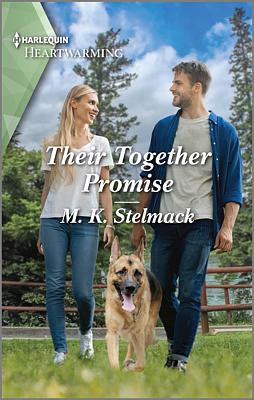

Their Together Promise
Autor
M. K. Stelmack
Leituras
19,5K
Capítulos
19
Her carefully controlled solitude…Is about to go to the dogs! Mara Montgomery insists she does not need a guide dog despite her vision loss. But charming dog trainer Connor Flanagan's plan is one that even Mara can't resist, though it means she'll be around Connor more. It would be too easy for Mara to fall for both him and his dogs. But will Connor still want her when he realizes she can't — or won't — give him all that he deserves?
CHAPTER ONE
MARA MONTGOMERY FEIGNED interest as her two sisters stood like performers in front of the fireplace directly across from Mara on the sofa. She hadn’t the heart to tell Bridget and Krista that at ten feet away they were still blurry, their matching gray sweatshirts melding them into a cloud. If they were indeed gray, and not brown or blue or orange or whatever other color that her brain now registered as that dull, dull hue.
At the periphery of her vision sat their respective husbands, Jack and Will, on either side of their wives. Sometimes she couldn’t tell the difference between them and had to wait for their voices or a little cue. Will, whether he knew it or not, always cleared his throat before speaking to her. Jack opened with a gesture.
Beside Mara, her mother gusted out her breath. “Just get on with it, will you?” She sounded impatient and bored. Did she know what her daughters were about to announce, too?
The seat cushions dipped and jiggled as Bridget and Jack’s daughters, Sofia and Isabella, bounced into the room in their pajamas, their hair perfumed strawberry and vanilla. Mara protected her full wineglass with her hand.
Krista-cloud said to Bridget-cloud, “Are you ready?”
They stripped off their sweatshirts to reveal white shirts with dark lettering and pictures. Mara couldn’t make out the words, but her mother read them.
“Bridget’s says ‘Cinna-bun in the oven.’ And Krista’s says ‘Farm help on the way.’”
Just as she thought. In the lead-up to tonight’s dinner at Bridget and Jack’s house, both Bridget and Krista had laid on the hints. I’m so tired! So weird, I crave pickled onions! I’ve decided to give up alcohol. Their mother must’ve gotten the same treatment because her surprise sounded forced. “Oh, who would’ve thought? Congratulations, girls.”
The shirt messages were too subtle for Isabella and Sofia. “What? What!” They tugged on Mara’s sleeve. She slid her glass onto the relative safety of the coffee table. She would need every drop to get through this happy ordeal. “Bridgie-ma and Jack-pa are having a baby,” she said. These were the names the girls had chosen for their parents since their adoption last year. “Auntie Krista and Uncle Will, too.”
Sofia squealed and hugged Bridget. She cupped her mouth and shouted at Bridget’s belly. “Hola! Can you hear me? This is your sister, Sofia. I am six and I will share my things with you.” She turned to Isabella. “Your turn. Say something.” Instead, her nine-year-old sister kissed the cinnamon bun on Bridget’s shirt.
“Congratulations.” Mara forced herself to smile. Her facial muscles quivered. She never knew a smile could hurt so much. “When?”
“November!” They said simultaneously. Seven months from now.
“Our due dates are two weeks apart,” Bridget said. “Mine is—”
“—on the second and mine is on the sixteenth which means we could have them on the same day.”
Her mother rose and wrapped her pregnant daughters in a hug. Wearing a shawl, she was a great gray cloud enveloping white cloud puffs. “I could be a twin grandma.” Her grumpiness had given way to teary excitement. Their mother was family-renowned for her emotional swings. Mara, for her lack of them.
“And me a twin auntie,” Mara said, trying to make it sound as if it was all she ever wanted. She lifted the wine to her lips, smelled the faint nutty, sun-and-leaf aromas, let the stream flood her tongue, sluicing over her taste buds and trailing, warm and healing, down her throat. That was the thing with wine—you didn’t have to be sighted to understand it.
In the middle of distributing her gift of “Big Cousin” shirts to Isabella and Sofia, Krista gasped and spun to Will. “Speaking of twins—you want to tell or me?”
Will waved her on, and Krista bounced as bad as her nieces. “Keith and Dana are expecting twins! In September. I’m going to be a twin auntie, too!”
“Triple,” Will said. “Don’t forget Laura.”
“Right, she’s up first in May. A month away! Weeks! Days, if she hurries up.”
Will folded his hands across his stomach. “Claverleys littering the place.” He spoke as if he’d pulled off the feat single-handedly.
“And there’s a shirt for it!” Krista reached into her bag. “‘Double Auntie’ T-shirt.” Soft cotton brushed Mara’s empty hand and she took the shirt. In yellow letters the size of a traffic sign, Mara read “Double Auntie premiering November.” “I ordered the same one in red for myself,” Krista said.
Mara tucked the shirt by her side. “Thank you,” she managed to choke out. “I think it’s time I topped up my wine.”
Once in the kitchen, Mara brushed her hand along the wall and found the light switch. A jumble of shapes. Pots and pans and dirty platters, points of light radiating away. Jack and Bridget insisted that no one help with cleanup because they liked to do it together as their nightly wind-down routine. Sweet, except that the clutter was a potential trap for Mara.
She had no intention of drinking more. Two glasses was her cutoff, especially since her volunteering started in less than an hour at the youth center, but to keep up appearances, she navigated the corners and counters toward the wine rack, depending on her muscle memory from when she’d lived in the house for a few months. That had been more than a year ago. How things had changed. Both sisters now married and pregnant, with good husbands. As for her, no husband, not even a boyfriend, certainly not pregnant. Her world had grown darker and narrower like the aperture on an unfocused telescope.
She leaned against the counter beside the wine rack, the one spot that couldn’t be seen from the living room. She’d pull herself together before reentering the fray.
“If you’re not having one, I will,” her mother said, coming into the kitchen.
Mara tipped the bottle over her mother’s empty glass and listened to the glug of the wine, lifting it up in time. She tilted her head to the chatter in the living room. “Did you know?”
“I suspected,” Deidre said. “I thought you were in on the secret, too.”
“No,” Mara said. “I wasn’t.” She usually was privy to her sisters’ secrets. Krista’s, especially. But motherhood had changed all that. The oldest and youngest sister formed their own little club of two now. They’d exchange their experiences and stories. Tips about teething and diaper rashes and nursing and sleep schedules. Nothing for her to add. And probably after these babies were born, there’d be more. She’d be an auntie again. Always an auntie, never a mother.
Her own mother leaned close, her shoulder touching Mara’s. “This is hard, isn’t it?”
No, it wasn’t hard. Hard was learning when you were thirteen that you had degenerative vision loss, hard was watching (notice the pun, ha ha) her vision deteriorate year after year, the world closing into a narrow tunnel and then that tunnel losing its contrasts, its depth and brilliance. Even as sounds and smells and textures sprang up to make up for her crumbling vision, like wild plants over an abandoned house.
That was hard. But hard was still doable. She had graduated with her master’s and, during the past year, moved from British Columbia to Alberta and built her business as a psychologist. She couldn’t drive but she could get around the smallish town of Spirit Lake easily enough, especially in daylight hours. She could have groceries—and wine—delivered. All manner of listening and decoding devices smoothed out obstacles.
Family birth announcements were...fine. If she could process them in her own time and place. If she could curl up on her living room sofa or meditate or play Solitaire Chess.
Or watch her fireworks. Shortly after her father’s unexpected death from a stroke six years ago, her vision had worsened. Lights—blue, purple and green—appeared constantly. They spiraled, exploded, rained down...exactly like fireworks. Her specialist had said it wasn’t unusual, that she might as well enjoy the show. Their constant activity had distracted and annoyed her at first, but they’d become their own kind of mandala, a focal point when grief threatened to immobilize her. A place of beauty to travel to at any time and from where she could return calm and detached.
She could do none of that yet. But she could go for a walk. “I’m delighted that our little family is growing. Unfortunately, I’ve got to be on my way. The youth group is tonight.”
“You’re going to that?”
“I go every Wednesday.” She loved the kids. She soaked up their energy, their plans for the future, their playing at adulthood. She could live through them.
And because Connor Flanagan would be there. The other group leader. The guy that made her heart beat as if she were a lovestruck teenager. A stupid, futile crush she couldn’t stop, no more than she could stop her blindness.
“Let me drive you.”
“Mom, that’s your third glass of wine. No.”
“Let someone else take you, then.”
She most certainly did not want to be confined for any amount of time with either of her sisters or brothers-in-law, pretending to be over the moon. “I prefer to walk. The exercise will do me good.”
“Why do you need exercise? You’re skinny. And soon enough, you’ll be skinnier than all us Montgomerys for a good long while.”
Meaning no chance Mara would get pregnant, not being in a relationship. She’d never told her family that relationship or not, she’d never have children. It seemed irrelevant, obvious. Like announcing that rain was wet. But it grated that her own mother assigned her the role of family spinster, because mothers tend to reflect societal perceptions.
To hide her annoyance, Mara corked her bottle and edged into the living room to say her goodbyes. “But it’s getting dark,” her mother called after her.
Of all the things to say on this day. “It’s been getting dark for most of my life!”
Voices died away. She could feel the heat of her family’s gazes concentrate on her. Lovely. She’d ruined her sisters’ joy. She could think of nothing to say or do to repair the damage. Except to leave.
She held aloft the bottle. “Since you two won’t need this,” she said to her sisters. “I’m off.” The room remained quiet.
Her coat. Where was it? “Isabella, can you get my jacket, please?”
Jack stood. “I’ll give you a ride.”
Would they all just stop? “I’ve got the youth group tonight. I’ll walk.”
“You sure?”
“Yes. I’m sure.” Isabella pressed Mara’s sheepskin-lined coat into her hands. “Thank you. Congratulations, everyone.”
She fumbled with her coat. Something was stuck in the left sleeve. The double-auntie shirt. “I put it there,” Isabella whispered, “so you wouldn’t lose it.”
Protective, thoughtful Isabella. Mara felt a shot of resentment toward the niece who every other day she adored. She shoved the detestable shirt and the bottle into her bag and hustled for the door, not trusting herself to say something that wasn’t petty or self-pitying.
Outside in the cool air of late April, she snapped together her extendable white cane. Tap, tap, tap to the top of the stairs. She bet every single one of her family was staring through the front windows. Let them look. At least they could.
IT WAS ANIMAL floor hockey. The dozen or so kids were divided into two teams, Bears versus Penguins. Half were on all fours, trying to use a stick with their front foreleg, while the birds waddled about with bands around their ankles to restrict their motions. All wore helmets with face guards at Mara’s strict insistence.
Judging from the shouts and raps of sticks and squeaks from runners on the gym floor, along with the occasional play-by-play called out by the kids, Mara had scored big with this activity. The teenagers could cut loose for the evening, released from the usual pressures at home, school and, for a few, work. They were misfits one way or another. They didn’t participate in Spirit Lake’s massive sports programs. They weren’t academic achievers. No musicians or inventors or artists here. She’d been the same when she was their age.
A figure broke from the fray and walked over to where Mara sat on the lowest bleacher. Talia Shirazi. One of the oldest at sixteen, she was usually in the thick of whatever was happening, sorting out conflicts, organizing, strategizing. She’d shown leadership, a true talent, but tonight she dropped to the bench beside Mara.
“Taking a break?” Mara said.
The metal seating shook as Talia gave a quick one-two stamp to dispense with her ankle band. “I’m not feeling well.”
“Where is it hurting?”
Talia gusted out a sharp breath. “Everywhere. And nowhere.”
“My mother calls that being ‘out of sorts.’ Would you like to go home?”
“Not really.”
Was everything okay with her parents? Mara had met them a few times—busy, professional types who doted on their only child. Perhaps too much. Mara suspected Talia was a regular here because she was free to squirt whipped cream, get mummy-wrapped in toilet paper, sing opera off-key. One night a week where she could be less than perfect.
Mara could relate. But no. At the doors to the youth center she’d promised herself not to surrender to any more self-indulgent thoughts or behaviors. She pressed her fingers to her temple and focused on Talia. “Any plans for spring break?”
“We’re going to Mexico.”
Mexico. That brought back memories of brightness and color. Mara had traveled there with her parents and Krista when she was a kid. Back when she could see almost as well as everyone else. When she’d run and not worried about crashing into things and people.
No. Stop with the boohoo, poor you. This was not her.
“That’ll be nice. Loads of sun and beach and water.”
“I guess. But it’s practically spring now. We have sun and beach and water here.”
Talia sounded cranky. Mara dived to the heart of the matter. “You’ll miss Dane.”
“I don’t know. I guess.” Yes, something was amiss between them. They’d been dating for nearly a year, their relationship growing steadily more serious. A breakup now wouldn’t be fixed with a good cry into a pillow.
Beside them, the double doors rattled, the metal handle snapped down. A ripple of energy passed through the kids. “It’s Dog Man!”
Connor Flanagan. The gym floor thundered as the kids moved as one to him and his three dogs. The board on the bench vibrated as Talia, too, joined them.
“Whoa, guys. Thanks for the big welcome. Oh wait, it’s the dogs you want to see.” His laughing words in his easy tenor rolled across the room and right into her heart. Every single time this happened. Mara made out a jumble of dogs and kids, and the tall, solid shape of Connor. She assembled the sounds. The faint drop of knees on floor as some kids got eye level with the dogs, the jangle of collars as canine necks were rubbed, a yip. That would be the year-old pups. These were therapy dogs-in-training, and this was their downtime. To come and mix it up with the kids and give the kids opportunities to touch and cuddle with warm beings when the humans in their lives were harder to access.
Mara was navigating her way over, when her cane encountered something narrow and long. A hockey stick, abandoned in the rush to meet Connor and his dogs. She picked it up and straightened. Connor had appeared in front of her. When she’d explained the nature of her vision loss to him, he’d immediately adjusted to center himself in front of her pinhole vision.
“You found the stick before I could get over,” he said. Had his voice dropped, become more intimate? No. She had a crush on him, not the other way around, as much as her heart might manipulate her into thinking so.
“Dogs trump safety,” Mara said.
“They shouldn’t,” he said, annoyance clipping his words. “Hey,” he said in a louder voice. “Who turned their stick into a tripping hazard?”
Three pairs of feet suddenly broke away and pounded to different points of the gym floor, followed by the scrape of lifted sticks.
Another pair of feet ran to her. “Sorry, Miss M.” That was Bryson.
She handed him the stick. “Next time be more careful. You don’t want Mr. C falling flat on his face.” She refused to call him Dog Man. The kids had nicknamed him after a fictional canine detective popular in upper elementary grades. Even after Isabella had explained the reference, Mara couldn’t bring herself to pin him with that flat descriptor. He was so much more than a man with dogs.
“I don’t think that—” Bryson broke off. “Are you making a joke?”
Bryson had difficulties figuring out the subtleties of jokes. Or even why people would bother to make them in the first place. Normally, she would assure him, but tonight, double auntie-hood made her a little unhinged. “Not a bit. I have my cane, but Mr. C is on his own. You need to put yourself in his shoes.”
“He’s not wearing any.”
So that was how he’d sneaked up on her. “And the dogs?” Mara said to Bryson. “Are they wearing any shoes? Or did they take them off, too?” She injected a light tone into her voice, a clue to Bryson that humor was...afoot.
“Uh. I can tell you that none of them have shoes on now.” He tapped his stick on the floor, quick and nervous. “I’m going to put away the stick.”
Connor reappeared in her vision. Close. His wide mouth with its perpetual upturn at the corners. The blue eyes radiating warmth and good humor. That was Connor Flanagan. A force of energy and lightness. But right now, a frown had appeared. “Are you all right?”
During the year she’d known him, mostly chatting at the youth group, he’d never asked her that. The conventional “How’s it going?” and “Life treating you okay?” but not this intimate concern. “Of course.”
“It’s just that you sounded a bit off with Bryson.”
“I was showing him different ways to look at the same thing.”
“Except he comes here not to have to deal with those challenges,” Connor said.
He was criticizing her. She must not take it personally that the man her irresponsible heart bounded after should question her logic. “Perspective gets us through the challenges.”
“So does alcohol,” he murmured.
Did he smell wine on her breath? Had Talia? She hadn’t drunk anything in nearly two hours. The bottle was stowed under her coat in the kitchen off the gym.
She better come clean. “I had two glasses earlier. Our family was celebrating.”
“Yeah?”
Here was her chance to declare how absolutely thrilled she was with her freshly updated status. She raised her eyebrows and her voice, to exude excitement. “I’m going to be an auntie. Again. Twice over. My sisters are both expecting in November.”
Connor’s eyebrows shot up as high as hers. Was he faking it, too? “Whoa. Congratulations.” No, he did sound genuine. From the way he mixed it up with the kids, he had a clear affinity with the young.
He touched her elbow and a zing shot up her arm. “We’d better move off to the side, or between the dogs and kids we’ll take a header.”
Once on the lower bleacher, Connor stretched out his legs in front of him and leaned against the row behind him. “The day I heard I was going to be an uncle was the second-best day of my life. The best day was when he was born, of course.” There it was. Connor Flanagan, family man-in-waiting and the reason she’d never act on her crush.
Mara forced herself down a more useful line of thought. Dane was Talia’s boyfriend and Connor’s nephew. Connor lived with his sister and Dane a few miles out of Spirit Lake. He might know if the two were going through a rough patch. She leaned toward him, an excuse really, since no kids were close enough to hear their conversation. She breathed in Connor’s shower soap, the cool flavors of the outdoors, the muskiness of his dogs. “Are there—” Her voice sounded too high, as if drawing in Connor was like sucking on helium. She cleared her throat and tried again. “Are you aware of any problems between Dane and Talia?”
“No. Why?”
“I talked to Talia earlier. She’s upset about something, and I think it involves Dane.”
“I can talk to him.”
“Don’t, please. Because if he’s the problem but doesn’t know it, then he will ask her and I’m sensing she needs some space.”
“One of the dogs is in her space right now,” Connor noted. “Resting her head on Talia’s lap over at the other end of the bleachers.”
He made a low tongue click to the roof of his mouth. It signaled he was thinking to himself. She stayed quiet. Let him have his space, too.
“Griffin!” Kids were calling one of Connor’s dogs. She felt his soft, thick body suddenly wedge between them.
Mara touched Griffin’s head with its mixed hair, short and long, soft and coarse. He allowed her touch but she felt his subtle shift toward Connor.
“What’s with you, Griffin?” Connor said. “You like to play. Now’s your chance.” To Mara, he said, “He loves people but he doesn’t always know how to deal with them.”
Mara leaned forward until she was on level with Griffin’s long snout and brown eyes. Connor had once described Griffin as mostly German shepherd, black with brown and with the occasional lick of white. Right now, all she saw was gray brown and gray black. “Hello,” she said softly. “What’s the matter? You want a piece of Connor, too?”
Too. That made it sound as if she also wanted Connor. “Everybody does,” she added quickly. She didn’t dare look up, worried she wore her emotions on her face. Griffin allowed her to scratch behind his ears and pet his head, tolerated the long strokes down his spine, but he kept his body angled to Connor.
When she felt confident her heart was shoved back into place, she remarked, “He’s a one-man dog.”
“Unfortunately, that’s a problem,” Connor said.
She stroked Griffin behind his whiskers. “Why? Have you given your heart to another dog?”
His gaze beat down on her. “Many dogs.”
Wasn’t that the truth? She’d visited his website. Excessively so. Flanagan Dog Academy. We repurpose dogs. His site described how he trained dogs for therapy and search-and-rescue, ran obedience classes, and as his “pet” project took in strays and unleashed their potential before matching them to forever owners and releasing them back into the world. A canine heaven on earth.
It also mentioned the launch of his guide dog program, a subject neither of them had broached. The guide dog was their white elephant in the room.
Her phone chimed to let her know it was the end of the evening, and she allowed the alarm to escalate in pitch to penetrate the squeaks and shouts and dog barks. The dogs obeyed first, gathering around Connor. The kids were next, Talia arriving last. On Connor’s command, they all heeled, including the dogs.
Sensing more than seeing the curve of kids in front of her, Mara instructed them to put away equipment and to come next week when, weather permitting, they’d play Frisbee baseball outside. Once Mara and Connor had closed the door on the last of them, he asked, “How about I drive you home?”
Every week he asked her the same question as if it were the first time—with a bit of uncertainty, almost shyness. It always made her heart do a little flip. And every week, she pretended to inject surprise as if she hadn’t come to expect his offer. “I’d love a ride home. Thanks.”
She detected his smile in the easy sway of his next words. “Griffin still needs to learn to give up shotgun if I’ve got passengers.” Passengers. A girlfriend, perhaps? He’d never mentioned one, but why would he? And what did it matter if he was seeing someone? She and Connor had no future together.
CONNOR PARKED HIS long-box SUV outside Mara’s town house and spoke before he lost his nerve. “I have a favor to ask.”
Griffin stuck his head between the front seats and panted like he’d run a mile in the sun, effectively blocking Connor’s view of Mara.
“Go back with the others,” Connor ordered. Griffin looked away, as if he hadn’t heard. The brat. Connor stiffened his voice. “Back.” Griffin retreated.
Griffin would’ve obeyed immediately if Mara wasn’t there, but he seemed to consider her a rival. No, not quite that. As someone he needed to keep an eye on. As if Mara might cause trouble.
As if.
When she’d told him in her quiet, steady voice about her vision loss, he’d sat in this same cab seat after dropping her off and looked up retinitis pigmentosa. Hereditary. Often diagnosed in childhood. Degenerative. Can lead to total blindness. He’d learned enough to have more questions. Did she have the recessive or dominant gene? What was her prognosis? What were her plans? Was she scared? How could he help?
He’d dwelled on this last question the most. He wanted to help her because, well, that was what he did. He might’ve walked away from his police career but he couldn’t suppress his innate drive to serve and protect. He was like the dogs he trained.
But to be truthful, he also couldn’t suppress how he felt about what she was doing right now.
She tilted her ear to him, presenting the curve of her cheek, as if priming for a kiss. She often did this around him, and more than once he fought the urge to give her one. He’d held back because she’d never indicated interest. Until tonight. You want a piece of Connor, too?
He pivoted his attention back to Griffin. “It’s our buddy here. I’m convinced that he would make someone a great companion, but he’s stuck on me.”
“Why not keep him, then?”
“Because dogs are my business. Kind of like how cattle are a rancher’s business. He deserves a home, not a business.”
“If you’re suggesting I take Griffin, I can’t. I don’t want a dog.”
Griffin inserted his head between them again. Connor ordered him back. “He’s hypersensitive to his name. He expects to be included in the conversation.”
“I think if he could be,” Mara said, “he’d take my side.”
Her reaction didn’t surprise him. She clung to her independence like a burr to a dog. “It wouldn’t be a permanent move. That would be too much for Griffin. I was thinking an afternoon here or there. Maybe you two go for walks.”
“I don’t trust us on walks, Connor. Or the backyard. I only moved here last month, and I don’t even trust myself alone in the place, much less Griffin who doesn’t really want to be with me.”
“You live by yourself?”
Not that her home status was any of his business, and she let him know that by a stiffening in her posture. She touched her bag and her pocket. Checking that she had everything. “Yes.”
Her fingers slid down the sides of the wine bottle between her thighs. Would she finish that off tonight? He knew all too well where that led. It’d taken him a good year of his life to dig out of that hole before he’d switched to the dog training division of the RCMP and then struck out on his own. Dogs had saved his life, and they’d save Mara’s, if she let them.
“Look, Connor. I know where you’re going with this. You want me to get used to Griffin, we become buddies, and then you graduate me to a guide dog. Isn’t that what you’re driving at?”
He’d never mentioned the guide dog side of his operation to her, because he didn’t want to mix business with how he’d come to see his time with Mara—pleasure. She must’ve discovered it for herself, which meant she was interested in him. Or at least, and more importantly, his dogs. “I’m not in the market for a dog,” she went on. “I don’t want to be responsible for any living creature. Not a fish, not a cat and especially not a dog.”
That didn’t make sense. Reaching out to the hurt and lonely, those trying to get their heads together, was her life. She wasn’t made to be alone. His eyes slid to the half-empty bottle, her hands still around it.
“I’m not trying to sell you anything. Honestly, Mara. Yes, I have a guide dog about to finish her training and I am looking to place her. Yes, I think she’d be perfect for you, but she’d be perfect for some other person, too.” Empty words, a lie even. While training Daisy he’d thought of Mara often. A single drop of an idea about how suitable the two were for each other had swelled into what was now a steady current in his mind.
“Look, I’m not so blind—” Mara gave a short bark of laughter “—as to think that I won’t need to consider other options someday. But not now.”
She’d slapped him down. In his peripheral vision, he saw the liquid shine of Griffin’s eyes fixed on him. A one-man dog, Mara had said. Griffin had come to him as a rescue pup a year ago, when he was six months old. A brilliant animal, he’d resisted training. Stubborn like Mara. “Is there any way we can make this thing work?”
She crawled her hand to the door latch. “I don’t think so. He only tolerates me when you’re around.”
“How about I come along?”
Her blue eyes widened. “I didn’t mean—that is, I didn’t mean to involve you.”
“Remember, I’m the one asking for the favor. Hopefully after a few times you two will be best buddies.”
He held his breath, as if he was asking her out. They would be alone together, doing something that would look very much like a date.
Mara’s hand caught the door latch. “Sure, that sounds fine. Text me and we’ll set something up.”
He waited, as he always did, while she unlocked the door to her town house, the process complicated by her hold on the bottle. The door opened and she turned to wave at him—as she always did. A wedge of light spilled onto her pink cheeks and light brown hair.
Griffin repossessed the shotgun seat, and panted a grin at Connor. “Don’t get too comfortable, boy. You’re taking a back seat the next while.”