

The Universe of Discretion: Things Left Unheard
Author
Michael BN
Reads
33.4K
Chapters
9
Unheard Echoes
MATEO
I’ve always known I was different, even from a young age.
My dad was never in the picture, and my mom, who had me at seventeen, left when I was six, claiming she wasn’t cut out for motherhood. She disappeared without a trace, leaving me wondering where she was until I started receiving birthday cards filled with cash from various parts of the country.
As I grew older, I found out she had opened a bank account in my name and was making yearly deposits. Despite this, I never touched the money.
My grandpa was the one who took me in and raised me.
During one of our many fishing trips, I tried to calculate the probability of him catching a fish. I took into account the volume of the lake, the estimated number of fish per cubic foot, and the average waiting time.
To me, it was a simple equation, but to Grandpa, it was mind-boggling. After that, he started looking at me differently, so I stopped sharing my thoughts. I didn’t want him to think my mom was right to leave.
The proudest I ever saw Grandpa was when I made the school baseball team. I had a knack for calculating the perfect trajectory of a ball and the force needed to hit it. I left the running to the other kids.
Math class was a breeze for me, but I played dumb so my teacher wouldn’t tell Grandpa. When Mr. Warner wasn’t looking, I’d solve Olympic-level problems in my spare notebook.
I spent my free time in the computer lab, seeking challenges that would stimulate my mind. Grandpa’s pension barely covered our expenses, but he managed to get me a laptop for my twelfth birthday. That gift changed my life.
By fifteen, I was coding and writing complex programs. A year before graduating high school, I sold a video compression software to Symillion for a hundred thousand dollars.
I wanted to use the money to buy Grandpa his dream beach house, but he insisted I use it for college. Craving a real challenge, I reluctantly agreed.
I chose to study computer science at the prestigious American Institute of Technology. It didn’t take long for me to realize it was the best decision I’d ever made.
***
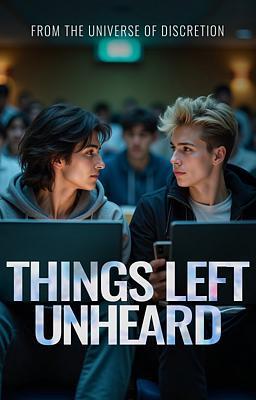
On my first day, I met Rupert during an Algorithms and Theory lecture. He sat in front of me with an AcuBook laptop.
“Hey,” I said, leaning forward. He was cute, and I was eager to make a friend.
He didn’t respond.
I watched as he pulled out a device that looked like a mini satellite dish, plugged it into his laptop, and adjusted its position.
“What’s that?” I asked, trying again to get his attention.
Again, he didn’t respond. The lecture had started, and I was starting to think he was just rude.
Professor Buchanan wasted no time diving into the lecture. I was still adjusting to the university environment and was scrambling to take notes.
It wasn’t until a student answered a question that I noticed what was happening on Rupert’s screen.
One column showed a small thumbnail of the professor and a transcription of his entire monologue. Another column displayed student profiles with pictures, names, and pronoun preferences. The last column was filled with social media posts, flashing by at a rapid pace.
It would stop on a video featuring the student currently speaking and announce, “Match Found.” The student’s profile picture would then move to the first column and be assigned to the transcription of their answer.
I was blown away. The device was transcribing the entire lecture in real time! I knew then that I had to be friends with this guy.
After class, I sat next to him and extended my hand.
“Mateo,” I said, grinning. He couldn’t ignore me now.
Rupert turned to me, seemingly just realizing he wasn’t alone. Instead of shaking my hand, he held up a finger, typed something into his phone, and let the device speak for him in a smooth baritone.
“Hello. I’m Rupert. What’s your name?”
I was taken aback. Why was he using his phone to speak? And hadn’t I just introduced myself?
Then it hit me. Rupert was deaf!
I had mistaken his silence for rudeness. Now, I needed to figure out how to communicate with him. The note app seemed like a good place to start.
I reached for my phone, ready to type out a message, when the synthetic voice from his device chimed in, “I can lip-read if you enunciate well.”
“MY NAME IS MATEO!” I practically shouted, my lips moving in exaggerated motions. I cringed internally. Was I seriously yelling at a deaf person? What was wrong with me?
Rupert chuckled, the sound barely audible, and typed out, “No need to shout, Gift of God.”
He knew the meaning of my name in Italian? I shot him a surprised look, and he giggled again, this time a small squeak escaping.
I didn’t want our conversation to end, so I gestured toward his device, asking what it was. This time, I made sure to enunciate without raising my voice.
“It’s for communicating with my mothership,” the device responded. He was smart, adorable, and funny.
“I think I know what it really does,” I said, speaking slowly. “Would you like a study partner?”
He laughed again, his breathy chuckle filling the air, and typed out, “Steady partner? But we just met!”
Holy fuck! Lip reading wasn’t an exact science, apparently.
“I’m just messing with you,” he typed, clearly amused by my embarrassment. “We can study together…if you can keep up.”
Holy shit!
***
During our first study session, Rupert explained how his device worked. He had co-created the tiny receiver with his father, and it was assembled by a manufacturer in Korea. It was designed to pick up sound waves in enclosed spaces and distinguish voices from background noise.
He had written the program I’d seen on his screen himself. It was a marvel of machine learning. Since Rupert was deaf, he couldn’t distinguish individual voices, so his software did it for him.
His algorithm would scour the internet for samples of a speaker’s voice, match it with their profile, and transcribe what they were saying.
“So you’re a deaf genius, like Beethoven?” I joked. Oh fuck! Was that offensive? I meant it as a compliment.
“I actually envy Beethoven’s kind of genius,” the synthetic voice responded.
What?!
“Musicians, artists, actors—they can all create beauty to share with the world,” his device spoke for him. “Our type of intelligence, on the other hand, has a tendency to alienate us from others.”
“Wow! For a person that doesn’t speak, you sure have a way with words,” I said, admiration clear in my voice. Holy shit, did I actually just say that!? What the fuck is wrong with me?
He smiled at my flustered expression and typed quickly. “I wasn’t always deaf. I choose not to speak because I can’t control how I sound.”
Really? I couldn’t imagine how hard it must be to lose your hearing after having it, rather than never having it at all.
“How did it happen?” I asked, feeling it would be more insensitive not to ask at this point.
“Let’s get back to this chapter, shall we?” his device responded, neatly sidestepping my question.
Rupert’s coding and algorithm skills far surpassed mine, but I had a stronger grasp of mathematics. We made a great team, filling in each other’s knowledge gaps whenever we studied together.
He had special permission to use his device in class. The accuracy of the transcripts it provided felt almost like cheating.
Being part of AIT’s elite meant intense competition among students, so I wasn’t about to pass up any advantage.
We quickly became friends. During the first few weeks of sophomore year, Rupert was undeniably the center of my social life.
Throughout all the time we spent together, he never mentioned any romantic interests—girls or boys.
Did he see his deafness as a barrier in that regard, or was there another reason?
Was he asexual?
Honestly, I didn’t have much experience with diverse sexual orientations. I knew without a doubt that I was gay, but where I grew up, that wasn’t something I openly shared.
The first guy I slept with was only interested in a casual hookup. The second wanted a relationship I wasn’t ready for.
Both experiences left me feeling like there was more out there.
It wasn’t until we were invited to a frat party at Hargrave University that I got a glimpse of what my new life could offer.