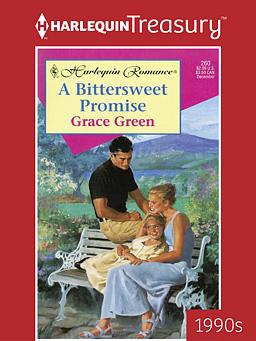

A Bittersweet Promise
Author
Grace Green
Reads
15.7K
Chapters
13
Once Bitten, Twice Shy! After her fiancé's betrayal, Jonquil made a promise — never to fall in love again! But when Slade Alexander starts taking more than a casual interest in her, she's intrigued. The man is an enigma. Wealth and success have made him tough, yet he treats his tiny ward, Natalie, with a tenderness that makes Jonquil long to be part of a real family. But then she discovers the real reason for Slade's interest in her….
CHAPTER ONE
‘WHAT the devil am I going to do with her?’
Slade Alexander’s words exploded into the quiet of his second-floor study as, dragging a frustrated hand through his black hair, he looked down from the window at the child in the garden below.
Natalie Gilbride—eight years old, blonde, delicately built...and smart as a whip...
But, on this sunny August afternoon, though she had been invited to attend a classmate’s birthday picnic atop Vancouver’s Grouse Mountain, she had chosen to stay home.
And now—alone, straight-backed and forbidding, impeccably clean in a crisp cotton dress and white socks, her flaxen hair in a perfect braid and her black patent shoes glistening—she sat on a bench at the bottom of the garden, by the pool, staring into space.
Slade muttered an impatient oath under his breath and, though the child couldn’t possibly have heard him, at that very moment she jerked her head round and looked up at the window. The instant their glances met, her kitten-gray eyes became shuttered, and her mouth set grimly. Then, without even the faintest hint of a smile, she tilted her chin and turned her head away again.
Slade squashed an involuntary flare of anger. Anger would solve nothing.
He exhaled wearily. Natalie Gilbride. His ward.
His problem.
But even as the word pulsed heavily in his brain he found his thoughts flitting back to the talk he’d had with his New York agent, Jeff Winters, eleven months before—the talk they’d had the day after the Gilbrides’ lawyer had read out their will following their funeral, and dropped the bombshell. Slade had phoned Jeff to warn him that, because of his new responsibility, his writing output might well be affected. Aghast, Jeff had taken the first available flight to Vancouver, hoping to make Slade see reason. According to Jeff, Natalie Gilbride was definitely not his problem.
‘These people had no right to designate you as their kid’s guardian!’ The agent’s normally clay-colored complexion had become an apoplectic pink. ‘Not without asking your permission. You’re under no legal obligation—’
‘Perhaps not a legal obligation...but how about a moral one?’ Slade had paced his office, his dark brows gathered, his hands rammed into the hip pockets of his worn blue jeans. ‘The child has no relatives... If I don’t take her, she’ll be put in a foster home.’
‘There are some good foster homes out—’
‘And there are some lousy ones too.’ Slade’s voice was suddenly harsh. ‘I know whereof I speak.’
For several minutes there was a taut silence in the room, and the scent of roses filtering through the open study window from the flowerbeds below seemed to Slade to have become suddenly, unbearably, cloying. With an irritable frown, he walked across to the window. ‘It would be expedient,’ he said over his shoulder in a self-mocking tone, ‘to take the child into my care for a few months, for the sake of appearances, and then quietly shunt her off to a foster home when everyone’s interest has died down.’
He slammed the window shut and, whirling round, strode back to the middle of the room, his eyes cold. ‘That is not—and never will be—an option. As I see it, I have only two choices, neither of which appeals. I can ignore the last wishes of James and Catriona Gilbride, put their child up for adoption and be tormented forever after with guilt—or I can do as the couple wanted and take over as her guardian.’
‘Goddammit, man, are you out of your mind?’ Jeff shoved back his chair roughly and got to his feet. ‘How on earth would you fit a seven-year-old kid into your life? When you’re home, you’re locked away in your study...and when you’re not writing you’re travelling all over hell’s half acre doing research for your next novel. Don’t you think, in fairness to this...what’s her name...Nicola—?’
‘Natalie.’
Jeff slashed the air dismissively, angrily, with one hand. ‘Whatever. Natalie, then. Don’t you think she’d be better off with some sort of family life? A girl that age needs a mother—or at the very least a woman to—’
‘I’ll hire a nanny. Fortunately I have an agent who always gets me top dollar—’ Slade’s green eyes held a cynical, mocking glitter ‘—so I can afford the best.’
Jeff glared at him accusingly. ‘You’d already made your mind up, hadn’t you, before you even called me yesterday? You and your goddamned ethics. You don’t owe the Gilbrides a thing—the guy only worked for you and I’m sure you paid him damned well...’ His words trailed away on an exasperated sigh. ‘I’m wasting my time, aren’t I?’
And, of course, he had been—and he’d been right about the other, too; Slade had already made up his mind before he’d called Jeff in New York. Deep down inside, he had known there was only one thing for him to do. He had to accept the responsibility that had been thrust upon him.
He hadn’t expected it would be easy...but he hadn’t expected that the child would react so intensely to her parents’ death. She had curled right into herself, and nobody...not even the top child psychologists to whom Slade had taken her...could make the slightest dent in her armor.
It was almost a year now since she had been orphaned, and instead of coming to terms with her loss Natalie was becoming more and more introverted. Her teacher at the school she now attended—Vancouver’s most exclusive private day school—was at her wits’ end; the child had a very high IQ, according to her report cards, completed her written work to the teacher’s satisfaction, but was reluctant to participate in class discussions or group activities. And, most worrying of all, refused to make friends.
Even Amelia, the energetic English nanny Slade had hired to look after her, had failed to ease her way into the child’s affections...
And had, just that morning, handed in her notice.
Slade shook his head wearily. Though he’d been at home for the past year, working on his latest novel, The Seventh Secret, it was finished now; he’d couriered it to Jeff the previous day. He planned to take a short break, planned to spend a couple of weeks with Natalie before she went back to school...but then he was going to have to get down to the research for his next novel, he had a contract to fulfil, deadlines to meet. How could he possibly expect to give his work the concentration it needed...and deserved...when he was so distracted with worry about the child?
Again, and in a tone of utter helplessness, he asked himself, What the devil am I going to do with her?
Face shadowed with concern, he turned from the window, and was half-way across the room to the door when his phone rang. He crossed to his desk and picked up the receiver, his mind still occupied with his problem as he growled, ‘Slade Alexander.’
‘Ah, Mr Alexander, I have some news for you—’
‘Who is this?’
‘Sorry.’ There was a rueful chuckle at the other end of the line. ‘Brad Jackson from the Jackson Detective Agency, phoning from my office downtown. Sorry to have been so long in getting back to you, sir, but—’
‘You say you have some news?’
‘Yes, in the James and Catriona Gilbride case. I had one helluva job getting a lead, and even when I did—well, have you any idea how many Gilbrides there are in the UK—?’
‘Get on with it, man!’
‘Sorry, sir.’ The invesigator cleared his throat and went on in a much more businesslike tone, ‘I did discover that James Gilbride was born and brought up in Strathloy, a small seaside resort in Scotland’s north-east...but I’m afraid I reached a dead end there. His parents died some years ago, and he had no siblings. No relatives at all.’
Slade pushed aside some books and slid his hip on to the edge of his desk. He hadn’t really held out much hope—James Gilbride had told him during his interview almost nine years ago that he and his wife were alone in the world, but still, Slade felt a sinking feeling of disappointment.
‘...a sister, living in the same little town—’
‘Back up!’ Slade was on his feet again, his eyes wide and alert. ‘Run that by me again, will you, Jackson?’
‘Catriona Gilbride—Catriona McLeod as she was then—was six when her mother died. She was brought up by her father, who had retired early due to ill health. They lived in Strathloy, as did the Gilbrides. The father—Tormod McLeod—had a weak heart and died a year or so before his daughter Catriona married James Gilbride and emigrated to Canada. But—and here’s the good news—there were two girls. Catriona had an older sister.’
Slade inhaled sharply. ‘And this sister...is she alive?’ Closing his eyes, he put up a silent prayer.
‘Alive and in good health. She’s a spinster, thirty-five years old—or will be, next week—and still living in the family home. Since her father’s death, she’s been running it as a B and B in the summer. In the off-season, she teaches sewing at night school, and takes in dressmaking.’
Silence hummed along the telephone wires as Slade, with rising excitement, assimilated the news. A sister. And one apparently without any ties. Without a husband who might refuse to take in a child not his own. A woman with no full-time outside job, no high-pressure career...
‘You’re sure of your facts?’ he demanded.
‘Absolutely. If you need a clincher, then you’ll find it in that letter you showed me. It mentioned a Jonquil, didn’t it? Well...Jonquil is the sister’s name.’
Slade’s heartbeats thudded heavily as he reached into one of the pigeonholes in his desk and withdrew the letter to which Jackson was referring...though it wasn’t actually a letter as such, just a torn fragment of mildewed paper.
He’d found the crumpled scrap months before, in the basement of the cottage where the Gilbrides had lived when James had worked for him; the cottage was situated here, in the grounds of Twinoaks, and he’d gone there to check out a report that the water pipes behind the wood stove needed replacing. Slade had noticed the paper under one of the pipes and picked it up idly. But as he’d scanned the few lines that were legible, and the signature, he’d realized it must be part of a letter Catriona had written at some time; she must have torn it up, perhaps had intended to burn it...but this small scrap had fluttered away unnoticed. He frowned now as he scanned the scrawled words again.
And I want you to know, Jonquil, how hurt I was when you returned my letter unopened. I know you must have been angry and jealous that James loved me and not you, but you didn’t need to be so cruel. I had always considered you my best friend. What a cold and bitter heart you have, so selfish you can’t bear to see other people happy...
It had never occurred to Slade that this ‘Jonquil’ might have been a sister—it was the ‘best friend’ reference, of course, which had thrown him—
He realized Brad Jackson was talking again, and with an effort he switched his attention to the wryly spoken words coming over the phone line. ‘I don’t know much about this Jonquil McLeod’s past—these small Scottish towns may be hotbeds of gossip, but the inhabitants sure know how to close ranks when it comes to giving away their secrets to strangers. I didn’t get to first base—’
‘The address.’ Slade was impatient now...and the past didn’t interest him. What interested him was the present. This woman in Scotland, this woman who would, if things went his way, be an answer to his problem. Would, in fact, relieve him of it completely. A mother for Natalie.
‘Angry...jealous...cold... bitter...cruel...selfish’.
The damning, accusatory words sprang out from the letter, demanding that he give them his attention. Not now, he thought irritably, not now; he would think about that later. With a brusque movement, he crammed the paper into the pigeonhole again. ‘The address,’ he repeated grimly, ‘where this woman lives. You have it?’
‘The town is called Strathloy. The street where she lives is called Strathloy Road. It runs along the edge of the local golf course, and overlooks the ocean...or rather, the firth. The Moray Firth. And the name of the house—’
‘Yes?’
‘The name of the house is Mhorven.’
* * *
‘Jonquil!’
Jonquil McLeod turned as she heard her name called out, and saw her next-door neighbor hurrying across from her back door to the low privet hedge that separated the two properties. Stifling a sigh, she dropped her grocery bags on the doorstep and, stretching her aching arms, walked toward the elderly woman. She was longing to go inside and make herself a cup of tea, but Molly Pringle—though a bit tiresome and gossipy at times—was a good soul, and she didn’t want to cut her off. ‘How are you?’
‘I’m just fine, lass.’ The gray-haired woman held out a small package. ‘This is for you—for your birthday.’
‘Oh, Molly, you shouldn’t have!’ But with a smile Jonquil accepted the present. ‘Thanks so much.’
‘It’s just some homemade tablet, but I thought...well, it’s not every day you turn thirty-five. It’s kind of a milestone, isn’t it?’
Jonquil ignored the reference to her age; thirty-five, sixty-five, it made no difference to her. Each day that passed was exactly like the one before, and had been so for longer than she cared to remember. ‘I’ll enjoy this...I don’t often treat myself to sweet things—’
‘You don’t often treat yourself to anything!’ Molly Pringle’s round, homely features were suddenly tight with disapproval. ‘You spent all those years looking after your invalid father, God rest his dear soul, and bringing up that sister of yours—thankless little viper she turned out to be!—and never anybody to look after you. What you need, my lass, is a man—’
She broke off, biting her lip in vexation as she saw Jonquil’s cheeks turn pale as a sheet, saw the soft, love-in-a-mist blue of her eyes suddenly become hard.
‘I had a man, Molly.’ Her voice had lost its gentle, pleasant lilt, had become as hard as her eyes. ‘Or don’t you remember?’
‘Och, I’m sorry, Jonquil!’ The other woman’s features crumpled. ‘It’s just that you used to be such a happy lassie, a sparkle always in your blue eyes, your hair the color of ripe wheat and flying out behind you when you rushed by on your bike, and aye a kind word for everybody—’ there was a catch in her voice ‘—but ever since—’ She shook her head as if she wished she hadn’t said the words, and then went on, ‘Now...I hate to see you with your hair screwed back and your eyes so sad—’
Brusquely, Jonquil broke in, ‘I really do have to go and unpack my groceries.’ Then, in a gentler tone, she added, ‘Thanks for the tablet. I appreciate it.’ With an effort, she managed to force some humor into her tone as she went on, ‘The sugar will give me energy to run around after the last of my B and Bs before the season’s end!’
‘Oh! Talking about B and Bs—I almost forgot! There was a man here earlier. He sat for ages across the road, in a car, just looking at your house, looking at Mhorven. In the end he got out and went to the front door—I saw him ring the bell. Then he hung around for about ten more minutes, and I was just about to ask him if he was looking for somewhere to stay the night...but by the time I’d made up my mind he’d gone.’
‘A stranger?’
‘Aye. A stranger. Looked like an American. And his car—it was a posh black one, from one of those rental agencies—a Mercedes, I believe. There was a wee lassie with him...but she was asleep in the back of the car.’
Jonquil hid a smile. Not much got by Molly Pringle.
She thanked the older woman again, before turning away toward the house. Scooter was waiting now on the doorstep, sniffing around the cod her mistress had bought for her.
‘Did you see someone, Scooter?’ she murmured as she drew a hand over the cat’s smooth black fur. ‘Did I miss a customer?’ But the only reply she received was a thickly purred welcome, and the winding of a sinuous body around her nylon-clad right ankle.
Too bad she’d missed the visitor, Jonquil reflected five minutes later as she poured boiling water from the kettle into her small teapot. She had found that tourists looking for B and Bs didn’t, as a rule, retrace their routes; if they found no one at home, they moved on. And, though the stranger might have been just a one-nighter, she’d have welcomed his business. July and August had been so wet and blustery, tourists had stayed away in droves; now that warm weather had finally arrived, the season was almost over. Summer had come too late.
The kitchen at Mhorven was a long narrow room, running from north to south and jutting out from the western gable-end of the house. The outside door led to the back garden, and the main window at the front faced north, overlooking the road, the golf course, and the ocean. Now, as Jonquil reached up into the cupboard above the sink for a mug, a movement in the road caught her attention, and, leaning forward, she flicked the edge of the lace curtain aside.
It was a beautiful afternoon. The sky was a clear delphinium-blue, the fairways were a deep lush green, and beyond the caravans fringing the sandy white beach the rippling waters of the Moray Firth sparkled joyfully.
And the car was back.
At least, it looked like the one Molly had described. It was a black Mercedes.
But this time, instead of parking across the road, at the edge of the golf course, the driver was swinging it across the pavement and up the driveway to Mhorven. The child was no longer asleep in the back. She was sitting in the front passenger seat, stiff and straight as a china doll. If she was on holiday, Jonquil mused absently, she certainly didn’t appear to be enjoying herself.
The man shut off the engine and got out the car.
He was tall, with hair as black and glossy as the paintwork on the Mercedes, and the kind of lean, tanned face that graced the covers of the movie magazines displayed at the Strathloy Foodmart check-out. Molly was right: the man did look as if he came from the other side of the Atlantic, but what Molly hadn’t mentioned was the athletic muscularity of his build, or the purposeful way he walked, or the arrogant grace with which he wore his petrol-blue bomber jacket and taupe trousers...trousers which were narrow-fitting and revealed long, powerful legs.
Legs which were now carrying him up her driveway.
Strangely mesmerized, Jonquil watched as the man strode on to the lawn and cut across the grass to the front door.
It was only when he disappeared from view, and she heard the sound of the door bell chiming, that she was jarred out of her momentary trance. Quickly, she dropped the edge of the curtain and turning away from the window, moved across the kitchen and out into the hall, and, without even taking a second to glance at her reflection in the hallstand mirror, she opened the front door.
The stranger was standing on the stoop, his head raised as he looked up at the name of the house, scrolled in gold lettering on the narrow window above the door. The sun glinted on his hair, and now that he was closer Jonquil could see silver threads at his temples; she could also see lines fanning around his eyes and deeper ones bracketing his mouth. She had at first sight put his age at about thirty, because of the muscular energy in his step; now she added about ten years to that earlier estimate.
He drew his gaze down abruptly, and fixed it on her, and as she looked straight into his sunbronzed face for the very first time she felt her breath catch in her throat.
The man’s features, taken individually, were harsh—he had an arrogant nose, angular cheekbones, and rather thin, chiseled lips—yet the overall impression was not one of ugliness but of hard, male beauty. And his eyes...
Never had she seen such incredible eyes. The irises were a fascinating color; it was as if they had started out as sharp emerald-green but had been scattered over with haphazard flakes of warm gold. The effect—the contrast between the clear cold green and the warmer overtones—was disconcerting. But even more disconcerting was the intense directness of his gaze, a gaze so piercing that the bizarre thought crossed her mind that the man was not just looking at her but searching for a window into her soul so that he could uncover the very essence of her being. A bizarre thought indeed...but, bizarre or not, there was no mistaking the shiver of unease that flickered through her as she waited for him to speak.
‘Mhorven.’ The stranger raised strongly marked dark brows in question. ‘How did the house get its name?’
He had a wonderful voice: deep, rich, and sensual, with a decidedly North American drawl. Jonquil felt something stir deep inside her, something that had long been dead. Savagely, she buried it again.
Straightening her shoulders under her yellow blouse, she moved out on to the step beside him and, with one hand shading her eyes from the slanting rays of the sun, gestured with the other to the undulating coast across the firth.
‘That mountain...the one with the scarf of white cloud around its peak...is called Mhorven.’
She had slipped on an old apron before putting her groceries away; now the tangy ocean breeze flapped the thin blue cotton, making a clapping sound. Automatically, she looked down, and smoothed the fabric with her fingertips. When she glanced up again, it was to find the stranger’s flecked eyes fixed steadily on her again—and again she felt that shiver of unease—fixed on her as if he was evaluating her. But even as she stood there, thrown off-balance, he flicked his hand in the air to swat away some small insect, and as he did she was made aware of the faint musky scent of his body. As abruptly as if he’d touched her, she drew back into the doorway and wrapped her arms around herself. The man, she realized giddily, exuded a sexual vitality that positively made the air quiver!
She cleared her throat. ‘You’re looking for a B and B?’
‘Right. Do you have a couple of rooms vacant?’
The breeze that had played with her apron now lifted his hair, and tossed a heavy strand over his brow. Jonquil found her eyes drawn inexorably to it. She’d never before seen hair of such a dramatic blue-black. How would it look, she wondered, against a crisp white pillow—?
Appalled by the direction of her thoughts, she said, rather more sharply than she’d meant to, ‘For one night?’
He glanced round at the car, his eyes darkening as he did so. The child, she noticed, had been watching them, but as soon as she became aware of their attention she jerked her head so that her profile was turned to them. Well, wasn’t she in a little mood, thought Jonquil—and wanting someone to coax her out of it? It wasn’t the first time she’d seen a child acting in that way—when Catriona was little, hadn’t she been exactly like—?
Jonquil felt the chill fingers of the past close around her heart. For years now, she had managed to banish her sister from her thoughts, yet...there was something in this child, in her attitude, that had given her a feeling of...of déjà vu. That was the only way she could describe it...
‘...probably stay for ten days.’
‘You...want two rooms, for ten days?’ she asked, her hand going nervously to her blonde chignon, her slender fingers curving around the coiled hair as if its neatness offered her reassurance. ‘Yes, that’ll be fine.’ She stated her terms, adding, ‘I serve dinner, for anyone who wants it, as long as guests give me notice in the morning. I can give you a meal tonight, though, if you like.’
‘Thanks...I’d prefer to eat here rather than take Natalie out to a restaurant—she’s had a rough trip. If you’re sure it’s not too much bother?’
‘No bother at all. By the way, I’m Miss McLeod.’
‘Slade Alexander.’
His handclasp was firm and cool, impersonal and brief. As she drew her fingers away, the wind teased his hair again, and this time he raised his hand—a lean, tanned hand with bluntly trimmed nails—and swept it back, before saying, with a smile that crinkled the outer edges of his black-lashed green eyes, ‘We Canadians are a pretty casual race. How about calling me Slade? And your name is...?’
‘Jonquil.’
She had expected to see a slight widening of his gaze— Jonquil was an unusual name, and most people, on first hearing it, commented on it...or at least revealed by some involuntary change in their expression that it had taken them by surprise. Strangely, Slade Alexander just repeated it, as if it was a name he was quite used to. ‘Jonquil,’ he said, stretching out the first syllable so that it had a foreign sound.
She felt as if he had run a caressing finger down her spine. Her throat muscles seemed tight as she said, ‘Would you like to come in and get settled?’
‘Sure. I’ll get Natalie...and our bags. Just be a sec.’ He turned to go, and then hesitated for a moment before turning back again. ‘Natalie is...going through a...difficult spell just now. Her therapist has suggested that for the moment no fuss should be made over her.’
Her therapist. Why on earth would a child so young have need of a therapist? ‘Don’t worry, Mr Alexander—’
‘Slade?’
Jonquil felt a surge of impatience. Perhaps Canadians were used to getting on a first-name basis with strangers right away; she herself preferred to be more formal. Slade Alexander was, however, not only a visitor in her country, and so deserving of courtesy, but was also going to be a guest in her home...albeit a paying one. ‘Slade.’ It sounded different when she said it. ‘Don’t worry. Though I have no children of my own, I’m well aware that when they go into these little moods they’re best left alone.’
He seemed to take offence at her rather curt tone, and there was an edge of irritation to his voice when he answered, ‘It’s rather more than a little mood—’ He shook his head and muttered under his breath, ‘Sorry, I didn’t mean to snap. I apologize.’
As he spoke, she noticed the twitch of a nerve in his cheek, and realized with a feeling of surprise, that he was not as relaxed as he had at first appeared. ‘No apologies necessary.’ She purposely used her best soothing-ruffled-feathers tone. ‘Now why don’t you get your bags and leave them in the front hall, and then bring...Natalie...through to the kitchen? That door to the right. I can have dinner ready for you around six, but I’ve just made a pot of tea; would you like some...or perhaps you’d rather have coffee?’
‘Tea would hit the spot, thanks. And for Natalie—milk and cookies?’
Jonquil was just about to say she didn’t have any cookies, when she remembered that North Americans meant biscuits when they referred to cookies, and she had just baked a batch of ginger snaps that very morning.
Back in the kitchen, as she reached up into the cupboard by the window for the biscuit tin, she saw that Slade had unloaded two bags from his boot, and was now opening the front passenger door. She paused, hugging the biscuit tin against her chest, as the little girl stepped out on to the gravel driveway.
She was a lovely child—that was another thing Molly hadn’t mentioned—with fragile features, eyes the same smoky gray as Scooter’s, and fine flaxen hair gathered in a neat ponytail. She didn’t cut across the grass, but went the long way round to the paved path that ran under the kitchen window. Most children romped over the grass when they came to Mhorven; most children stooped to play with the red-pixied gnome at the bottom of the steps; most children cried out gleefully as they saw the ocean so close by...
But this child wasn’t like most children. She walked sedately, her face set in unsmiling lines.
By the time her visitors came through to the kitchen, Jonquil had arranged an assortment of her homemade biscuits on a plate with a gold rim, and was placing it on the table. She turned toward the door as she heard Slade say, ‘Jonquil, I’d like you to meet Natalie. Natalie, this is our landlady, Jonquil McLeod.’
Natalie’s hand came out automatically, but when Jonquil clasped it, saying, ‘I’m pleased to meet you, Natalie,’ she was startled to find the delicate fingers as cold as ice.
The child’s eyes were raised to hers, but they settled on a spot on the wall somewhere behind her. ‘Hi,’ Natalie said, her voice totally devoid of emotion, her fingers sliding swiftly from Jonquil’s warm clasp.
Jonquil cleared her throat and, in an attempt to conceal the awkwardness she was feeling, said in a voice that was rather too loud, rather too cheerful, ‘Why don’t you both sit down and I’ll pour the tea?’
Obediently, the child crossed to the table, pulled out the nearest chair, and sat down.
Jonquil took a jug of milk from the fridge, and set it on the table, along with a glass and a bone-china mug. After pouring milk into the glass, she put it in front of the child. She thought she heard a terse, ‘Thanks.’
Wishing she’d turned Slade Alexander away when he’d come to her door, she poured his tea. ‘Do you take sugar?’
‘No, just milk,’ he said, but instead of sitting down he wandered around the kitchen, coming to a halt by the dresser, where he appeared to be interested in the one photo set on the lace runner—a framed picture of her father, her mother and her, taken when she was about Natalie’s age.
‘Your parents?’ he asked, glancing round.
‘Mm.’
‘And you?’
‘That’s right.’
‘You were...an only child?’
There was a strange stillness in the air. She could hear Natalie’s teeth crunching into a crisp ginger snap, she could hear someone chopping wood next door in Molly’s back garden...but yet, around herself and this stranger, there seemed to have gathered a blanket of stillness. He seemed to be waiting for something...but waiting for what?
‘At the time that picture was taken,’ she said, ‘yes.’ Then, gesturing toward the table, she went on in a detached voice that she hoped would convey to him that she didn’t want to chat, ‘Now do have your tea before it gets cold.’
He held the photo a moment longer, before putting it back, and then crossed to the table. But instead of sitting down he looked at the single mug steaming on the scrubbed wooden tabletop, and said, ‘You won’t join us?’
‘No—I’m going to check your rooms.’ Strange, five minutes ago she’d been dying for a cup of tea; now all she could think of was getting out of the kitchen, away from this stranger with the prying eyes. ‘When you’re finished,’ she said, ‘I’ll show you where to put your bags.’
‘Thanks. And then I plan on taking Natalie for a walk by the ocean. The beaches here are beautiful...I had no idea they stretched so far, or that the sand was so white.’
‘Mm, they are beautiful...I should warn you, though, not to wander out on to the sandbar a couple of miles east of town. At high tide, it gets cut off, and you run the risk of becoming stranded there till the tide goes out again.’
‘Has that happened to people in the past?’
‘Mm. A group of tourists drowned there, tragically, some years ago. The tide came in and apparently they tried to wade back to shore, but a mist had risen and they lost their bearings.’ Jonquil shivered; she hated even to think of the incident, but always felt it incumbent on her to warn her guests of the dangers that lay in wait for the unwary.
‘Today is clear, though,’ she went on in a deilberately lighter tone, ‘and with your jet lag you won’t want to walk that far anyway. But be sure to wear a jacket, Natalie. There’s always a cool breeze off the sea.’
A few moments later, as she climbed the stairs to the second floor, her own words echoed in her head. ‘Be sure to wear a jacket.’ How often had she said that to Catriona when she was a child? Be sure to wear a jacket. Be sure to come straight home. Be sure to look both ways before you cross the street...
And after all those years of caring for her little sister, of worrying about her, of loving her, in the most devastating way possible Catriona had betrayed her, and with a cruelty and selfishness that had broken her heart.
Abruptly, as she opened the door to the airing cupboard and withdrew a pile of fluffy blue towels, Jonquil shoved all thoughts of her sister away, back into the past where they belonged. The lesson Catriona—and James—had taught her had been a brutal one, but a simple one...and one she had learned well. Because of the pain they had inflicted on her by their deceitful behavior, she had promised herself she would never love, or trust, again.
It was a bitter promise...but one she intended to keep.