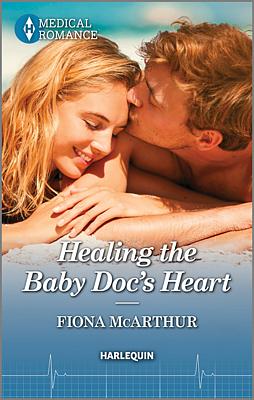

Healing the Baby Doc's Heart
Author
Fiona McArthur
Reads
18.8K
Chapters
33
The last thing this neonatal nurse needs is to develop feelings for her devastatingly handsome new colleague! But can she resist the pediatrician? Find out in the latest Medical Romance from Fiona McArthur! BENEATH THE PEDIATRICIAN'S BROODING FACADE… Neonatal nurse Isabella has dropped everything to rush back to Australia to be with her dying grandmother and pregnant sister. But her new role on the NICU quickly leads her to cross swords with guarded, handsome neonatal doc Simon! He's the exact type she's learned to avoid — a commitment-phobic workaholic. Until Isabella sees behind this widower's walls to a heart that needs healing… Could they be each other's chance for a happy future?
PROLOGUE
ISABELLA HARGRAVES PULLED aside the curtains and looked down to the waking Hanoi street, seven floors below.
Warm air swirled around her fingers as she cracked open the window, yet the sky still radiated a pink glow from dawn. Her favourite time. Another hot day was coming.
An elderly vendor peddled below on a push-bike laden with multi-sized straw hats. These conical woven workers’ hats could be seen in fields, sampans, on cyclists, and on the heads of tourists. On this pushbike, the towers of plaited straw rose behind the rider and out sideways, so he was encased in a cage of hats. He’d be on his way to sell them in the old quarter of the city.
One of Isabella’s highlights for people-watching in Vietnam was noting the piles of drums, ladders, picture frames—in fact anything—on the back and front of push-bikes. Once she’d even seen a cow on a trailer pulled along by a motorcycle.
Nine million people and three million motorcycles. Such a crazy, wonderful place to live and work.
Of course, if you wanted to cross the road only a percentage of traffic would stop, and you needed to take your life in your hands. The trick, she’d found, was to walk slowly—no dashing—hand out, eyes open, and voila, the traffic avoided you. That was the local theory, anyway, and when she followed that it seemed to work.
From her window she could just see the pink sky lighting Hoen Kiem, the Lake of the Returned Sword, where an emperor had been said to use a magical sword to defeat the Ming Dynasty from China. The legends here fascinated her.
In this story, after victory, the Golden Turtle god had returned the sword to the bottom of the lake, and today the Turtle Tower stood on its own tiny island, on guard, as if to keep an eye out for the endangered turtles that were swimming in the lake.
Isabella pulled on her runners so she could circle the expanse of still water in the early morning before she went to the maternity wing of the Old City Hospital.
Circumnavigating the lake on the winding paths at daybreak had become Isabella’s favourite start to the day. The streets were quiet, and the pleasure of watching groups of women on the grassed foreshore, line-dancing to boom boxes, bickering over which song to play and the exuberance once decided, seemed to bring some of their infectious joy her way.
She and her partner Conlon had another month of secondment here. She’d loved every second so far. Loved sharing it with Conlon. She’d even begun to hope she’d found a partner in life after she’d been alone for so long. Conlon had suggested she should become a full-time academic instead of fitting her research in blocks between her nursing work as an intensivist.
Her mood dipped. Yesterday’s emergency in the neonatal intensive care unit—or NICU—had required all her skills to assist in saving the firstborn son of a woman she’d befriended, and though she’d been present in the unit only for research, it had been her skills from the other part of her life that had helped to save the baby.
Isabella, an expert in the field, had been invited to participate in a study of neonatal outcomes for premature babies. Conlon, an ambitious lecturer at Sydney University, had been so eager to co-author the paper she was writing that he’d asked to join her. Their relationship had become more than collegial, and he now shared the flat she’d rented.
She was still getting used to the fact that Conlon had said he was there for her. It seemed hard to believe when she’d been let down so often by her father’s work priorities while she was growing up. It had felt as if every single time she’d needed him that her father had been elsewhere, working.
Her phone rang and she glanced down to see the caller ID. Speak of the devil. Her brows furrowed. Dad? Six a.m. here... It would be nine in the morning in Australia.
Suddenly she felt as if she were a motherless seven-year-old seeking an elusive hug, not a woman of twenty-seven.
She could count on the fingers of one hand how many times her father had rung her in the last year. Messages were usually sent via his very busy secretary at the Sydney Central Neurology Department.
A feeling of foreboding crept up her neck and circled her throat—because the last time he’d phoned had been to tell her about her brother-in-law’s car accident, six months ago.
‘Dad?’
‘Isabella. I have bad news.’
No sugar coating. No, How are you? No, I’m sorry to say this. Not from Dad.
She felt her stomach roil with sick fear.
Was her widowed sister sick? Was it Nadia’s pregnancy? The baby?
‘It’s your grandmother.’
Gran! The woman who had made up for the loss of her mother so long ago. The loss of her father, too, really. Because he’d morphed into a machine after Mum had died, and had only become more mechanical in his affections.
No. It couldn’t be. Not Gran.
‘An accident. Hit and run in Coolangatta. She’s unconscious,’ he went on. ‘I don’t believe she’ll wake.’
Isabella closed her eyes as horror and the wash of devastation began to saturate her insides along with cold fear.
‘Isabella? Hello? Are you there?’
She jumped at the tone in her father’s voice. ‘Yes, sorry. I’m just trying to take it in. I’ll come home, of course.’
‘What?’ she heard him snap. ‘Why? There’s nothing you can do.’ His tone disbelieving. Sharp. Emphatic. ‘No need. No. You must finish your work.’ She heard the cold and clinical man for whom the god Work meant everything.
Her grandmother lay dying. Unconscious in hospital. Isabella wasn’t leaving her alone.
‘Of course there’s something I can do. I can be with her. And with Nadia.’
Her father hmphed with exasperation. ‘Your grandmother’s not going to know you’re with her.’
There it was. The impatience she’d grown up with. The inhuman being who was her father. He was probably already thinking about his next task.
‘She’s comatose. It’s very sad. However, as I’ve said, it’s unlikely she’s going to regain consciousness.’
‘I’m coming home.’
Or at least not home. Not to the cold, empty mausoleum her father lived in.
‘I’ll go to the Gold Coast. Be with Nadia. Stay at Gran’s flat.’
I will talk to my grandmother even if she’s unconscious.
It might help. Her grandmother might hear her at any point. Isabella would be there when she woke up.
Oh, Gran.
He huffed. ‘You do what you need to do—though I can’t imagine Conlon will be happy if you leave.’
She tilted her head at that. ‘Conlon will come with me. Be with me. He’ll support me.’
‘Really? You both went there to do a job. Conlon knows your work is important and it’s not finished. You should both stay.’
‘We’ll go back to Australia early. Come back to Vietnam later.’
Of course he’ll come with me...support me.
God, she wanted him now, his arms around her, but he was already out jogging around the lake.
‘I don’t think you should. Nadia’s there. She’ll keep you up to date.’
She could almost imagine her father looking at his watch. Thinking he’d wasted enough time on this call.
‘Thank you for ringing.’
And not getting your secretary to do it.
Isabella’s fingers felt numb. Her lips clumsy as she said goodbye.
Gran...
A flash of sympathy for her father pierced her before he could hang up. ‘Dad. Are you okay? Gran’s your mother...’
‘I’m sorry it’s happened, of course.’ He was silent for a moment. As if he was actually going to say he was upset. But no. ‘There’s nothing we can do. Your grandmother is eighty. She’s had a good life.’
And then he was gone.
At first Isabella walked around the room in circles, picking things up and putting them down, trying to work out what to do. Trying to grasp the enormity of Gran lying in a hospital thousands of miles away. Alone. Possibly dying.
She thought about how much life, and love and laughter her grandmother had left inside her. Gran had to wake up. She couldn’t bear the thought that her grandmother wouldn’t be there. Wouldn’t see Nadia’s baby born.
The Sydney flights didn’t leave until six p.m. from Hanoi to Singapore. And then a few hours later from Singapore to Sydney. They’d have to catch a domestic flight from Sydney to Brisbane and hire a car to drive to the Gold Coast. She’d arrange for her own car to be shipped up.
She thought of her sister. Alone in this. Poor Nadia... Six months pregnant and now she’d be losing two people she loved. Nadia needed her, too. No. Gran wouldn’t die. She’d phone her as soon as she spoke to Conlon.
The door opened and Conlon breezed in from his run, bringing the heat from the pavements outside. His jet-black hair lay plastered to the sweat across his brows, which creased when he saw her face.
His long legs crossed the room to her quickly.
‘What’s wrong?’
She wasn’t alone. Too many times in her childhood she and her sister had been alone...until Gran had stepped in. Thank goodness Conlon was here.
‘My grandmother. She’s in a coma. Hit and run in Coolangatta. We’ll have to go back to Australia.’ She reached forward and took his hand. ‘We have to go home.’
He stared. ‘I’m sorry... Run that by me again?’
How could he not have understood her?
She tamped down her impatience. ‘My grandmother has been involved in an accident. I have to go home. I’ll tell them we have to postpone our study. Put a hold on the paper.’
‘Of course you have to go. But what do you mean, we have to postpone? We need to finish the project.’
He shook his head.
‘I’m going home.’
‘I know. I heard that. Your grandmother. You’re fond of her.’
Fond? The word sat oddly.
‘I’m terrified my grandmother is going to die,’ she said slowly. Familiar dread was coiling inside her chest. ‘I need you right now. You’ll support me...?’
She hadn’t meant to make it a question but it was too late now. She trailed off, looked at his face. Saw the truth. The distance that had grown between them in just minutes. That’s all it took. Saw the selfishness she’d tried to ignore in all those little daily moments. Saw her father.
Conlon was looking past her, his gaze shifting away. He gave a more emphatic shake of his head this time.
‘I’m not going to be any help. I’ll stay and finish the project.’
This wasn’t happening.
‘They’ll understand...we can come back. You don’t need—’
He cut her off. ‘No, it will only take a month for me to finish it. You go. Do what you have to do. Then come back if you can make it in time. If you can’t, I’ll tie it all up.’ His chin went up. ‘I’ll still add your name on the paper.’
She shifted again at that. It had been her paper and she’d invited him to join her. He’d asked her to let him join. Now he was going to ‘add her name’ on it when she’d done eighty percent of the work?
She shook her head. Stung. Disgusted, actually. She narrowed her eyes as he avoided hers. But that was just work. Stuff to think on later. Later—when Gran was well. This was not important now.
Isabella shook her head. ‘You’re not listening to me. I want you to come and be with me. Support me. What if she dies?’
She knew she sounded forlorn and lost, and she hated it.
His face was screwed up, incredulous. ‘You’ve flown alone more than I have. You’ll be fine.’ He waved a hand and glanced at his watch as it moved past his face. ‘I’d better get moving.’
Isabella felt sick. And stupid. ‘I don’t want protection. I want support. There’s a difference.’
‘I would. If this was finished. But this work is too important, Isabella.’
She winced. Hurt. ‘And I’m not?’
He’d already turned towards the bedroom. ‘Don’t be petty. Of course you’re important. But I think you’re not thinking right. Not thinking of our work. You’re prioritising all wrong.’
Had he really just said that? Red-hot anger flooded through her. She could almost imagine her blood boiling like lava. Her father’s favourite word all through her childhood. At school events and award nights. He was unable to come because he was ‘prioritising’.
Conlon turned back briefly, oblivious to the fact that he wasn’t in the right. ‘Ridiculous for me to come with you. We’re so close to finishing. This will be a breakthrough paper. Give us excellent credibility behind us.’
Through gritted teeth she whispered, ‘My grandmother is dying.’
Oh, God. She saw it then. Why? Why was she attracted to these men who put work in front of everything? Like her father. She’d thought Conlon was safe. He was an academic, so at least he had no urgent calls taking him back to the hospital night after night. She’d thought—foolish her—that during every event or crisis, he would be there. For her. Would want to be.
If it hadn’t been for Gran, she and Nadia wouldn’t even have had a childhood. They would have spent their holidays locked in the house with part-time servants instead of going to visit Gran and flying up to her at the weekends when they were older.
And she’d thought she could make a life with Conlon. Thought they wanted the same things. Thought they’d be a caring family.
Idiot.
She’d have spent her life waiting for scraps of attention that didn’t involve work. Just like in her childhood.
But she couldn’t think about that now.
She said dully, ‘You go and shower. When you come home I’ll be gone.’
‘Of course. That’s fine. I’ll give you a ring.’
Wow. So generous. Thoughtful.
Very quietly and clearly she said, ‘No, don’t bother.’
Conlon’s dark brows drew together. He was irritated. His turn to be impatient. ‘You’re being foolish. We’re good together. Our work is amazing.’
‘My work is amazing.’
Because she was the one who found it easy. Made the connections and garnered the interviews that clarified the answers. She had a way with equations, and probabilities, always finding the right questions and writing everything down in the right words.
Conlon had let her down.
Hell, he couldn’t even take the time to give her a hug of sympathy. What had she been thinking to attach herself to a man who was so like her father she’d have been starved for affection for the rest of her life?
Her heart wasn’t broken—bruised, maybe—but her pride had taken a blow that had left her reeling.
She’d loved her time in Vietnam, had been honoured by the openness of the midwives and neonatal nurses she’d interviewed for her thesis. She’d ached over their stories, and enjoyed learning about a culture that was so different from her own. But she’d been here with Conlon and had thought something had been growing between them.
He’d been so enthusiastic about her scientific paper, and his handsome face had promised her a wonderful future at home and at work. She’d not seen what was now so obvious—that the man was selfish and egotistical.
Wow. Remembered his comment about the paper. Seemed he thought it was generous that he’d let her share credit for her own thesis.
She’d almost loved him—or the man she’d thought he was—but now, as he turned to shower and change for the hospital, she felt as hollow and cast off as she’d felt as a child, when her father had immersed himself in his high-powered job.
She’d thought she’d got over that. Her gran would have scolded her for being dramatic. Would’ve said Conlon had done her a favour, exposing his shortfalls before she’d done something worse—like marrying him.
But after that Gran would have lovingly offered her a shoulder to cry on. Conlon hadn’t.
It would take her twenty-four hours, but Isabella would be by her grandmother’s bedside until she woke up. And Gran would wake up. She had to.
Alone, seven floors above the Hanoi street, Isabella said quietly, ‘I’m coming, Gran...’ To her sister whom she’d ring shortly, she promised silently, Nadia, I’ve got your back.
She’d find a job at the nearest hospital, visit Gran, be there for Nadia in the last months of her pregnancy. She’d get back to doing what she needed to do. Caring for those who loved and wanted her. Working with babies. She would leave behind Vietnam...this foray into academia... Conlon. Leave behind any silly little girl fantasies that men could be relied on.
She’d learnt that lesson. Oh, yes.