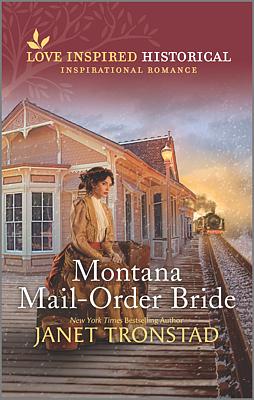

Montana Mail-Order Bride
Автор
Janet Tronstad
Прочтений
19,1K
Глав
12
Can a marriage in name only give her the new life she needs? There's no future in Chicago for Eleanor Fitzpatrick and her sister — but out West, she can have a fresh start as a sheriff's mail-order match. She'll be a good mother to Matt Baynes's orphaned niece and nephew…but will she be a good wife? She's never known an honorable man, and trusting Matt is a daily struggle. Yet as the children bond — and begin matchmaking — her resolve is tested. Can this kind, brave man teach her to trust her heart and his love?
Chapter One
The Union Pacific train rumbled softly as it sped along the tracks in the darkness, but the noise wasn’t what was keeping Eleanor Fitzpatrick awake. Every time she snuggled down into her cloak and closed her eyes, she was filled with a sense of foreboding. This impulsive journey—taking herself and her younger sister from their wretched tenement building west of the Chicago River to some remote town in the hills of the Montana Territory—could be the single biggest mistake of her twenty-two years. After all, what kind of a man advertised for a bride he didn’t know, even if he was in dire circumstances? Worse yet, what kind of a woman answered his ad?
“A desperate woman—that’s who,” she muttered softly to herself as she glanced down at the top of the curly blond head sleeping against her shoulder and smiled. Her seven-year-old sister, Lily, was the only family she had left and she would do anything to keep the girl safe.
For the second time that night, Eleanor pulled out the wrinkled newspaper ad from her pocket. The porter’s lantern, hanging from a hook at the front of the passenger car, barely gave off enough light for her to see the words, but she read them again anyway.
BRIDE WANTED: Dying sheriff, leaving two young children behind, seeks mail-order bride to be their mother. Applicant must promise to raise the children when he’s gone. Will have a small bakery to operate for income. Marriage in name only. Must be honest and a good Christian woman. Reply immediately to Sheriff Matt P. Baynes in Dillon, Montana Territory. Train ticket will be provided.
She had too much pride to answer a mail-order bride ad like that, but her friend, Mrs. Gunni, had done so in Eleanor’s name and without her knowledge. It all became clear this past Monday.
As usual, Eleanor had been out looking for work in the huge, noisy factories near where she lived in the heart of Chicago. Everyone knew that those kinds of places always had openings, especially for people like her who were willing to take the most menial and low paying of jobs. But no one would even talk to her. In fact, the hiring foreman hurried past her as though she had the plague, calling out everyone for an interview except her. She didn’t know what was wrong.
Finally, cold and defeated, Eleanor headed home and was wearily climbing the very long stairway to the tiny attic room she shared with Lily when—suddenly—she glanced up and saw the huge dour man who delivered their coal, Otis Finch, rushing down the steps, his black coat flapping as he shoved her aside so he could pass. He had something dark gripped in one hand, but he was at the bottom of the stairs before she realized it was Lily’s custom-made shoe.
Alarmed at that, Eleanor bolted up the few remaining stairs, threw open the door and found her trembling sister sitting on the only piece of furniture in the room, a cot with an unbleached wool blanket spread neatly over the thin mattress.
“I don’t want to be brave anymore,” the girl whispered, tears pooling in her eyes. She was wearing her favorite blue dress, and her long skirt was spread out, as it always was, to hide the deformity in her right foot. “I want to go home to Grandmother’s house. Please.”
Eleanor knelt down and embraced her sister. She, too, often longed for the safety of the home they’d shared with their grandmother until her death three months ago. “You know the bank owns that place now.”
“And Grandmother is in Heaven,” Lily said, finishing the thought with a sigh.
Eleanor didn’t answer. Instead, she tentatively leaned back to see Lily’s face better. “Did the coal man put his hands on you?”
Lily wrinkled up her nose before shaking her head slowly. “But he growled at me like this.” She made a ferocious face and then demonstrated the sound deep in her throat. “And he said he would be back and fix me for good.” She shuddered and continued in a flood of words. “I didn’t like that. He didn’t say when. What does he mean? He’s not a nice man.”
“He scared you,” Eleanor said softly and Lily nodded. There was no reason for Otis to take her sister’s shoe. He had no possible use for it. Eleanor did not understand his power in the neighborhood, but he was a bully. She had heard he could be bribed to do certain things, but he certainly could hope for no money from her. He must know she was penniless.
They were silent for some time, just sitting together wrapped in their hug.
“Let’s go outside,” Eleanor finally suggested. “That always makes you feel better.”
Lily nodded and Eleanor twisted around so that Lily could climb onto her back. It was the only way Eleanor could carry her sister, and she wrapped her cloak around them both before standing upright.
Despite the smoke in the air from the factory chimneys, they each took deep breaths when Eleanor finished the flight of stairs down ten levels to the building’s worn entryway. Then she stepped outside with Lily still on her back. The nearby structures blocked most of the view of the sky, but what could be seen was the usual heavy gray. Everything felt damp and cold. The soles on Eleanor’s black high-button shoes had been worn so thin that she could feel the icy pebbles on the street beneath her feet. She looked around, but there was no one in sight except for their friend, Mrs. Gunni, who operated the vegetable stall in front of their tenement.
“Was that Otis Finch I just saw running past here?” the woman asked in her slight Danish accent as Eleanor carefully walked over and turned so that Lily could be seated on the stool the woman kept next to her business.
Eleanor nodded. “I hope you don’t mind us sitting here a minute.”
Although Eleanor had carried Lily down here today, her sister occasionally made the trip on her own. It was a struggle for her and took a long time, but she managed.
“Of course I don’t mind,” Mrs. Gunni said gruffly as she pulled a blanket off a low shelf in the stall and wrapped it around the girl. “I keep that seat for my favorite visitor, and well she knows it.” She gave a quick kiss to the top of Lily’s head and studied them both for a moment. “Now, tell me what is wrong that makes such worried faces.”
“It was my fault.” Lily spoke first, her tears dry by now. The color had come back into her cheeks as she turned to Eleanor. “I didn’t open the door. You told me not to and I didn’t. But that stinky coal man had a key to our room and he just—poof.” The girl made an explosion gesture with her tiny hands. “He came inside. Like in a fairy tale. Just poof—poof.” Lily finished her hand movements and crossed her arms, scowling. “He’s a wicked troll.”
Mrs. Gunni looked over at Eleanor in alarm. “He has a key?”
“Apparently,” Eleanor said as she stepped over to hug Lily. “You’re not to feel bad. You did everything right. We’ll change the lock so he can’t get in next time. I’ll protect you.”
“If I see that coal man again, I’m going to turn him into a toad,” Lily declared with determination in her voice. Her shiny yellow curls shook in fury. “An ugly toad, too, with a big lump on his foot so he can’t walk and has to crawl everywhere. Let’s see if he likes that! He deserves it, too.”
“He’s certainly no prince,” Eleanor agreed, forcing a smile. Her sister never forgot the anguish of her limp, not even when she was dreaming up the most wonderful or horrible of fairy tales. Being a toad might be the worst possible fate in Lily’s stories, but being lame in her actual life was never far from her mind.
Eleanor turned to Mrs. Gunni and lowered her voice. “You were right about Otis. I cancelled our coal order, thinking that would do it, but—”
The two women took a few steps away so Lily couldn’t hear them talk.
“He’s more dangerous than I knew,” Mrs. Gunni said softly. “A locked door won’t stop him. His older brother came by my stall this morning. He said Otis has something wrong in the head, and the brother thinks he will hurt Lily or you—badly. The two brothers were raised by a wicked aunt, and Otis got it in his head that you’re Lily’s aunt. He was all upset after that. Aunts are bad people in his mind. He thinks you are a danger to everyone.” Mrs. Gunni paused to look at Eleanor intently and her voice softened. “Otis has been telling everyone that you are a mean person and that’s why no one will hire you. Plus, even though he’s afraid of you, his brother says Otis is determined to get his revenge for what he thinks you did to him.”
“But I’ve done nothing to him,” Eleanor protested.
Mrs. Gunni nodded. “I know. He’s just not right in the head. One minute it’s like he thinks he has to protect Lily from you, and the next, he’s breaking in and running off with her custom shoe. His brother is not sure what Otis will do, but he wanted me to tell you Otis has a knife and he might use it.”
Both women were silent for a minute. “It’s not safe for Lily to stay around here,” Eleanor said in despair. “We’ll have to move. I can’t afford to go far, but—”
“His brother says Otis will come looking for you,” Mrs. Gunni answered. “Once he gets a notion in his head...” She threw up her hands. “He thinks of nothing but Lily and the aunt who is with her. He thinks of nothing else.”
Eleanor stood there. “What can we do, then?”
Mrs. Gunni walked back to her stall, reached down to the bottom shelf and picked up an envelope. “Maybe you and Lily have a place to go—far away. This came in the mail today.”
“What is it?” Eleanor asked, following Mrs. Gunni back to where Lily sat.
The other woman pulled a folded piece of newsprint out of her pocket and handed it to Eleanor. “Read. It will tell you everything.”
That piece of newsprint was the ad she now held in her hand on the rumbling train away from Chicago.
When Eleanor had lifted her eyes from the ad, the other woman spoke in a rush. “I thought there would be more letters before the tickets were sent. Lily and I talked—we both thought we would have plenty of time to speak with you. We did not know he would send railroad tickets so soon. He is a trusting man.”
“Lily helped you with this?” Eleanor turned to look at her little sister, who beamed proudly as though to confirm it. Eleanor was aghast as more pieces fell into place in her mind. “He thinks I’m going to marry him, doesn’t he?”
“Maybe, yes,” Mrs. Gunni admitted, ducking her head. Then, like she could hold it in no longer, she burst forth with her final thought. “But this one—he must be a wonderful man! He sent a ticket for our Lily, too. We did not even need to ask. A kind man, he is. But he needs a wife in a hurry. He is sick. He may die soon. And you? You need to leave Chicago.”
Mrs. Gunni stopped in seeming exhaustion.
“And the sheriff might be your True Love,” Lily chimed in then, her sweet voice barely penetrating the headache Eleanor felt growing.
“But marriage is forever,” she protested. She’d set aside thoughts of romance years ago when she realized that if she had a husband, he would have legal rights over Lily. She didn’t trust any man that much.
“Well, who can say marriage is forever? This man—he must be very ill,” Mrs. Gunni had gathered up her breath again and replied matter-of-factly. “Me—I had many good years with my husband before he died, but you and this man? It won’t be long.”
“All the more reason why I can’t do this,” Eleanor said. “It would be taking advantage of him. Why, he doesn’t even want a real wife.”
“And you don’t want a real husband,” Mrs. Gunni said with a grin. “That’s why Lily and I—we thought maybe it would work. Anyway, the man needs a nurse, and you have done much caring for your bedridden grandmother—and her being so difficult.”
Eleanor was surprised. She’d never said anything negative to anyone about the way their grandmother had treated her and Lily. Not even when the woman had been most scornful of them.
Mrs. Gunni waved her hand as though she understood the relationship was not to be discussed. Clearly, though, Lily had told her, even if inadvertently. Then Mrs. Gunni held out the envelope. “The tickets are here.”
“Surely, there’s something else we can do,” Eleanor protested.
Then Lily twisted around and spoke.
“That Otis man stole my shoe,” she declared with disgust on her rosy face. “He said he wanted to see how it was made and I untied it to show him. Then he took it and laughed as he ran out the door. With my shoe!”
“He had it in his hand when I saw him,” Eleanor confirmed. They all knew how important that shoe was. Lily had been three years old when she had finally started to walk. They had been living with their grandmother then, since their parents had been killed in a carriage accident two years before that. The doctor said Lily needed a custom-made brace and shoe to walk normally, though, and their grandmother surprised Eleanor by paying a cobbler to make the leather contraption. Without it, Lily tilted to one side and lurched so much that other children teased her.
Mrs. Gunni was silent for a minute. Snow was falling and the wind was beginning to blow. Then she leaned close.
“You see what Otis has done, don’t you?” she whispered to Eleanor. “He has made it impossible for Lily to escape if he comes back to your room. She cannot run without that shoe.”
Eleanor closed her eyes. The woman was right. God, help us.
When Eleanor opened her eyes, all she saw was Lily sitting on that stool with a look of complete trust on her face. Eleanor knew she had no choice. She took the envelope. “You’re right.”
She stood there feeling her heart turn to ice.
“I believe the good Lord sent those tickets for you,” Mrs. Gunni said with an upward glance to what was becoming an increasingly stormy sky.
Eleanor wasn’t willing to go that far. She believed God answered orderly prayers said in church, but the wild cries of her heart never seemed to move Him. At least, they hadn’t when she’d prayed for her father to stay home and not turn away from baby Lily in disgust over her misshapen foot.
Eleanor kept praying, of course. It was a habit from childhood, and in truth, she knew God was high up there somewhere. She even believed He answered some prayers, but she had begun to wonder lately if He listened to only important people like ministers and bankers and not poor young women like her.
Eleanor faced her friend. Mrs. Gunni was right about one thing. “I don’t really have a choice, do I?”
The other woman put her hand on Eleanor’s arm. “I hope that this new life will bring more joy than you expect. I’ll send a telegram to the sheriff after you leave so he’ll know when you and Lily are to arrive. Give the man a chance.”
Eleanor nodded. “I’ll do my best.”
Now, days later, she leaned back in her train seat and looked out the window, wondering how many women had started their married lives with those same, lifeless words. Duty didn’t make any woman’s heart beat faster. She’d given up thoughts of romance years ago, but she suddenly realized she’d always expected to live a happy life anyway, with herself and Lily and, maybe someday, a friendly cat.
Yes, she thought, a sweet kitten is what they needed. Eleanor wished that she knew if this sheriff was a good man, the type of man who would welcome a nice, quiet pet. It would make all of the difference if he cared enough about weaker beings to see that they were fed and had a home. Then he might be trusted with her Lily.
Sheriff Matt P. Baynes scowled at the old tomcat that was huddled behind a wooden box on the platform of the Utah and Northern Railroad in the small town of Dillon. That beast of a cat had been stalking him for days and was wise to try to hide from him, even if the feline wasn’t careful enough to notice that the box was made of slats and a man could see right through it. Then again, the gray-striped animal might just be taunting him.
“Scat,” Matt ordered. The cat stared back, without moving. Matt shook his head. No doubt the beast had looked good in its younger years, but now with its torn ears and patchy fur, it barely seemed fit for polite company. “I expect they’ll have something for you to eat over at the saloon.”
The tom would just have to make peace with the haughty white Persian cat that had seemingly replaced him when the saloon owner recently hired a piano player who came with her own well-groomed pet. Matt had seen the two animals arch their backs and spit at each other on more than one occasion, but for some reason, the old tom avoided an out-and-out fight—which was odd now that Matt thought about it. The creature had the battle scars to prove he’d win any contest with that Persian beauty, but for some reason, the tom kept slinking away, even choosing to spend the nights on the jail’s side of the street. Matt knew that, because when he lay on his cot at night, he couldn’t sleep for all the shuffling and snarling cat noise coming from the other side of his thin wall.
Turning back to the railroad track, Matt squinted despairingly into the distance. He had more to worry about than that animal. He was still of two minds over whether he hoped his bride and her sister were on this scheduled train or not. He might need a wife, but he wasn’t happy about it. All he knew was that any self-respecting man would meet the train when his future wife came in on it.
His mother had instilled that much sense into him before she abandoned them all when he was twelve years old. Matt shook his head, wondering why the thought of that mail-order bride should call to mind his traitorous mother. It did not bode well—that much he knew.
Being miserably cold didn’t help his spirits any either. He had his sheepskin coat pulled tight around his chin and he was still shivering. A March blizzard had been hitting the small town with everything it had for the past week, and he couldn’t see the railroad tracks for more than twenty yards in either direction. The train was already an hour late. It might not even make it in today.
Matt shook his head, growing more convinced that no one was coming. He should be relieved. It was fate. He was thirty years old and, so far, not much had worked out with him when it came to women. There was no reason to think it was going to change now, no matter what kind of charming letter he’d received in response to that ad.
“Meeting the bride, Sheriff?” a voice asked, startling Matt out of his ruminations. The snow was heavy enough that he hadn’t noticed the intruder. He knew the man worked for the railroad, but he didn’t remember his name. Was it Adam? No, that didn’t sound right.
“Only polite to meet her train,” Matt mumbled in response.
The gossip about his ad had spread all over Dillon like wildfire. He should have known. Nothing much else was going on with the weather being like this and Matt supposed everyone liked a love story as long as it was happening to someone else. He could tell the whole town a thing or two about the pitfalls of love, though, having watched his parents’ marriage turn sour.
“Heard, too, that you’re planning to go out and round up the Blackwood brothers,” the man continued. By now, he was leaning on the handle of the shovel he’d used to scrape the snow off the platform. “You think they’re the ones who shot and killed your brother and his wife?”
Matt waited, hoping that the man would grow uncomfortable and leave. The man didn’t move and Matt started feeling awkward himself, so he answered, “I figure so. Angus, isn’t it? Angus Wells?” The man nodded and Matt continued, “I won’t know for sure who did it until I get one of them to confess. The undertaker thought my sister-in-law, Adeline, was shot by mistake, even if she was holding a gun.”
“Can’t be the Blackwood boys, then,” Angus said. “They don’t miss much with their shooting.”
Angus took the opportunity to spit toward the back corner of the platform. Matt watched in fascination as the liquid froze and crackled when it hit the ground.
“I know the Blackwood boys are good with their firearms,” Matt answered. “I’m the one who taught them.”
It had been eighteen years ago, he calculated.
“Why would you do a fool thing like that?” Angus asked, his mouth hanging open in astonishment.
“Well, the oldest one was eight years old at the time,” Matt replied. “And their father had been gone awhile.” Matt left out that the reason their father was absent was that the man had run off with Matt’s mother. Both families had suffered. “The fact was that someone needed to teach them boys how to shoot or they’d never see meat on their table again. Besides, they weren’t outlaws back then. They were ranch boys, like me and my brother.”
The two families had been neighborly before the runaway incident, even though the Bayneses grew cattle and the Blackwoods raised sheep.
“You reckon they’ll think back to your kindness and not kill you, then?” Angus asked as he stood there.
Matt snorted. “Not likely. No, they’ll do their best to lay me out dead.” He didn’t add that it hadn’t taken long for the Blackwood boys to blame the Baynes family all those years ago. They claimed that what happened to their father could be laid square at the feet of Rose Prinz Baynes, Matt’s mother. She’d always been flirtatious, but the boys figured she must have gone to some extra effort to seduce their father or he would have never left his wife and six sons, two of whom were twins and mere babies at the time.
“Well, who’s going to take care of your brother’s kids if you up and get yourself killed by those Blackwood boys?” Angus demanded to know, like he was their keeper instead of Matt. “No one around here is going to take them in.”
Matt nodded wearily. The man spoke the truth. Apparently, there had been rumored threats and bad talk from the Blackwood brothers ever since Dillon started calling itself a town three years ago. Matt had been down in the Idaho Territory longer than that, but it was clear that those boys had been scarred for life by their father leaving them the way he had. None of them had settled down and married. Although, in fairness, Matt had to admit the same could be said for him, and he was older than those boys by a good four years. The truth was that both families had been damaged by those two adulterers who should have known better. To Matt’s knowledge, no one had heard from either one of them since, and after all this time, it was unlikely they would—which suited him just fine.
“It’s a shame about those children of your brother’s though,” Angus continued after making a few more futile swipes at the still-falling snow. “That’s got to be tough.”
Matt nodded again. His brother had never seemed as angry with their mother as Matt had been, but then, Luke hadn’t been the one who caused that argument no one talked about. And, maybe his brother had been too sick to notice the grief that twisted their father into knots whenever anyone mentioned their mother. As a boy, Luke had trouble breathing. Matt nursed him as much as he was able, but he never knew what to do for sure. Their father would only dismiss Luke as weak, and so he was not much help.
Luke’s lungs seemed to get better as he got older and he had even gone up to Canada close to a decade ago and came back with a French bride, just like their father had done when he wanted to get married. Luke’s two children, a boy and a girl, had been huddled together in a jail cell ever since Matt had first stepped into the sheriff’s office a couple of weeks ago. He hadn’t even seen them at first, given that they were quiet and he was upset after hearing about the killing of his brother. Matt had ridden hard to get here from the Green River, and he hadn’t known about Adeline being shot and dying, too, until he got to Dillon.
“Heard you’re having a time with them,” Angus offered his insight, or maybe it was meant to be sympathy. “Could be you should just arrest them for not cooperating with the law.”
The man chuckled like he’d said something witty.
Matt sighed and didn’t respond. But Angus kept looking at him, intent on getting an answer, even if it was none of his business.
“I’ve done everything I can think of,” Matt finally admitted, hoping that would stop the questions. Angus nodded sympathetically, though, and Matt found himself relaxing. Finally, he confessed, “Nothing seems to make them feel any better. I might as well have arrested them.”
Angus nodded. “The poor young’uns must be missing their folks.”
And they didn’t like their uncle much either, Matt thought glumly. They had sat in that jail cell like prisoners of war for over a week. Henry—or, as he insisted on being called, Henri—was a boy of seven with a fierce scowl on his face. His sister, Sylvie, was three years old with a trembling lip. Neither of them had said a word other than to mumble to each other in French.
Matt had tried smiling and singing to the children. He’d made shadow puppets on the wall and showed them how to polish their shoes. He’d even gone over to the general store and bought them each a handful of lemon drops. Nothing worked. They continued to look at him like he was a rattler, ready to strike them down the minute they relaxed their guard.
It took a few minutes for Matt to hear the distant sound of the train engine.
The other man heard it, too.
“Here she comes!” Angus looked over and grinned. “I reckon you’re some excited.”
“Well, they might not be on it,” Matt said, by now hoping it was true.
“Oh, they’ll be on it all right,” Angus said with a chuckle. “I already got a telegraph from some friend of theirs in Chicago asking me to let him know when Eleanor Fitzpatrick and her sister arrive.”
“A friend? Who would that be?”
“Some man named Otis Finch,” Angus said. “He wanted me to let him know the minute they arrived. Maybe he’s a suitor who regrets letting one of them get away.” Angus gave a heavy sigh. “Ain’t that nice? Him missing her already?”
Matt wondered if the whole town of Dillon had gone too far in wondering about the love life of his mail-order bride.
“I’m sure he’s not a suitor.” Matt figured he should stop that rumor right now. If either one of the sisters had matrimonial possibilities, they wouldn’t have answered his ad.
Of course, it could be a bill collector. Or even be a bounty hunter, if it came to that. Matt was suddenly aware of how little he knew about the woman he was going to marry. And that didn’t even count what mischief the sister might be bringing along with her.
Matt turned to Angus. “Don’t reply to that telegram until I tell you. We don’t know what we’re dealing with here yet.”
Angus looked surprised, but nodded. “I suppose that’s best. Let everyone settle down first.”
“Thanks,” Matt said to the other man.
He should have never agreed to do this, Matt thought as he watched one of the passenger cars come to a halt right beside the platform. A black ashy smoke, caught by the wind, swept down from the billowing stacks that stood on top of the engine. The lengthy snow-covered train, which had come up from Ogden, was overflowing with travelers and they spilled out onto the icy platform like chickens let loose from their coop.
Matt panicked. He didn’t even know what the woman looked like who was going to be his wife. Then he saw a sturdy, gray-haired woman, trailed by a younger woman, both plainly dressed and sober. The younger one moved slowly, like she might have that foot problem mentioned in the letter. That had to be them, he thought with a sigh. They looked nice enough, albeit a little dull and self-righteous. Then he saw a man come up to them and greet them both with hugs. He had to admit to some relief. The letter he’d received in answer to his ad hadn’t mentioned age, so he figured Eleanor Fitzpatrick would be on the older side of forty, maybe even of fifty. He didn’t care. The more years she had on her, the more likely she’d be to stay and do her duty to the children after he was killed.
Suddenly, it seemed people were rushing to leave the platform, going this way or that. Of course, it was too cold to stand around and talk.
Finally, the only passengers who were left looked like a young mother and her daughter. It was hard to tell their exact ages. The younger one leaned on the older one, and they were both standing straight in the wind, dressed like exotic birds in gray, a muted mauve and bright blue. They were surveying the deserted area in dismay. He knew Eleanor had a sister, but he thought she was full-grown. The younger one here was a child. She had a long dress, so he could barely see the scuffed boot on one of her feet. A small battered trunk sat at the side of the eldest, along with two carpetbags.
He decided his bride had not come, and he was going to turn around.
But the woman, a gray cloak gathered around her, settled the girl on top of the trunk and stepped over to him.
“Are you Sheriff Matt P. Baynes?” she asked with a voice colder than the air swirling around him. Matt was stunned. Her hair, what he could see of it under the brim of her lady hat, was raven black. Her eyes gray as an evening sleet storm. Her skin so fine that it reminded him of the translucent inside of one of the china cups his mother used to line up on the mantel out at their family ranch. He’d never seen someone so delicate and beautiful. She didn’t even come up to his shoulders, but she held herself with pride. Despite its chilly tone, the woman’s voice had a sweet lilt to it that was vaguely familiar.
“You can’t be Eleanor Fitzpatrick.” The words burst out of him before he considered how they would sound. “I mean, you wouldn’t need to answer an ad to get a husband. Surely, men all over would line up to marry you.”
He might be dismayed at her beauty, but she was clearly taken aback at his comment.
“I beg your pardon.” He certainly had not expected a woman like this. “I’m just—That is, most women would have mentioned their good looks in the letter.”
Jacob Goetts, the man who had convinced Matt it was his duty to marry for the sake of his nephew and niece before he went after the Blackwood brothers, had told him that women teetered on the edge of lying in those matrimonial letters, most saying they were attractive or pleasant-faced, no matter how they looked. Not that Matt cared much about the outside of the woman he was set to marry, but he was suspicious that she hadn’t mentioned it. Made him wonder what else she hadn’t said.
But he didn’t have time to ask. The woman’s cheeks flamed at his words and she said, “About that letter, it—”
“We’ll have time to talk later,” Matt said, suddenly seeing Angus walking toward them. He didn’t want the man to come and start quizzing his bride about any suitors she’d left behind in Chicago. He might have his questions about her, but he nonetheless felt very protective of his prize and he didn’t want her to turn back before he could convince her to stay. “Let me start over. It is a pleasure to meet you, Eleanor Fitzpatrick.”
He had shaved his beard off this morning, but the snow that sat on his hat probably still made him look like an old grizzled trapper in his sheepskin coat. And then, he had that scratch on his cheek from a few days ago when he tried to pick up that wildcat so he could haul it back to where it belonged. His mother’s disappointment with his general looks and manner had made him shy away from ladies like the one in front of him.
“Eleanor Marie Fitzpatrick,” she corrected him, emphasizing her middle name and then smiling slightly. “Eleanor because that was the name of my father’s Irish mother. Marie is from my French mother’s side of the family. And the Fitzpatrick is my father’s surname.”
Her name was like a whole bouquet of dainty flowers, Matt thought and then noticed she was waiting for a response.
“And what do you prefer?” Matt asked while waving Angus away behind his back. He wanted to learn all he could about this woman.
“I was Marie Fitzpatrick when I was a girl.” She smiled, showing off a little dimple on her left cheek. That name was sweet, too, Matt thought.
“I’m sure you were as delightful as a young girl as you are now,” he said before thinking. Fortunately, he stopped himself short before he sounded as lovesick as Angus. He figured most of the gladness he felt was relief that Eleanor was here and the wait was over. Only then did he realize the storm was still blowing freezing air on them all.
Eleanor gamely continued the conversation. “But when I was fifteen years old, I decided Eleanor Fitzpatrick was more fitting for a grown woman. Our family situation had changed and it sounded responsible.”
“And is that what you are now?” he asked. “Responsible?”
“Yes,” she said, sounding resolute but not happy about it.
“You’re too pretty to worry about things like responsibility,” Matt said softly.
“Someone has to,” she answered, looking at him like he should know that.
“Then, let me,” Matt said. He was stunned at his own words and, when he realized what he’d said, he winced.
Lord, help me, he scrambled to pray. He needed to stop this. He was openly flirting with this woman—in a blizzard on a deserted train platform, no less. He planned to marry her, but he wasn’t prepared to be smitten with her, no matter how attractive she was. He must have grimaced again then because, all of a sudden it seemed, she was scrutinizing his face.
“Where’s the pain?” she asked briskly as she assessed him. “I know the Lord can help us endure most anything. Prayer works. But if you feel bad, I have supplies in the trunk to make you a special tea that will help.”
“Tea?” Matt said, realizing he must have mouthed his short prayer asking for help. Maybe she had read his lips. Or he was so off-balance he might have actually said the words aloud?
“Tea is good for sick people,” Eleanor informed him. “I know ones that cut the pain. Most nurses know how to use herbs to make different broths that are useful. And poultices, too.”
“I don’t need a nurse.”
“Of course you do,” she said. “Your ad said you were dying.”
“Oh, that.” Matt felt a headache coming on. He’d rather be facing the whole Blackwood gang than standing here. It was enough to make him feel the cold temperature more deeply. “We really need to get inside out of this storm.”
Matt looked down and focused on the young girl for the first time. He took a step closer to her. She had climbed down from the trunk and was leaning on it as she waited patiently. She already looked frozen, her body quite a bit off-center because of that scruffy boot. It was too big for her. But it didn’t take away any of her charm. Her skin was pale and her hair so fair it was like spun white gold around her face. Even though her footwear didn’t match, she did have two pairs of gloves on her hands. He noted that Eleanor had none—which meant the older one had given hers to her sister. Neither one was dressed for this kind of weather.
“This is my younger sister, Lily.” Eleanor had followed him over and now introduced him.
Matt smiled as he nodded to the girl. “You’re probably freezing. Jacob Goetts, my—uh, I suppose he’s my deputy—put a new pot of coffee on the stove in the office.”
He suddenly realized the girl looked too young for that. “He can warm up some milk for you, if you’d rather. I think we might have some chocolate to put in it, too.”
He’d gotten the dark sweet for the children a few days ago and he kept a jug of milk for them in the coldest cell in the jail, which happened to belong to Jacob. Lily smiled and Matt picked up their trunk, using a hand to balance it on his shoulder. It was remarkably light. He gripped the two valises on the other side and lifted them, as well. Then he looked down at the little girl. Her smile had faded and she was looking worried as she gazed out into the storm.
Suddenly, Matt understood and he called to Angus. “Give me a hand, will you?”
The man walked over and smiled. “What can I do?”
“You can carry the trunk and these bags to the jailhouse,” Matt said. “And tell Jacob we’re on the way. See if he can warm up some milk.”
Then Matt set the trunk and bags down on the platform and opened his arms to Lily. “Want a ride?”
The anxiety left her face and she glanced up to her sister. “Can I?”
“There’s no need,” Eleanor said to Matt primly. “I can manage Lily. She’s not too steady on icy ground, but we’ll make it to where we’re going. We always do. I don’t want you to have to do anything extra.”
The woman stood there looking stern, like a schoolteacher who expected to be obeyed. But Matt thought she didn’t look strong enough to get her own self to the jailhouse, let alone help someone else.
“Nonsense,” Matt said as he opened his huge sheepskin coat and swept down to pick up the girl. She wrapped her arms around his neck and snuggled close.
“Make sure your hands are tucked in,” he instructed her.
Then he turned to Eleanor. “Close me up and your sister will be warm as a bear in hibernating season.”
As Eleanor worked the buttons on his coat, he noticed her hands were shivering. They were so white they almost seemed gray.
He looked down at the girl whose soft breath warmed his neck. “Can you pull off a pair of those gloves to give to your sister? Your hands will be fine if you keep them under my collar.”
Lily wiggled around and, before long, her tiny hand emerged from the opening in his coat with two leather gloves dangling from her fingers.
“Thanks,” Eleanor said as she accepted Lily’s offering and started to slip them on her hands.
“You’ll be glad to know the town put in a boardwalk that goes all the way down the main street,” Matt said as he waited for Eleanor to get her fingers inside the gloves. “The jail is, of course, off the street.”
Matt noted she didn’t look especially impressed as she glanced at the wooden walkway, even though he’d heard it had taken the town months to make the improvement. Maybe the woman was distracted though. Her frown certainly indicated something was wrong.
“Lily will be able to step right along on it when there’s no snow,” he added so she would understand more fully.
“Oh, yes,” Eleanor said, her head bowed down as she struggled to get the last of the gloves on her hands. “I see now. That’s very nice.”
Matt figured nice was polite, but not enthused.
He realized then that a boardwalk probably did not make this town stand out as better than Chicago. Dillon, even with its new brick bank and all of the false storefronts it had added recently, was still a frontier town. It even occasionally had shoot-outs on Saturday nights. As sheriff, he carried his guns everywhere except into the church. No, he thought, an elegant lady like this was not likely to approve of a place like Dillon.
“I heard they have cobbled streets in Chicago.” He wasn’t sure that was true, but he remembered some traveling salesman saying it. “I expect that’s what fine ladies are used to in a town. Keeps their shoes clean when they do their shopping.”
“Not everyone is able to worry about their footwear,” Eleanor said. “Chicago has dirt streets west of the river, but it is the smoky factories that keep everyone and their shoes filthy. The city’s not all fancy hotels. My grandmother had a fine Victorian house there, but she was blessed. As we were also, when we came to live with her over five years ago after our parents died in a carriage accident. Lily and I loved sitting on her porch in the springtime. It was a shame when the bank took that place.”
The woman stopped abruptly as though she didn’t usually talk that much.
“Oh,” Matt replied, not knowing if he was supposed to offer up some similar details in response. For years, he’d been a ranch hand down by the Green River in Idaho Territory, until he got the word about the death of his brother. He didn’t have a porch, but he liked riding night duty with a herd of cattle when the stars were out. Not that it would impress this woman, so he settled for saying “Follow me.”
“Of course, we don’t expect to be sitting on the porch here,” Eleanor added in a low voice, making him think he was right that she was anxious.
Well, he was, too, he thought, wishing he could ask her right out what she had expected. But it was cold and he wasn’t sure it mattered at this point anyway. The woman and girl were here. The time for refusing this marriage was over—at least on his side of things. Technically, he was the one who had invited them, even if it had been Jacob’s idea and letter that had gotten them here.
Never in all his conversations with Jacob had either of them expected society ladies to come, though, and that’s what these two were. Jacob had told him it was mostly widows and poor women who answered these ads. Matt’s heart sank. Ladies would expect a gentleman. He remembered his mother wanting him to wear a tie, like the men did in New York City, instead of a bandana like everyone in the Territories wore. He didn’t care for poetry. He preferred a banjo to a violin. The list of his failings as a gentleman was long.
He almost sighed. He would have been better off with the older woman who’d stepped down from the train first. She looked like she’d accept a man as he was and not fuss at him. Besides, she wouldn’t tangle up his tongue like Eleanor did.
Not that the society sisters were guaranteed to stay long. They’d have difficulty adapting to Western ways if they did. He thought he was only trying to keep an open mind, but he suddenly realized that the thought of them leaving made him feel like a stone had been dropped down his gullet and left to settle in his stomach.
He might not be a gentleman, but he was in trouble. He consoled himself with the fact that he’d probably not have long to suffer their disapproval. Not with the Blackwood brothers to face. All six of them were reputed to be deadly shots. He should be planning his funeral and not worrying about whether some woman was going to find him as lacking as his mother had in the gentlemanly graces.
He looked down at Eleanor. She surely was a fine-looking bride. It would almost be worth wearing a tie to win her regard. And then she frowned, almost like she had something withering to say. He waited, but she remained silent—at least, for now.