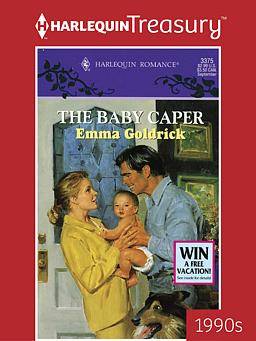

The Baby Caper
Author
Emma Goldrick
Reads
17.9K
Chapters
10
A Bachelor, a Bachelorette and a Baby… It was the formula for disaster — novelist Jeb Lacey was left holding a baby! No wonder Meg Hubbard seemed heaven-sent; she was, after all, a woman, and bound to be naturally gifted with children. Meg only agreed with Jeb's optimism to get a newspaper interview with him, but within the change of a diaper she was utterly entranced by little Eleanor. However, Meg's grandmother, Annie Mae, didn't hold with this newfound domestic bliss: to her, babies needed parents — married ones!
CHAPTER ONE
JEB LACEY lived in the old house in Urbanna because his mother preferred Paris, and his sister Gwen wouldn’t touch the Rappahannock River and Southside Virginia with a ten-foot pole. The house was brick and stone and wood, mostly from after the fire of 1852. The windows didn’t fit their frames, and rattled like ghost-walkers on a windy night. The two huge chimneys fed six open fireplaces—whenever they had been swept, which didn’t happen very often. There were occasional leaks in the roof, and the driveway was a mass of mud in the springtime, but no matter.
So Jeb, who made a good living by writing—anything that any editor might buy on any subject—would spend three months at his word processor, then take the next three months off to go fishing. He kept a dog for companionship, an ancient collie who might have been older than the house. The dog responded equally well to ‘Hey you’ or ‘Rex’, when he responded at all. The dog was big and handsome. Jeb Lacey was merely big. Six feet two, thin, with light brown hair and brown eyes, a matching set of pearly teeth, and a pair of ears that were slightly bigger than necessary. Not Mr Spock size, but big enough to be noticeable. Oh, and a cheerful smile that, when flashing, caught any woman from six to sixty. All in all, Jeb Lacey was very happy with life.
And then, on a cool autumn night in September, Rex stirred along about ten o’clock at night and barked like a fool puppy, and the doorbell rang.
“Good Gawd, who is it?” Jeb muttered from the study. It was one of his working months, and his hero had just murdered the Crown Prince of Moldavia. The doorbell rang again. Rex actually made the effort to get up off his pile rug next to the word processor and ambled out to the door.
“Keep quiet,” Jeb commanded. “They’ll think nobody’s home and go away.” But a splash of wind rattled the windows, the doorbell rang again, and Rex sat down with his nose at the letter slot and whined. Jeb gave up.
“All right, all right,” he yelled. “I’m coming!” His slippers were hidden somewhere or another. He barked his toe on the frame of the computer, said something nasty in four languages, and weaved his way out to the hall, using two hands to pull the sticky door open.
“Well, it’s about time,” his sister Gwen grumbled. “Here. Hold this.”
It was too small to be a suitcase, and he hadn’t seen Gwen in two years or more—hadn’t wanted to, for a fact—and his mind was just not with it. “What is it?” he asked.
“Don’t drop it,” his sister grouched at him. “It’s a baby.”
She forced her way by him, stomping on his bare toe as she went. Rex stayed by the door. Jeb followed his sister into the living room, his eyes watering from his aching toe. It struck him suddenly how much he cared for sister Gwen. The baby cried.
“I need a place to put up,” his sister said. “I suppose Mother is still in Paris?”
“Yes, indeed,” Jeb said sarcastically. “Want me to get you a plane ticket to France? We have a dandy travel bureau up on State Route 227.”
“Don’t push,” his sister groaned as she fell into a cushioned chair. “We just got here.”
“I did notice,” Jeb muttered. “Lovely child. He looks like—”
“She,” Gwen snapped. “Got anything to eat in this mausoleum?”
“I—not much. I could send out for some pizza. Does the kid eat Italian food?”
“How can you write so many books and be so stupid?” Gwen asked disgustedly. “The kid’s only eight months old. You don’t know a thing, do you?”
“I guess not,” he confessed. “I didn’t even know you were married.”
“I’m not,” Gwen retorted.
“Oh.” And a pause. “You’d like it in Paris. I could fix you up easily.”
“Hate kids, don’t you, little brother?”
“I don’t hate them,” he replied. “Who hates kids? I just don’t understand them. Especially girl kids.”
“So find us a place to bed down,” his sister said as she stood up and stretched. “And get my suitcase. It has all the kid’s clothes in it. It’s out on the porch.”
And that, Jeb knew, was the end of the Moldavian murder. So he turned off the switches on the computer, found a bedroom down the hall from his own on the second floor, and struggled with sheets and blankets and pillows. And milk. His sister had brought a quart of fresh cow juice, and she quickly showed Jeb had to prepare it before she went to bed.
Jeb sat for a while in the rocking chair, and fed the child. The baby was cute. She dozed off in her uncle’s arms, bubbling little milk bubbles. He burped her according to instructions, then tucked her away among a pile of pillows on the floor, and sneaked out to his own room, three doors down. His sister snored, he remembered.
It was eight o’clock before Jeb awoke; the baby was crying, and Gwen might just as well have been dead for all the attention she paid. So although he cared not a wink for his sister, nor knew anything at all about babies, Jeb stumbled out of bed, and went down the hall and peered into the other bedroom.
The child had managed to roll over on her stomach, and had crawled halfway up the pillow-barrier he had erected the previous night. When she saw her uncle Jeb she rolled over on her side and gave him a big smile, and then started to cry again.
“Gwen,” he muttered. His sister did not answer.
“For Gawd’s sake, Gwen, wake up before your kid has a screaming fit.” He reached over and shook the bundle of blankets. Gwen always slept that way, her body curled up, her head tucked under the blankets. But he was not the dumbest member of the Lacey family. When he shook the blankets for the second time it became apparent that Gwen was not under them, or in the room, or—as he discovered ten minutes later—in the house.
He checked his watch. It would be around lunchtime in Paris. He picked up the little girl and jiggled her over his shoulder as he dialed his mother’s overseas number. She was just getting up.
“Gwen?” she repeated after him. “I haven’t seen Gwen since a year ago. Why would she come here?”
“I don’t know,” Jeb said. “She was here last night, asking for you. Her and the baby.”
“Her and the what?”
“Baby. B.A.B.Y. Now this morning Gwen’s gone and the baby is still here. What do I know about taking care of a baby? Maybe I could hire someone to bring the kid over to you?”
“Don’t you dare,” his mother snapped. “Money yes, babies no. I had enough of raising babies with you two. And you didn’t send me a check this month!”
“And I’m not going to.” Jeb, frustrated, told the truth for once. “Not until I get rid of this kid. How do you figure Gwen leaving her child on my doorstep?”
“Why not?” his mother said. “Mothers don’t necessarily have to love their children. Besides, you don’t have anything much else to do except run that stupid computer machine. Why don’t you write a bestseller for a change, instead of all those odds and ends?”
“Odds and ends that keep you fed and happy in Paris,” he snapped, and then pulled the telephone away from his ear as his mother slammed the receiver down. He could have sworn she was laughing at him, and it hardly seemed fair at all. But then his mother and his sister had been living off his income for the past ten years.
* * *
He had left the baby upstairs on the floor, and now suddenly he noticed that the child was no longer crying. “Holy—” he muttered, and dashed for the stairs. The baby—didn’t babies have names?—was squirming around the middle of the floor while Rex washed her face for her with his big rough tongue. Both of them seemed happy with the world.
Jeb leaned over and picked the child up. Soaking wet, she was. Dripping. Even an uncle knew that couldn’t be right. The suitcase that Gwen had ordered to be brought into the house was now sitting, open, in a corner of the room. He grabbed a diaper off the top of the pile, added a dry undershirt and socks, wrapped the child in a towel, and took the whole mix downstairs. Rex tagged along behind.
The house didn’t live on fireplaces. He pushed the central-heating thermostat up to seventy-five degrees Fahrenheit. There was a big metal sink in the kitchen. He stripped the child, filled the sink with lukewarm water, and sat the little girl down in it. She acted surprised, but courageous. She splashed a time or two to get the range, and then raised a fountain which bathed him more than it did her.
“Damn,” he said. “Why me, God?”
His punishment began immediately. His back-door alarm went off, sending a shrill whistle throughout the house. The telephone rang. The doorbell rang. His radio alarm clock turned on and flooded the house with rock music. And the baby cried.
Jeb started for the door. The baby fell over and gurgled. He came back, wiped her off with a dry towel, and used another to wrap her up. The doorbell rang. He started for the door again. “I’m coming, I’m coming,” he yelled as the thick oak door stuck. “I’m coming.” He put the child down on the rug in front of the door and used two hands to force it open.
“Mr Lacey?” He picked the child up again, and double-wrapped the towel to protect against the chill.
“The only one in town,” he commented. “But I don’t buy at the door.”
“At your office?” she asked.
He had the normal number of male genes. And she looked like a very great deal of woman. Five feet ten, perhaps, with honey-gold hair tied back into a ponytail, a figure that would give Venus conniption fits, deep green eyes, parchment-clear skin with a dash of color on each cheek. Just the sort of woman he didn’t want to bother with—at this particular moment.
“I don’t have an office,” he said. “Who might you be?”
“Meg Hubbard,” she said. “From the Virginia Lady. I have an appointment.”
“Do you really?” He passed the baby over to her. “Come in.”
She bustled through the door and he closed it behind her. “Oh. A baby,” she said, staring. She held the child gingerly a few inches in front of her, as if it were some form of off-planet life.
“Yes, a girl-type baby. You’re familiar with the design?”
“Not so’s you’d notice,” Meg announced. “I happen to be a bachelor.”
“Bachelorette,” he quoted from his extensive vocabulary. “Maiden.”
She held up a one-handed stop sign. “So you could put something on the kid and we’ll go ahead with the interview. I don’t have a great deal of time.”
“Me neither.” He shrugged. “In fact I’ve never—er—dressed a female. I mean of this size and age, you understand.”
“From what I hear,” Meg retorted, “you’ve dressed or undressed a whole bunch of women in your time. Shall we begin?”
She made an effort to hand the child back to him. He moved out of range. “You might perhaps put a diaper on the babe?”
“I tend to believe you could do it better,” she said stiffly.
“I don’t see why you’d say that,” he returned. “She happens to be a female—as do you.”
“You’re about to tell me, Mr Lacey, that you’ve never diapered a baby?”
“Not a girl baby.”
Meg sighed. Her editor had warned her about this interview. And about Jeb Lacey, for that matter. But not this. She held the baby up in front of her. Cute kid, no doubt. If you liked kids, that was.
“The one thing I do know,” he cautioned, “is that if you don’t cover her—bottom—she may very well—er—”
“Yes.” There was a long mahogany table in the study, covered with miscellaneous stacks of paper. She brushed one of the stacks off onto the floor and stretched the baby out. Out of the corner of her eye she could see that he was watching her like a hawk.
“You needn’t be surprised,” she said as her fingers fumbled with the diaper. “I did this once fifteen years ago for my niece Sara.”
“Nice name,” he mumbled, “but you just threw Svetlana, the Princess of Moldavia, on the floor, and I have a twenty-day deadline on her.”
“I wish I knew what you were talking about,” she returned. “Where’s the pin?”
“Pin?”
“Yes. Pin. To fasten the diaper. The kid can’t hold the thing up with two hands.”
“Smart reporters seldom get good interviews,” he said coldly.
Meg Hubbard flushed. The interview was important to her. Her editor had said so, her publisher had said so, and Mrs Macomber, who owned the whole shebang, had made certain threatening statements. The Urbanna Oyster Festival was not until November, and if Meg didn’t get another assignment before then it would lead to hungry times.
“Observe,” she said. “You put the diaper under here, and around there, and you—if you had one—pin the whole thing together. Now you try it.”
“Not me,” he objected. “How about a paper clip? Or a paper staple?”
“I don’t see what’s bothering you,” Meg said. “She’s only a little girl.”
“I did notice.”
“And, if you follow scripture, was created after Adam.”
“And—what’s your point?”
“Being the second model, women turned out considerably better than men. God, when She did this second work, you’ll note, got all the plumbing inside.”
“Here’s the pin,” he said, with a disgusted snort.
“What do you call the child?” she asked as she finished the job.
“I don’t know. How about Rex?”
“You’re the father of a child and you don’t even know what her name is?”
“I’m not the father of the child, and no, I don’t know what her name is. Nor do I know any reasonable way to find out. My sister dumped her on me last night.”
“Well, Rex is a dog’s name.” The dog, hearing his name taken in vain, got up off his rug and came wagging his way across the room. The baby made hungry noises. Rex did the same.
“Well, we’ll call her Maria,” Meg said. “Now, what’s for breakfast?”
“I don’t know. I usually go up the street to the restaurant.”
“You can’t haul a child this age out to a restaurant.”
“I don’t know why not—it’s a good restaurant!”
“Men!”
“Look, I’ve got a ton of work to do. It you’re not happy with—er—Maria, then go do something about it. But leave me alone. I’ve a big family to support.”
“Money,” she responded, and held out one hand. “I’m a reporter, not a banker. If you want me to buy food, put your money where your mouth is.”
“Women,” he muttered, and pored through his desk drawers. There was an assortment of currency, ranging from twenties to one hundreds. He stacked a few of them. A check book; he signed two blank checks. A credit card, unsigned. He passed everything over to Meg. “Stock the cupboards,” he ordered, “but please leave me alone.”
“And the baby?”
“Well, take her with you, of course. There’s a suitcase upstairs in the green room filled with her clothes.”
“I—” Meg hesitated. “I don’t have forever to do this interview,” she said.
“And I don’t have forever to do this book,” he returned, gesturing toward the papers on the floor. “These books.”
“My grandmother told me about men like you,” Meg said, sighing. “I didn’t believe her.”
“G’bye,” he said. “Get a lot. I like Italian.”
* * *
By midafternoon she was back, bursting through the big front door with a happy baby riding in a new child-tot. “C’mon,” she yelled.
Jeb popped out of the study. “Now what?” he grumbled. “You’re blowing my plot all to Hades.”
“Plots I don’t need,” Meg responded. “Muscles I need.”
He shook his head. Nothing had gone right since the baby appeared. Female baby. But he followed Meg out to the drive. She was using her own car, a 1992 van, loaded to the eyebrows. The library was across the street, in what was once a tobacco warehouse. The librarian came out onto the wide porch to watch and wave.
“All your neighbors keep a kindly eye on you?” Meg was there beside him, loading her arms with goodies.
“Keep a kindly eye? Nonsense,” he replied as he dug into the food piles. “They all hate me. They expect me to donate copies of every new book I get published—for free, no less. I keep telling them I’m in the business of selling books, not giving them away.”
“Watch out for the milk,” she warned. “I could only get glass bottles.” She said something else as well. Could it have been Scrooge? He wasn’t sure, and so let it go by the board. But she was whistling as he brought in the next load. Whistling? Barking dogs and whistling girls will come to no good end, he recalled the old adage as saying. She paid it all no attention.
“I don’t believe any of this,” Jeb maintained on his fifth trip to the car. “All this we need?”
“All this you need. I can always go home to my gran’s for dinner.”
“Oh, no. Just a darn minute,” he said. “You can’t expect me to live through the night—”
“And you can’t expect me to overnight with a male bachelor,” she answered. “What do you think my grandmother would say about that, for goodness’ sakes?”
“I wouldn’t know. That’s all the relative you have?”
“That’s plenty. You are a bachelor? No wife in hiding, or something like that? A mistress?”
“Not anything like that,” he said. “Now, what are you going to make us for supper?”
“What?”
* * *
In the end he showed pure genius about the supper. Canned beans and hot dogs, with ketchup and french fries. And for the baby a jar of mixed vegetables, which little Maria ate, but not with a lot of enthusiasm. When it was over Jeb managed to police up the little face, and found a smiling niece beneath it all.
He was startled. It wasn’t something he expected. He leaned over and found a clean place on the end of her nose, which he kissed. Maria gurgled in delight.
“Now,” Meg said, “you can start the dishes, and while you do that I’ll ask you some questions for my article.”
“That doesn’t seem entirely fair,” he protested. “I’ve got work to do in Moldavia.”
“You’ve also got work to do in Urbanna,” she said. Behind the kitchen door she found an old pinafore which looked as if it had been hanging there since the war between the states. She tossed it to him. He fumbled around with it and gritted his teeth.
While Meg collected dishes Jeb collected hot water and soap and a chair so that the baby could watch him. Just before the child fell off on her nose he snatched his one necktie from the study and used it to tie her in. At about that time Meg came out to join them.
“Telephone call,” she announced.
“That’s nice,” Jeb said. “What did he want?”
“A she,” Meg said. “Your sister.”
“Dear Gawd,” Jeb yelled as he stuck his finger under the hot instead of the cold-water faucet. “Watch the kid. I need to talk to that woman.”
“Too late. She hung up.”
“What? You let her—?”
“Just how do you suppose I could have kept her from hanging up?”
“Threats,” he shouted at her. “Bribes.” The baby started crying.
“Men! See what you’ve done?” Meg comforted the baby.
“So what did my sister want?” he asked softly.
“Two things. She wanted to know how the baby was, and she wanted to know when you would send her another check.”
“And that’s all?”
“And that’s all. Oh, she did mention that the kid’s name is Eleanor.”
“Oh, Gawd, why me?” Jeb muttered.
“And she gave me the address for the check you’re going to send her. She’s in Atlanta, in Georgia.”
“I know where Atlanta is,” he muttered. “And you let her believe I’d send her a check?”
“Of course. She’s your sister, isn’t she?”
“Oh, sure. Rhett Butler will bring it to her the next time he sets the city afire. You know, like Gone with the Wind. Sister? You should have a sister like that, let me tell you.”
“Well, I really wish I had a sister.”
“Don’t worry, I’ll give you one,” he threatened. “Just after I murder her. Why is it that I feel you’re trying to get even with me for something?”
“Why, I can’t imagine why,” she said as she offered him a demure little smile. “Now, about my article. You were born in...?”
“Memphis, Tennessee,” he said without thinking about it. “My father was Ralph Wormeley Lacey, and my mother was Leni Leoti.”
“Wow,” Meg said. “Ralph Wormeley? That’s a famous name in these parts.”
“So I’ve heard. My several-times grandfather was one of them. John of Cool Springs, they refer to him around here. Actually, in our family his son was known as Cold Water John. He was run out of the Shenandoah valley because he was a Tory Temperance lecturer.”
“I don’t believe that,” Meg said. “You’re making it all up. Who ever heard of a Moldavian princess named Svetlana?”
“Listen. It’s my book. I can name the characters any which way I want.”
“Yeah, but look out for the baby. She’s falling asleep and is about to—”
Jeb caught the little tyke before she actually fell. Cute little thing, he told himself. I wonder who the father could be? He held the baby gently while Meg found a wet cloth and gave her a gentle hand bathe. And that’s not bad, either, Jeb thought. I haven’t seen honey-gold hair like that in a dog’s age. Why don’t I just talk her into my bed tonight? It’s been almost forever since I had a good romp.
“Don’t even think about it,” Meg told him.
“What?”
“I’m a psychic,” she told him. “I can read your mind.”
“I don’t believe in psychics,” he announced. “You’re a pretty good fiction writer yourself, aren’t you?”
“So I’m going to take the baby upstairs,” Meg said. “I bought her a portable crib. Look at the darling. Your sister must be some kind of beauty.”
“Some kind is right,” he agreed. “But lord knows what kind.”
He watched hungrily as Meg went up the stairs. Long legs, well-shaped, altogether too sharp for her health—or mine. But out to get me. I can’t let her get away with that. No way!
For another hour he worked in the study. It was true, he thought. There never was a Moldavian princess named Svetlana. That was a Slavic name. He turned to one of his favorite sources. When one needed a number of names, only a telephone book would do. A big telephone book.
He ruffled through the pages of the Middlesex County telephone system. And found a name that appealed to him. Hubbard. Where had he seen that name before? Margaret Hubbard? Of course. Meg. Long Meg, a favorite English name from the seventeenth century. And why couldn’t he give her a hard time? Love Little Meg! His fingers diddled the dial before his conscience could catch up to him.
“Hello. Mrs Hubbard? I wanted to let you know that Meg is going to stay over at my house tonight. Yes, it involves her work. I’m Jeb Lacey, ma’am, and—” He moved the instrument a few inches away from his tender ear. “But ma’am—you know she wouldn’t. Well, if you’re going to take that attitude I don’t think I will give you my address.” With which he put the telephone down on its stand. It sounded as if Mrs Hubbard might be having a stroke. Or was planning a lynching party.
With a very self-satisfied smile on his face Jeb went back to work.
* * *
Meg Hubbard came back downstairs within the hour. The baby was fast asleep, her face registering happy dreams. As for herself, Meg was still not certain. Oh, it was true that she barely held her job on the Southside Press, and only a good interview with Jeb Lacey would do her career any good. Beyond that? Hardly anything. Maybe a slot behind a counter at Bristows, but she shuddered at that. The last time she had worked behind a counter had left her with a vile disposition and tired feet. Even her grandmother couldn’t approve such a job.
And so that left Be Kind To Jeb Lacey Week? Well, not that much. He was a nice man—sometimes. He looked—acceptable—when he smiled. Which wasn’t all that often. And besides, a lot of women in small towns learned to get along with homely men!
And so into the study. He looked up—and smiled.
“How about a cup of coffee?” she offered.
“Tea. I don’t care for coffee,” he said, and put his nose down to the grindstone again.
“Tea? I can make that.” She started for the kitchen, but his movements held her. Those long fingers of his were gliding over the keyboard of his word processor like greyhounds running a short track. He hesitated and looked up. Meg fled the scene. It was bad enough to be caught staring, never mind collecting all the smart remarks he probably would make.
The teakettle was under the sink. It looked as if it had been rescued from the Titanic. Rather than try to polish it Meg located a small saucepan and set the water to boiling.
To the right above the sink there was a cup cupboard. Containing one cup, and not a very clean one. Meg shrugged helplessly. How could you be nice to a man who lived like this? Against the opposite wall was a dish washer. She walked over and lifted the lid. It was loaded with dishes, cups, saucers, utensils, everything. They even looked clean.
The tea bags were no trouble to find. She had just purchased them up at the Park Side supermarket. And so, loading a tray with tea, cookies and condiments, she started back to the study. He was still at it, but looked up as she came in the room.
“What’s that I smell?” he asked.
Meg looked down at the tray. There was nothing unusual there. “Cookies, hot tea,” she said as she brushed off a space on the table. “You wanted something else?”
“No, I guess not,” he said. “I was getting a little hungry but—that’s not important.”
“Can I ask you a question?”
“Well, of course. That’s what you’re here for, isn’t it?”
“Yes, well—how fast can you type when you’re working?”
“It all depends,” he said. “When I have a clear line on the plot I can do about one hundred fifteen words a minute.”
Meg took a deep breath. At her best level she might possibly make seventy words a minute. On sunny days, so to speak, when the wind was right. Of course, she told herself, speed isn’t everything. It’s what you write that’s important. And the little voice of her conscience said, Nonsense, Margaret Hubbard. You can’t even keep up to the secretary in the office! Which left a bad taste in her mouth.
She sat back in her chair, her feet straight ahead, balancing on her heels, and tried a sip of tea. Not that tea was her favorite drink. I am, she reminded herself, just learning to get along with the boss! She took another sip of the tea and looked at him. He had stopped work.
“I don’t know,” he said, drawling out the words. “I thought at first that the Prince would be killed by the Black Hand.”
“The Black Hand?”
“A secret society of assassins. But now I think he’ll be killed by the paramour of the Grand Duchess Sophie. With poison.” He rubbed his nose as if it itched madly. “No, that won’t do. Poison’s out. The last story I did about Moldavia used poison.” He leaned back in his chair and clasped his hands behind his neck. “It’s hard to keep things straight,” he said, sighing.
“How many—murder stories have you done?”
“Oh, about twenty, I would guess.”
“Twenty? I thought—my editor said you’ve written a phenomenal number of books.”
“Oh. I see. I meant that I had written twenty stories about murder. And some sixty or so thrillers set in England. Then you have to include about fifty romances in the Regency period, and perhaps sixty more modern romances. It’s just too hard to keep track.”
“Yes, I believe you,” she said flatly. She had started calling herself a novelist when her first book was published. It had been followed by exactly none! She groaned. Her grandmother’s favorite quotation was from the Bible. ”Pride goeth before destruction, and an haughty spirit before a fall.” And here it was.
“Something bothering you?” he asked.
“N-no,” she stuttered. “I think I’ll go out to the kitchen and—”
And the front doorbell rang.
“Good Gawd,” Jeb said. “After ten o’clock of an evening. And who would be ringing at my bell?”
“All sorts of people,” she answered. “Shall I—?”
“No. It’s all a mistake,” he commented. “There are exactly two buildings on this end of Virginia Street, and the other one is the library.”
The bell rang again, more forcefully. It was one of those twist bells. The more energy the ringer applied, the louder the bell rang.
“Some kid,” Jeb said. “They surely won’t ring again.”
But they did.
Meg shrugged and headed for the front door.
“Damn,” Jeb growled. “How in the world can I get this book finished?”
He flipped the off switch on the computer. There was no sense to wasting paper, not with prices what they were today. He heard the door open. Isn’t that something? he asked himself. I have to put two hands on the knob to get it to open. This little lady can do it one-handed! Maybe I need more outside exercise.
He heard a murmur of voices in the outer hall. There was a light out there, but the bulb was burned out. Some day, he had said a dozen times or more. Some day I’ll get it fixed.
Shadows crossed into the hallway. The kitchen light was on, as well as both the study lights. Meg Hubbard was leading the way. Behind her, hidden by her own size, was another woman.
“Mr Lacey,” Meg said in a very subdued voice, “this is Annie Mae Hubbard—my grandmother.”
Meg stepped aside. Jeb struggled to his feet. The woman confronting him was about five feet nothing, weighing in probably at one hundred pounds. Her face was remarkably smooth and clear, her hair white as snow, and she carried a black umbrella in her hand.
“Mr Lacey,” she said in a deep strong alto, “just what are your intentions toward my granddaughter?”