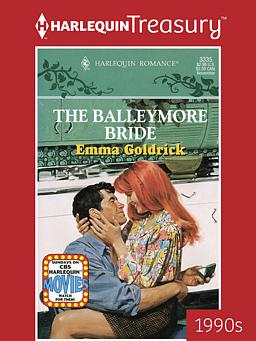

The Balleymore Bride
Author
Emma Goldrick
Reads
16.7K
Chapters
10
He Held the Key to Her Heart. Emma Ballentine had come to Balleymore looking for the answers to questions she'd had her whole life. In a cryptic letter left for her in her father's will, he'd instructed her to go to the historic estate, and she was sure it held the key to her past. But Emma discovered more than she'd bargained for: an inheritance, a mother she'd thought was dead and a woman who claimed to be Emma! The most startling — and unsettling — discovery of all, however, was John Weld, who awakened her heart….
CHAPTER ONE
“AND you say that’s all he left?” Emma turned in a circle and scanned the tiny room, the worn furnishings, the rusty sink in the corner. Outside the dingy window she could see the dilapidated nearby buildings of the south Bronx.
“That’s all there was, dearie.” The landlady was in a hurry. As bad as the room was, it was rentable. “Oh, I almost forgot. There’s a suitcase down in the basement. And a package of them queer paintings he did. I’ll have Frank bring them up. You won’t forget he owed me rent.”
“Of course,” Emma said. “I’ll pay you now.” She opened her purse.
“A fine man, he was, Mr. Ballentine,” the landlady simpered as she snatched at the offered bills. “You won’t be in the room too long?”
Emma brushed her long red hair back off her face. “I don’t suppose so.”
“You was related?”
“My father,” Emma said.
My father, Emma repeated the words to herself. This was the man who left me at the Social Services building when I was five. I cried for him to take me with him, but he didn’t.
“I haven’t seen him for ten years or more. Where—?”
“The city buried him, miss. I don’t exactly know where. In Potter’s Field, I s’pose.” With her money in hand, her conscience clear, the landlady bustled out of the door.
Emma collapsed on the rickety bed. So much for Edward Everett Ballentine, she thought. He was a good man, they say. I wish I could have known him. Somehow or another, all the dreams she’d had growing up had centered on him coming to get her. He’d come to see her, once, the day she graduated from high school. He’d come to the ceremony and then walked away. He hadn’t spoken to her but she’d recognized him, even from a distance. She hadn’t called out or gone after him. He was a stranger. He wasn’t the “father” she’d built in her daydreams. But he was her father.
Much later, when she’d thought about it, she’d realized he must have kept track of her somehow. How else would he have known about her graduation? Or how would he have known where to send that birthday card for her fifteenth birthday? Or even that letter he’d sent when she was sixteen. She’d sworn that she would never read the letter. Heaven only knew what she’d hoped to find in it. Understanding, perhaps, or an invitation to join him. The letter had had neither. She had spent so many years not understanding what she’d done wrong; why he had deserted her. As the years passed and she’d come to understand the letter he’d written, she’d got angry. She kept it safe in her strong box. She couldn’t understand why she took such care of it, but she did.
He had sent her another letter. Her finger toyed with the smudged letter in the pocket of her jacket. Written in pencil, addressed to her Staten Island address, the one from which she had moved three years earlier. Uncle Sam and his postmen had finally tracked her down. She pulled out the envelope and took the single sheet of paper out of it again. There was only a single bulb hanging from the ceiling. Emma reached for her goldrimmed glasses.
“Emma,” the letter said. “I haven’t done well by you. But others will. Go to Balleymore.”
And no signature. She tapped her fingers on the edge of the paper. Through all the years of foster homes, and state care, when she’d needed something or someone, she would have jumped at the chance to know about Balleymore. But now, with her fourth novel on the stands, there was no need.
Balleymore? Where had she heard the name? A long time ago. There was something to do with a house high on a hill, deep in the country, where the snow in winter piled as high as a little girl’s head. An old house, and people who walked solemnly and quietly and brushed her out of the way. Where?
There was something painful about the memory, and she could not tell just what it was. She closed her green eyes and thought. Balleymore. Had her father come from there? Or perhaps her mother. Everyone had a mother, even if one didn’t remember her. Isn’t that strange? she thought. I can remember almost everything. But not my mother. Or Balleymore. Where?
Who am I? she asked herself. Who am I really? There’s nothing of me in the world, except for the last four years when my books began to appear on the shelves. Surely somewhere, somehow there are people who know who I am, or who I used to be—and I have to find them! I can’t go on any longer without the answers to the question, Who am I?
She tapped the little packet of papers, sealed in plastic, that her father had left behind, but was too tired to investigate them at the moment. They dropped into her capacious bag as her eyes made one last survey of her father’s domain.
* * *
The trip west from Boston was a delight. Her rented Buick responded like a charm on the fine highways leading westward. As she approached the rolling hills around the Mohawk trail, Emma began to look carefully for the sign. Just getting here had appeared impossible, but had turned out to be so easy. How did you find a house when you didn’t know the address? A house that was only a name? Sitting in her hotel room in New York, she had been struck quickly by a thought. How did you find anything? Anybody? You hired a detective!
So, she’d dialed the Trentmore detective agency, expecting a laugh and a big brush-off. Instead, the next day, she had received a call from the agency and a bright-sounding man had laughed when he’d told her, “Our charges for four hours’ work are two hundred and fifty dollars.”
Emma had taken a deep breath, her first in some hours. At least my bank account isn’t going to run aground, she’d thought. “And what did you have to do?” she had asked.
“Simple,” the young man had replied. “We looked in the National Register of Historical Structures, and, after considerable searching, there it was. Balleymore, you said. It’s in the hills of western Massachusetts. General Ephram Ballentine of the Massachusetts Militia lived there in 1768. Would you like the address and description?”
Emma would. She had copied all the information quickly, thanked the young man politely, and sent him his check before she’d read her notes. The next day, after a long and violent argument with both her agent and her editor, she had taken the shuttle flight to Boston, her mind clear for once in a long time. Well, not exactly clear. Her editor had blackmailed her into a promise. One more of those Emma Ballentine thrillers, based in the mountains of the Bay State.
A passing truck, doing seventy miles an hour in a fifty-five-mile zone, sounded its horn and brought her back to attention. The road signs were flashing by. She slowed down to make sure she didn’t overlook one of them. Finally, she found the one she was looking for.
Balleymore, the historical marker said, with an arrow pointing north, toward the foothills. She turned off the main highway and within minutes was climbing up and down hills, ridge after ridge, each one rising slightly higher than the one before. The road narrowed, first to three lanes, and then to two. When she came to the turn at the top of the last ridge there it was. “Balleymore,” the sign said.
There was a small metal historical marker, such as one saw everywhere in the countryside in New England. Emma pulled over to the side of the road and shifted into neutral. She had not realized how tense she had become. Her shoulders ached, and her eyes were blurring. She set the emergency brake, climbed out of the car and walked over to the marker, glad to be able to stretch her legs.
“Balleymore,” the sign said, “the home of General Ephram Ballentine. Revolutionary War General killed in the Battle of Ticonderoga.”
Emma leaned against the sign and brushed at her forehead. She had dressed conservatively for this trip, not knowing who or what she might find. Her navy blue suit was perhaps too heavy for the heat of the day, and her hair, fastened up in a tight bun, was beginning to slip its pins. Ephram Ballentine, she thought. Certainly a relative of some sort. And if he isn’t, I’m going to claim him anyway! And with that smart conclusion she took off her glasses and headed back toward the car, wiping her eyes.
Not all Massachusetts drivers were insane. But there were enough to give the state a bad name. Just as she reached the front of her car a three-toned horn screamed at her, and a low white two-passenger sports car went by her at rocket speed. Emma was so startled that she dropped both glasses and tissue. Although the road was paved, a dust storm surrounded her, leaving her coughing.
Emma was a tall, healthy girl. She stood five feet eleven in her stockinged feet, weighed in at one hundred and thirty well-curved pounds, and was as blind as a bat without her glasses. She also owned a small but effective vocabulary—perhaps not suitable for New England ladies, but highly desirable for a woman who dealt with fiction editors daily.
By the time she recovered her spectacles they were too dirty to see through. Emma slid into the driver’s seat of her car and fished around for her spare set. An old pair, not the lightweight gold-rims she favored, but rather a heavy plastic pair of horn-rims. A few more words for the driver of the little white car, a moment or two to do something about her falling hair, and she started on down the road. And there was the house, popping up out of a sharp turn. It was like nothing she had ever expected to see. All along her mind had been on 1768 and log cabins. Instead, Balleymore was a two-story house, with the central section built of stone like a fortress, with frame additions on each side in the shape of the letter U. Like most New England country houses it was painted white. Sitting atop the central section, squarely over the front door, was a tiny cupola.
She slowed to a stop again. The two extensions that formed the U looked like a pair of welcome arms. Dazed, Emma began to daydream again. The space between the arms was big enough to form a courtyard into which a coach and four would easily fit. With eyes half closed she pictured herself descending from just such a coach. And just at that moment that white sports car came roaring down the hill at her again, its horn tooting wildly as it passed her with no more than inches to spare.
Emma ducked. It seemed to only sensible thing to do. As a result, she failed to see the driver and passenger, both of whom were laughing at her. Stop, Emma commanded herself. Turn around and go back. This is no place for you! She banged her hands on the steering wheel in frustration. And then her common sense took over. Of course this is a place good enough for me, she thought. I hope.
Her fingers were still shaking. She locked them around the steering wheel and drove up into the courtyard. There was deep silence around the house, as if nothing lived in the area. A driveway led around the house to what was evidently a garage—or perhaps merely a converted barn. But nothing stirred there either. Despite the beauty of the place, Emma came down out of her cloud of enjoyment and slapped reality in the face. Nobody here. I can’t remember when I last passed a town, she thought. If there’s no one on top of this mountain then I’ll have to go and find a place to spend the night. Well, I’ve come this far. Only a coward quits within sight of the enemy. Which was a quotation out of the worst Napoleon Bonaparte book she had ever read. She opened the car door and stepped out, slamming the door lustily hoping someone would hear. Somebody did.
Two dogs came racing around the side of the house, Dobermann pinschers, black as night and as evil as sin, their teeth gleaming at her as they came howling up the driveway.
Emma, not noticeably affected by animal angers, was taken completely by surprise. She backed away from them in the direction of the house. They came snarling, close to her but not up to her. Pawing the ground, both of them with sparkling teeth which looked capable of sheer destruction, they bellied closer. The farther she backed, the more distressed she became. Finally she was cornered in the little niche that led to the front door. She banged on the door a couple of times with no response. The dogs stayed their distance but growled and barked at her. There had to be some other way to get attention. She searched carefully, keeping one eye on the dogs, but there was no doorbell button. There was no knocker, either.
Instead, by the side of the door there was a long steel chain hanging down between two brackets. Emma grabbed the chain, gave it a large pull and then covered her ears when bells began to ring. Heavy bells, loud bells. Coming from the little steeple at the top of the house rather than inside. In a moment, the door opened halfway. Just wide enough for a teenage girl’s face to be seen.
“Whatcha want?” the girl asked.
“W-well, the dogs—” Emma stammered. “Let me in, please.”
“Not me,” the girl said. “I ain’t gonna open the door for them damn dogs.”
“If you don’t, I don’t know what’s going to happen,” Emma said. “I—”
At that moment another voice sounded in the background, “Hilda, what’s going on out there?” The door opened a little wider. Beside the thin string of a girl, perhaps sixteen years old, there was now a rounded well-aged woman with gray hair, a gaunt expression and a sense of command about her. She took one look at the person at the door, stepped out on the porch and flapped her apron at the two dogs.
“Shoo, shoo,” she said, “you monsters. Shoo!” The dogs reluctantly withdrew.
“Now then,” said the lady as she returned to Emma. “I’m Mrs. Macrae, the housekeeper, and you are—” She paused for a second. Her eyes looked as if they were about to jump out of her head. “Emma? Emma, is it you?”
“I—er—yes, I’m Emma. Who—I don’t know who you might be. I need to get in. I need to— Those dogs have scared me nearly to death.”
“Come in, child,” the housekeeper said. “Come in. Now then, you, Hilda, go heat some water for tea. The girl is shaking to the bone. Shivering in the middle of August, no less. Come here, Emma.” She opened her arms wide and Emma, not knowing why, walked into them and received a hug that was well worth the coming. “Emma, Emma, Emma,” said the old lady. “It’s been so many years. Where have you been, child?”
“I—I’m afraid I don’t know where I’ve been, and I don’t really know where I am,” Emma stuttered. “I was looking for—is this home?”
“Yes,” said the housekeeper comfortingly, “this is home. Come on in, dear.” She lead the way into the dark hall and closed the big oak door behind them. It slammed with a satisfying thud that shut out all the troubles and noises of the world.
“Ah, lass, it’s good to see you. Come, now, into the lounge where we can sit and talk for a while.” They walked down the dark hall to the last door at the back of the house. Mrs. Macrae opened it and they entered the sunshine and glory of a beautiful room. A whole wall of window glass sprayed the sunshine into the room. It was a library as well as a lounge. Books were stacked on three sides, sky-high. A fireplace was in the middle of the north wall. Ornate but unused.
“Sit you here,” said the housekeeper. “Here now, Emma, my Emma.”
“How do you know me?” Emma asked. “I’ve never been here before.”
“Well, go on with you, lass,” the housekeeper said. “Did I not raise you? Did I not change your diapers? Wash you, walk you, talk to you? For four long years were you not the center of my heart? Until he took you away.”
“When I was four?”
“When you were four, love. And there’s not a change in you, is there, except that you’re bigger? Green eyes, I never forgot those big green eyes. And that tawny hair. Only you should let it be free, girl, not bobbed all up in a bunch like an old lady. Now then. You must be hungry. It’s been a long time you’ve been traveling?”
“Well,” Emma said, “I flew into Boston from New York this morning and then drove out here. And—”
“No wonder you’re tired,” the housekeeper said. “No wonder you’re shaking. Sit you down here. Now then, you wait just a minute while I go stir up the kitchen. We’ll have a little hot tea and a little something to eat. And then you’ll tell me.”
Emma sat down. She relaxed for the first time in a long time. She rested her arms on the arms of the chair. It was a strange welcome. To come all these years and all this distance and find somebody who knew you when you were a little girl? Amazing. Yet it was only a part of the search. She relaxed against the back of the chair, slouched slightly to rest herself and closed her eyes for a moment. She was being enveloped by a feeling that she’d never had before. She felt at home and she couldn’t explain the feeling. She liked it.
In the distance, a great clock was booming. She could count the steady, solemn strokes. Four o’clock in the afternoon.
She heard the door open behind her and straightened up to look over her shoulder. Mrs. Macrae came in with the teenager, who was carrying a tray.
“Put it down here on the table, Hilda,” Mrs. Macrae said. “Right there beside the poor girl. And now go you up and make sure that the green room is ready.”
The teenager, Hilda, placed the tray on the side table, rattling the cups as she did. Then she nodded her head and disappeared.
“So now, Emma Ballentine,” said the housekeeper. “Tea?” She poured a cupful without waiting for acknowledgment and passed it over.
It was warm. Emma cherished the cup between her fingers. Why she was shivering she couldn’t tell. Why she felt cold she didn’t know. But the warmth of the teacup did something to her. Carefully, she lifted it to her lips, managed to hold it steady for a moment and then sipped.
“Mrs. Macrae—you knew me? You knew me when I was a child?”
“I knew you when you were a child, lass. I did that. I knew your father. How is he?”
“I’m—I’m afraid it’s all bad news,” Emma said. “My father died three months ago, in New York.”
“Ah. Have you been all alone since then?”
“No, it— Well, I’ve been alone most of my life,” Emma said. “Not just since Father died. I’ve been all alone since I was five.” Mrs. Macrae tried to smother a small muted cry but gave Emma a nod to continue on. “He couldn’t support me and I ended up in a state orphanage and half a dozen foster homes.” Her audience tsked and shook her head. “But those days are behind me now. I’ve managed to establish myself in a small business. I never heard of Balleymore until my father sent me a note that told me to come here.”
She reached into her wallet and pulled out the crumpled letter her father had left. The housekeeper whipped up her glasses, which were suspended across her bosom by a bright gold chain.
“Ah,” she said. “Of course, why should you not? You should have come long, long before.” Mrs. Macrae continued under her breath, “You should never have left. I would have cared for you.”
Emma wasn’t sure she had heard correctly, said, “I didn’t even know the place existed.”
“Ah, well. We’ll make you home here now,” Mrs. Macrae said. “Home is the place that’s always ready to welcome you back, child. And here we are. All waiting.”
“When you say you are all waiting, who is that? Do I have family? Brothers, sisters, aunts or uncles?” Emma asked.
“No,” Mrs. Macrae replied with great sympathy. “There’s only you in your generation. Your mother and father were only children. The Ballentines were never large families. You are the end of the line.”
“Oh—well. I—this is some strange place,” Emma commented, almost trying to change the subject.
“Strange?”
“There’s nothing around it. There’s no place close. No city. No town.”
“Ah,” Mrs. Macrae laughed. “Twas the conceit of the old general, you know. He wanted to be at the frontier, and this was the frontier in those days. Built this house, he did, on the spot where the Indians burned down the old wooden fort. Swore no one would ever do that again. Built it out of stone. And then marched off to war—the Revolution, you ken—and never came back. Famous, famous man.”
“I suppose so,” Emma said, sighing. “Although I’ve never heard of him.”
Two more sips of the hot tea put her back into constitutional shape. There were little finger sandwiches. Ham, bacon, tomato sandwiches. She sampled one of each and gained her strength back quickly.
“The house seems empty,” she offered.
“Oh, not exactly, Emma,” Mrs. Macrae said. “Not exactly. There’s a lot of living going on behind these walls. Upstairs are the two of them, and down here are Hilda and me and him, who went out to work in the fields today. Working the fields—what I mean is, supervising the work in the fields. He comes several times a week.”
Emma nodded her head as if she were an expert. But the other item stuck on her tongue. “Him?”
“Yes, him. Mr. Weld. He does the supervising, you know. There is none here, outside of him, who can make a decision. Him and the lawyers. Although he has been trying to get his brother involved in the farm.”
“Ah,” Emma said. “Do they own the place?”
“Oh, no,” Mrs. Macrae said. “They just run the place. They—her, upstairs, she owns the place. At least, we think so. And Mr. Weld has been appointed the conservator of the place by the local court. You know she’s not well, not well at all. In fact, we hardly ever see her. Ah, but you now. What have you done? Where is your mark on the world, Emma?”
“It’s hardly a mark,” Emma said. “A scratch maybe. I’ve written four books that have sold pretty well. Fiction. I don’t say that they’re world shakers, but two of them have managed to make the New York Times bestseller list.”
“A writer, now! There had to be some talent in you, of course,” she said. “Your mother was a painter. Your father was an artist himself but not as good as she. So now, our Emma is an eminent writer. Well.”
“Oh, don’t say it like that,” Emma said, chuckling. “Eminent? Hardly. Passable, perhaps. I think of myself as a journeyman in the trade. I have a lot to learn. I don’t know enough about people, places and things. I don’t even know who I am.”
“You have come to the right place to find out,” Mrs. Macrae said, and then she went quiet.
Emma’s eyes were blinking. She struggled to keep them open and failed. The teacup rattled in her hand and was snatched away from her by an unseen rescuer. She leaned back against the chair. “Balleymore,” she mumbled, “home?”
There was no more sound to be heard. Her ears had shut down as her mind wrestled with all this new information. All the years of trial and tribulation. All the longing, all the fears and here I am. Do I belong here? she asked herself. Without her notice the day passed by and it was coming on sunset.
Emma had no feeling for time. A door slammed and a heavy voice said something harsh, threateningly. Emma squirmed farther down in the chair, pulling the broken quiet around her like a shield. Suddenly there was a hand on her shoulder shaking her.
“Hey now. Who in God’s name are you?”
Emma opened her eyes, with a snap. He shook her again and almost cracked her neck. Her glasses had slipped down her nose. She pushed them back up to bring him in focus. There was a big man leaning over her. A big, black-haired man. She blinked her eyes. His face was craggy, the skin tanned from an outdoor life. A line or two marked the brow. His eyes were too close for her to focus. A great deal of sunshine had fallen on that face. The eyes were dark; almost as dark as his hair. The nose was, perhaps, a little too big for the face, but still not out of proportion entirely. And it was altogether too close to her for comfort!
“I say again, who are you?”
“Well—I— Who are you?” Emma challenged, clearing her throat and struggling to get control of herself. There was something about this man that disturbed her; he was more than the sum of his parts.
When Emma didn’t respond he shook his head. “I asked you first,” he said. When Emma didn’t respond he said very slowly, as if to an idiot child, “I happen to be the conservator of this place. My name is Weld. John Weld. And who might you be?”
“Why, I—” Emma stumbled over her words. All of a sudden she felt very small, very unimportant, very weak. “I’m just Emma,” she said.
“Emma what?” he demanded. There was a fierceness to his tone and his eyes glared at her. “Emma what?”
Her lips were so dry, she had to moisten them with the tip of her tongue. “Emma—Emma Ballentine,” she almost whispered.
The man straightened up and stepped away from her. One step, two steps. “Oh, my God. With all the troubles we have, here comes another Emma Ballentine.”
Emma propelled herself to her feet, shaking more now than when she had first arrived. “What do you mean, another Emma Ballentine?” she snapped.
“Very simple,” he said. “The lawyers are coming this week. Emma Ballentine may very well inherit a lot of property. Not much money, you understand, but the property is quite valuable. You are the second claimant to the throne. Which mouse hole did you pop out of, lady?”
Emma clenched both her fists. I’d love to hit him, she thought, I really would, and he’s not that much taller than me. Six feet? Too big to hit, but I could kick him. I have sharp-toed shoes and—
He was watching where she was looking and stepped another step or two away. “No, you don’t, lady,” he said, and grinned as he said it. “I don’t intend to have my shins bruised by another claimant.”
At that moment the door opened and Mrs. Macrae came in. “Ah, good evening, John,” she said.
“Good evening, Edna,” he returned. “Where did we get this one?”
“This one just appeared out of the clear blue sky about two hours ago,” Mrs. Macrae said. “And, John—?”
“Yes, dear?”
“John, this one is real. I remember her. The dark green eyes, the pixie face, the lovely hair. I remember her well. All those years ago, but she looks just like she did then.”
“Come on, now, Edna,” he said. “It’s a long time ago. A long, long time ago. You remember when she was—what? Four years old?”
“Yes, four years old. I remember her well.”
“Well, we have to have more proof than that,” he said. “A lot more. In the meantime—”
“In the meantime,” Mrs. Macrae said, “I’ve put her up in the green room, next door to that other—person.”
John chuckled. “That other person? You don’t trust my brother’s protégé?”
“I don’t trust him farther than I could throw a piano,” Mrs. Macrae said. “Nor her either. Emma was a redhead. From the day she was born she had red hair. Red hair, emerald green eyes, freckles, and a temper to match. This other—” she paused for a moment to mull over a couple of descriptive adjectives and then decided not to use them after all “—and this other one is a dirty blond with light green eyes. You can change your hair color with a little dye, but your eyes don’t change. No, this is the one, John. Believe me.”
“I don’t know what to say,” John mused. “I don’t remember. I guess I must have been about ten when they—I guess I’ll have to leave it to the lawyers. All right. Send her off and get her cleaned up. Let her get bedded down. We’ll have them all at dinner, shall we?”
“What a lovely idea,” Mrs. Macrae said. “Come on, Emma. Come with me.”
She reached out her hand. Emma took it for comfort’s sake and edged her way around this big crude man. She hurried to the door, hoping that he wouldn’t catch up with her while her back was turned. Mrs. Macrae stopped at the door, patted her hand one time.
“Don’t worry about him,” Mrs. Macrae murmured. “He has a terrible bark but he never bites. Dinner at seven tonight. We don’t dress fancy.”
Easy enough for you to say, Emma muttered under her breath as she followed the housekeeper up the stairs.
Her room was at the head of the stairs, in the main section of the house. The green room referred to the décor. A thick green rug, green dimity curtains and the upper half of the walls were finished in a pale green swirl. The bed did not match the room. It was an old brass bedstead, big enough for four. Or five, she told herself as she fell back onto it.
The firm mattress bounced her a couple of times. Emma threw out her arms as far as they would go, and squealed at the joy of relaxation. Two hours, her wristwatch told her. Two hours to relax and puzzle and—
There was another door in the wall. More curious than tired by now, Emma bounced off the bed and tried the knob. The bathroom was almost as big as the bedroom, with a big claw-footed tub, a shower, and all the other appurtenances. “Shower!” she commanded herself.
Her bags had been brought up while she had been napping downstairs. Unpacking was short work. Emma had not yet brought her wardrobe up to the level of her income. What she carried was mostly wash-and-wear, to fit into her heavy travel schedule.
Dinner tonight. Everyone would be present. She had no idea who “everyone” might be. But certainly it would be inspection time, and she the inspectee. From her limited selection she chose a light blue shirtwaister that would hug her bodice, and swing jauntily down to her knees. It was one of those dresses which were advertised as being “wickedly demure.” Emma hung it up on the wardrobe door, and dug into her bag for her shower robe and her toilet kit.
Wickedly demure? She had owned the dress for a year, and had yet to have the nerve to wear it in public. It wasn’t the sort of thing one would wear to a “book” party, and, outside of her editor and her agent, she hardly knew another male under sixty-five.
But—John Weld? Not perhaps the sort of man for an amateur to try her claws on. On the other hand, he was the only male in residence. And a girl, she lectured herself, who has dreamed for years about marriage and a home and children had darned well better get on her track shoes! And so into the shower.
There were lots of good reasons to enjoy an old house. On the other hand, there were always possibilities for disaster. Emma approached the shower with caution. It looked fairly new. The chrome was on all the fixtures, and the knobs matched. She turned on the hot-water tap first. It quickly worked up a head of steam, and she mixed in some of the cold and climbed in herself.
There were few joys for a traveler that exceeded the pleasure of slipping into a warm shower. Emma reveled in it, used the soap liberally, and carefully scrubbed herself down. The soft smoothness of her hands matched up against the velvet of her skin. She snatched them away. Life in state care taught sixteen-year-old girls to beware of men—all men.
Just the idea brought a body-wide blush. She shut off the water and climbed hastily out onto the bath mat. A full-length mirror was mounted on the wall directly opposite the shower. Emma used both hands to wipe of steam from its surface. She grabbed for one of the towels on the warming rack, and punished her own insolence with a harsh rubdown. And then into her robe, and a hairbrush for her required one hundred strokes. She took her medicine. Good, she thought as she gagged down the bitter-tasting liquid, I don’t have to do this much longer. With that distasteful chore done, she breezed out into the bedroom, followed by a trail of steam.
There was an unusual feeling in her heart—a celebration of youth. Everything had come true—so far—on this expedition into the unknown, she told herself. She knew more about herself now than she had ever known before. And Mrs. Macrae could very well prove to be a wonderful source of information and understanding.
She had lived here at Balleymore. People knew her. She did a couple of pirouettes in the middle of the spacious bedroom, humming as she went. And then she heard the scream!
Bathrobe around her, comb in hand, Emma ran for the door. The scream had come from her right, down the hall at what would be the north wing. Barefoot, Emma sprinted down and around the corner—and ran into a heavy door that blocked off the entire wing.
Emma paused. Because I heard a scream, should I try to break in? Warily her hand tried the knob. It refused to move. A relatively new Yale lock provided the barrier.
So did one knock and say, Who’s screaming in there? She put her ear to the door and heard nothing. She backed off a step or two until she was back in the transverse corridor.
“Maybe, Emma Ballentine,” she lectured herself, “you could just for once mind your own business?”
* * *
John Weld leaned back in his swivel chair and shook his head. The desk in front of him was covered with papers. Wearily he ran one large hand through his hair. There had been enough surprises today. Especially the last one. Emma Ballentine II was some dish!
The door opened and his younger brother Luke came in.
“Well, you look like the cat that found the cream.”
“Not exactly. To tell the truth, John, I’m a little short of—”
“Cash? Damn it, Luke, you draw a salary—oh, hell, how much do you need now?”
“About five hundred,” his brother said. Brother John knew he was being conned, but was too tired to do anything about it. He fished his wallet out of his back pocket and peeled off the requisite bills.
“You won’t regret it, John. When all this mess of paperwork is settled up, you’ll see you’ll get all your money back.”
“You mean that you and Jill—”
“Yep. Me and Jill. It can’t be too much longer, can it?”
“I don’t think that’s the way to talk.”
“Come off it. You know that you hate the old woman as much as I do.”
“Well, I congratulate you, brother,” John said. “Jill’s not the brightest girl that ever came down the pike, but you can’t beat her for looks. There’s only one little problem.”
“What’s that?”
John gestured toward the scattered pile of papers in front of him. “There’s another Emma Ballentine shown up on the scene.”
“Oh, my God!”
“My God is right. This one appeared out of a clear blue sky, with a handful of papers. Including her birth certificate, her father’s death certificate, and a holograph will. Can you imagine that? According to her, Edward Ballentine died broke in New York City about three months ago.”
John had been riffling through the papers. Now he looked up. His brother had turned as pale as a ghost.
“You’re not going to fall for that, John?”
“Fall for?” John eased his swivel chair back from the desk and studied his younger brother. Very seldom do you see a working farmer dressed in a white suit, he told himself. Nor one with clean fingernails when he was supposedly overseeing the potato crop. But he had admonished Luke a hundred times or more with no results. At thirty, Luke Weld was not interested in being a farmer. Something else had to be found for him.
“Yeah. A good-looking chick comes along with a stack of papers and—”
“You’ve got that right. She is one good-looking lady. Listen, we’re all dining over here tonight. Better tell Jill. And get out of here now. I’ve got a million things to do beforehand.”
He turned back toward the papers in front of him, but was unable to concentrate. A good-looking chick. Indeed she was. Flashing green eyes, flaming-red hair with a temper to match, and a figure that would stop the show in any hall.
All he had to do was discover which of the two Emmas was the legal heir. This might be harder than he thought, considering the fact that Emma’s mother broke up the Weld household. He hated the entire Ballentine family, but he would find the legal heir and dump the estate, with all its problems, on her.