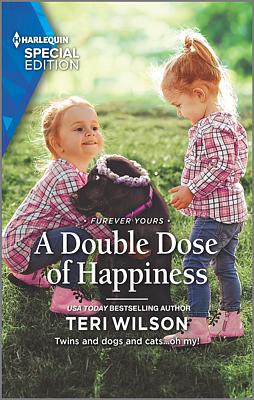

A Double Dose of Happiness
Autore
Teri Wilson
Letto da
17,9K
Capitoli
16
A home full of chaos…and comfort. With three-year-old twins to raise, widower Ian Parsons temporarily hires Rachel Gray hoping she'll solve all their problems. And soon the nanny is working wonders with his girls…and Ian. Rachel even has him agreeing to adopt a bonded dog and cat because the twins love them. He's laughing, smiling and falling in love again. But will Ian need a double dose of courage to ask Rachel to stay…as his wife?
Chapter One
“How can my kid be behind in school when she’s not even three years old yet?”
Ian Parsons felt another headache coming on—a Baby Einstein, toddler Mensa-induced rager of a headache. Wasn’t preschool supposed to be fun?
“I think maybe you’ve misunderstood.” Marianne Foster, the director of the Spring Forest Day School, gazed at Ian serenely from the other side of her desk. Serenity aside, he still felt like a teenager who’d been called into the principal’s office and was about to get expelled. “When I say Annie is falling behind, I’m not talking about schoolwork. I mean that she’s behind her peers developmentally.”
Right, because that’s so much better.
“She’s become quite withdrawn lately, and when she does speak, it’s often in baby talk,” Marianne said, whispering the last two words as if they were far too horrible to say out loud.
Ian shifted in his chair. He’d noticed the baby talk thing. But honestly, was it really that big of a deal? Annie was only two and a half. It was sort of cute. And after what his twin girls had been through in their short lives, a little baby talk or thumb-sucking was understandable.
In the first few months after Serena passed away, Ian himself had felt like curling into the fetal position on the floor on more than one occasion. He wasn’t sure how baby talk helped Annie—but he wasn’t a psychologist and he wasn’t going to argue with anything that helped his daughter cope. Because they were talking about coping mechanisms, weren’t they? That’s what all these sorts of behaviors were. Ian would have been more concerned if Annie hadn’t shown any outward signs of reacting to all of the struggles their little family had been dealing with in the past year.
“She is a baby,” Ian said, smoothing down his tie. “And I’m not going to stand in the way of her expressing herself in whatever way is most comfortable to her.”
That’s right, lady. I’m a widowed father of twin toddlers who works fifty hours a week and still makes time to read parenting books.
What choice did he have? Without the advice of his bookshelf full of literary Mary Poppinses, along with all those annoyingly cheerful Baby Einstein videos, Ian wouldn’t have the first clue what he was doing. He still didn’t, truth be told.
But he tried. Even now, after a full day at the office of the civil engineering firm where Ian was a senior partner, the words to Abby and Annie’s favorite educational song—the one about rocket ships—spun through his mind on constant repeat. Ian didn’t spend his free time on the golf course or at Pins and Pints—the local bar/bowling alley—like his work friends did. He made an effort, and he possessed enough book knowledge to know that the term baby could be used to describe any child from birth to four years old.
Nevertheless, Marianne arched a judgmental eyebrow at him. “The point is that your daughter is regressing. To be honest, they both are. Just yesterday, Abby intentionally knocked down a tower of blocks that one of her classmates built.”
“And?” Ian prompted.
Wasn’t that what happened with block towers? If not, wouldn’t the world be littered with stacks of blocks far and wide?
“And—” Marianne huffed dramatically “—the other child was quite upset. There were tears.”
Again, they were toddlers. Weren’t tears perfectly normal with this age group? Should he have put his engineering skills to work and constructed a fence to surround said block tower?
“You make Abby sound like a toddler-sized Godzilla,” he said flatly.
Marianne’s eyebrow arched even higher. If she didn’t realign her features, Ian was going to lose it.
“Back to Annie,” she said. Thank God. “It seems she’s taken a step backward in her mobility skills, as well.”
Ian’s response was a blank stare. He had no idea what she was talking about, but he wished she’d talk about it faster and get to the point—if she actually had one. He hadn’t expected to be called into the principal’s office when he’d arrived to pick up the twins at the end of the school day. He just wanted to get out of this office, go home and do something normal. Something non-angst ridden, like dining on dinosaur-shaped chicken nuggets for dinner. Or maybe the girls could ride their matching pink tricycles around the cul-de-sac in their quiet, wooded neighborhood in the Kingdom Creek development. Abby could point out the Lost Cat flyers that she’d become so obsessed with. They dotted almost every lamppost in Spring Forest, courtesy of a very determined nine-year-old Brooklyn Hobbs, who’d been inconsolable since her cat wandered off. Ian was mildly surprised that he hadn’t started seeing Oliver Hobbs’s orange tabby face in his sleep.
“Perhaps you’ve noticed that Annie has regressed to crawling rather than walking?” Marianne said, dragging his attention back to the matter at hand.
“What?” Ian shook his head. “No.”
That just wasn’t possible. He would have noticed if one of his daughters had stopped walking. Sure, Annie liked to pretend she was a dog sometimes and move around on all fours, but that seemed perfectly logical to Ian. He’d never met a dog who walked on his hind legs on a regular basis. Frankly, that sounded creepy—far more disturbing than a toddler who dabbled in baby talk and puppy role-play.
Marianne ignored his objection. Ian was starting to believe that the director of his children’s day care center had an agenda, and he wasn’t altogether sure he wanted to know what it was.
“I understand that things have been difficult at home. It’s perfectly natural for the twins to be struggling, but if things don’t improve soon, we might have to consider an alternative arrangement,” she said.
Every muscle in Ian’s body tensed. “You’re not seriously considering expelling my daughters, are you?”
Had she lost her mind? They were two-year-olds. And even if Abby had gotten a little aggressive with block towers, surely that wasn’t enough to warrant expulsion.
“No.” She gave him another serene smile that made Ian think she had one of those mini Zen gardens tucked into a desk drawer somewhere. He had a sudden urge to find it and snap the tiny rake in two. “We believe Abby can still function well in the classroom, but we’d like you to consider sending Annie elsewhere so she can receive the dedicated, individualized help she needs.”
Ian gripped the arms of the chair he was sitting on so hard that his knuckles turned white. “You want to separate the girls? Absolutely not.”
Never. Abby and Annie had lost their mother. He wasn’t about to let them lose each other. His twins did everything together. They’d never understand why they needed to attend separate schools.
Serena is probably rolling in her grave right now. In her last days, Ian had promised his wife he would do his best to give their girls a happy childhood. He’d sworn. And now here he was, just a year after Serena’s funeral, on the verge of being an epic parental failure.
Marianne folded her hands neatly in front of her, clearly unfazed by Ian’s unraveling. “Mr. Parsons, everyone here at Spring Forest Day School only wants what’s best for Annie, I assure you.”
“What’s best is not separating her from her sister. I’d pull both girls out of this school before I let that happen.” Ian stood. He couldn’t keep having this discussion.
How on earth am I going to explain this madness to Elma?
His mother-in-law was well-meaning, but like most mothers-in-law, Elma had strong opinions about how her grandchildren should be raised. Those feelings had only grown in intensity since Serena’s passing. If Elma had her way, Annie and Abby would stay with her on weekdays when Ian went to work, playing in their mother’s old room. Serena’s childhood bedroom was still perfectly preserved in all of its gingham-ruffled glory. The only change Elma had made was to remove the grand canopy bed and replace it with twin beds for the girls. Annie and Abby felt perfectly at home there.
Too at home, as far as Ian was concerned. He knew Elma missed her daughter, but that didn’t give the woman the right to commandeer her granddaughters to fill that gap. They were still his children, after all, and he wanted to be the person who raised them. Serena’s dying wish had been for her girls to have a normal and happy childhood. Happy, well-adjusted kids had friends, and that’s why Ian wanted the girls in preschool, interacting with other kids their age, instead of at Elma’s house during the day.
A little healthy distance from his mother-in-law couldn’t hurt, either, though. It was hard to be a good dad when he felt like Elma was constantly looking over his shoulder. But this...
This was different. This was serious. If Elma got wind of the fact that Annie was on the verge of expulsion, Ian was toast.
“Mr. Parsons, please sit down.” Marianne waved a hand at the chair he’d just vacated. Her tone was as tranquil as ever. It made Ian want to roar. “Maybe if we just calm down—”
He glared at Marianne. “You mean me, right? You think I should calm down.”
Not going to happen. Ian couldn’t remember the last time he’d felt calm. The word sounded almost foreign on his tongue. Stressed had become his default state a long, long time ago. And they were talking about his girls. His precious, perfect twins—the sole reason he still managed to get out of bed in the mornings.
“We’re just trying to help.” Marianne smiled at him again, but the look in her eyes told another story. They glittered with pity.
Ian looked away. He neither needed nor wanted pity—not for himself and definitely not for his daughters.
They were his tiny fighters—strong, sweet and resilient. Were they perfect? Of course not. What child was? But he would never want them to be anything but themselves—and to hell with anyone who had a problem with that.
Ian aimed his gaze back at the day care center director. “I appreciate your concern, but you’re way off base. There’s nothing wrong with Annie that a little patience and understanding won’t cure. But perhaps I was foolish to think she could find that at Spring Forest Day School.”
Then he spun on his heel to leave, because he’d said his piece. He was finished here.
Maybe his girls were too.
Rachel Gray lingered outside her boss’s office at Spring Forest Day School, gripping a plastic tub of building blocks and trying to decide if she should walk inside or make herself scarce.
When Rachel had gotten word that Marianne wanted to see her in her office, she’d assumed it had something to do with her employment paperwork. She’d been so nervous at that idea that she’d forgotten to put down the toys she’d been organizing before she’d been summoned. Now here she was, clutching the box of blocks like it was a security blanket.
But maybe this impromptu meeting wasn’t about her job application or her I-9 form. Just this morning, Rachel had mentioned that Annie Parsons seemed even more withdrawn and quiet than usual, and now Marianne seemed to be deep in conversation with the little girl’s father. Did she want Rachel to join in the conversation so she could back her up?
No. Rachel turned to go. No way.
She’d been on the job for all of two weeks, and she was just a teacher’s aide. She definitely wasn’t ready to deal with an upset father. Just the thought of it made her stomach hurt.
But before Rachel could make her getaway, Ian Parsons came storming out of Marianne’s office and plowed into the corner of the plastic tub in Rachel’s hands. The bin wobbled, and she tried her best to keep it upright, but it did a somersault in the air, sending little wooden building blocks scattering far and wide. An avalanche of ABCs.
“Oh my gosh.” Rachel’s hand flew to her throat as Ian Parson’s face turned as red as the shiny apple that little Johnny Cooper had brought her this morning. “I’m so sorry.”
She dropped to her knees and began gathering as many blocks as she could into her arms, hating the way that her heart felt like it might pound right out of her chest.
He’s a total stranger. And you’re in a public place. He can’t hurt you.
Ian sighed as he loomed above her, six feet two inches of pure fury and frustration. “Here, let me help.”
Rachel shook her head. “No, really. It was my fault.”
But he was already crouching beside her, picking up blocks and tossing them into the bin. Rachel would have gladly done it herself if he’d just go away and leave her alone.
No such luck, apparently.
“I suppose you heard what just went on in there,” he said, jerking his head toward Marianne’s office.
Rachel couldn’t help but notice that some of the bite had gone out of his tone. She looked up to meet his gaze.
“I wasn’t trying to eavesdrop.” She swallowed hard. He had the most unusual eyes she’d ever seen up close before—light brown with flecks of gold. Warm, like amber honey.
Rachel might even have considered him handsome, if not for the angry vein throbbing in his forehead.
“It was probably hard not to overhear.” The corner of his mouth hitched up a barely noticeable amount.
“Well, you were rather—” Rachel cleared her throat “—passionate.”
That sounded better than defensive and indignant, didn’t it?
Rachel didn’t know why she was trying to sugarcoat things. She didn’t like people who threw their weight around and raised their voices. Men, in particular.
But then Ian Parsons’s hands slowed until he stopped moving altogether and just sat staring down at the blocks cradled in his palm. Two red As were etched on their smooth wooden surfaces.
Annie and Abby.
He swallowed, and Rachel traced the movement up and down the muscular column of this throat. The fight seemed to drain slowly out of him, leaving something else in its place. Something rawer, more vulnerable.
Rachel moved quietly, picking up blocks and setting them gently in the bin. Being beside Ian in this private moment of reflection somehow felt more intrusive than standing outside Marianne’s door listening to him argue with her boss.
Once the rest of the mess was cleaned up, she waited a beat and then gently pried the two A blocks from his grip. A lump formed in her throat for some ridiculous reason.
Ian’s gaze lingered on the place where her fingertips had just brushed his skin, a slight furrow in his brow. Then he blinked hard, picked up the plastic tub full of blocks and stood.
Rachel scrambled to her feet and held out her hands, but he seemed to have no intention of handing over the bin.
“I’ve never seen you here before,” he said.
“I’m new.” She crossed her arms at her waist. Why couldn’t she seem to figure out what to do with her hands? “My name is Rachel Gray. I started working here as a teaching assistant with the preschoolers a couple weeks ago.”
“Do you know my daughters?” His amber eyes seemed to bore into her, making her head spin. “Abby and Annie Parsons? They’re in the preschool class. Identical twins with blond pigtails that are usually lopsided.”
Rachel felt herself smile. “Yes, I know Abby and Annie.”
“So, what do you think?”
“About the pigtails?” She let out a little laugh. “Adorable.”
He gave her another near-invisible half grin. If Rachel hadn’t been looking at his mouth, she would have missed it entirely.
Why was she looking at his mouth?
“No, not the pigtails. I meant what do you think about their behavior? Do you agree with the day care director?” he asked.
The sudden arch of his eyebrow felt like a challenge.
Uh-oh.
The last thing Rachel wanted to do was to insert herself in an argument that had nothing to do with her, particularly after he’d just stormed out of Marianne’s office and nearly reduced her to toddler roadkill. But he seemed to have calmed down a bit. When he’d been staring down at those twin A blocks in his hand, sadness had seemed to roll off him in waves.
He was asking for her opinion, plain and simple. What kind of child behavior specialist would she be if she didn’t try and help? Not that he knew she was a child behavioral specialist, but still...
“To be honest, I understand where Marianne is coming from. While I don’t necessarily agree that Annie should be removed from the classroom, I’ve noticed some developmental regression that concerns me.” She paused to take a breath. Any hint of a smile on Ian Parsons’s mouth had vanished completely. “Most of it appears to be self-soothing behaviors, things like rocking back and forth during story time and occasionally sucking her thumb. Some kids simply grow out of this sort of thing, but others don’t.”
“And you think Annie falls into the latter group,” Ian said tersely.
Rachel forced herself to square her shoulders and meet his gaze head-on. “I didn’t say that.”
“But you thought it.”
She took a deep breath. “Mr. Parsons, it doesn’t matter what I think. What matters is what we do about it.”
We.
Rachel had said we, as if she, her boss and this impatient, seething man were some sort of team, which they clearly weren’t. And that was fine. She wasn’t sure she wanted to be part of a team that would have Ian Parsons as a member.
But she cared about his daughter, whether he believed that to be true or not. So she kept on talking, even if it suddenly felt like she was addressing a brick wall.
A brick wall with lovely, moody eyes and a startlingly chiseled jawline, but a brick wall nonetheless.
Stop noticing his looks. His runner’s build and his unreasonably grumpy streak are his wife’s problems, not yours.
“There are ways to help Annie come out of her shell and give her strategies to deal with whatever situations might be troubling her and causing these changes in her behavior. I’ve worked with children who are struggling in this way before.” She lifted her chin. “I think I can help.”
He gazed coolly at her, clearly unconvinced. “Do you, now?”
“I do,” she said, holding out her arms once again so he could hand off the plastic tub. And maybe just a little bit of the burden that he was either unwilling or unable to accept.
He gave up the plastic tub but offered no indication whatsoever that he took her offer seriously.
Rachel should’ve felt relieved, but an irrational stab of disappointment hit her square in the feels.
What was she doing? She’d come to Spring Forest in search of peace and quiet. A nice, normal life. A safe life. And here she was, practically inviting herself into the den of yet another lion.
But the lion had other ideas.
“With all due respect, I think I know my daughters and ‘whatever situations might be troubling’ them better than you do,” he said through gritted teeth.
He didn’t make those irritating little air quotes around the words he’d parroted back to her, but he didn’t have to. They swam before her eyes anyway, mocking her.
“Have a nice day, Miss Gray,” he said, and then he prowled off someplace else, leaving Rachel almost wishing that she’d overturned the box of blocks again, this time over his stubborn, annoying head.