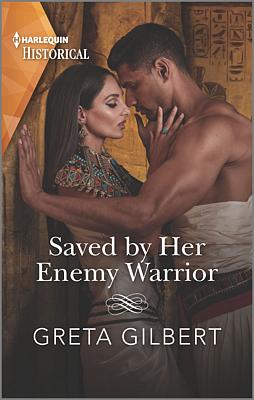

Saved by Her Enemy Warrior
highlight_author
Greta Gilbert
highlight_reads
19.0K
highlight_chapters
28
Entombed with her enemy… Will her heart remain unscathed? Left to die in the tomb of her beloved Pharaoh Tausret, royal adviser Aya would be silenced forever by those who seek power. But she is not alone! Egyptian soldier Intef is there to steal her mistress's gold. Now they must work together to escape. This handsome warrior is Aya's enemy, yet it's passion not hatred that burns between them. Can their desire withstand the revelations that await them outside?
Chapter One
Aya was kneeling in prayer when she felt the guard’s hand cover her mouth. She tried to cry out, but his large palm muted the sound. ‘Do not scream,’ he muttered in her ear. ‘Remember your dignity.’
He tugged her head backwards and she felt the cool of a blade against her throat. ‘It will be over soon,’ he assured her. ‘Close your eyes.’
Aya did as she was told. Quickly, she thought. A merciful death.
A bronze voice sliced the silence. ‘Cease.’
Aya opened her eyes to discover the High Priest of Amun standing over her, the torchlight flickering on his powdered face. He blinked at the guard. ‘No blood may be spilled inside a house of eternity. Use rope.’
There was a rush of movement into the burial chamber. Aya was seized by her arms and lifted, and her feet were pulled out from beneath her.
‘Behind the shrine,’ the High Priest directed and Aya was carried across the chamber like a goat.
‘Holy One,’ she said. ‘What is happening?’
She was tossed to the floor beside the hut-sized golden container that had been constructed around Pharaoh’s sarcophagus. She tried to sit up, but the guard’s large palm held her down.
‘Pharaoh’s Most Beloved Advisor is irrelevant now,’ he muttered, his sour breath in her ear. ‘She will follow Pharaoh to the fields of paradise.’
Aya perceived a rope being threaded between her bound arms and wrapped around the shrine.
She heard the sound of men heaving. Her wrists rose up above her head, suspended by a rope she could not see.
‘The pectoral,’ the High Priest intoned. Aya felt the weight of her golden pectoral necklace—the most valuable thing she owned—being lifted off her chest.
She tried to kick, but her feet were already bound. They were being lifted above the floor like her wrists had been.
‘I beg you to cease!’ she shouted at last and, when she heard the High Priest’s bemused grunt, she began to sob. ‘For the love of Isis.’
‘Silence her,’ he snapped and Aya felt a blow to her stomach.
‘Holy Ones!’ she shouted. Another blow. ‘Guards!’ A blow to her side, her head, her face...nothing.
When her wits returned, Aya heard the sound of bricks being stacked in mud. If death had a sound, this was it. Scoop, swish, set. Her head throbbed and her heart filled with dread. She moved to cover her ears, forgetting that her wrists were tied.
She opened her eyes.
If death had an aura, it was the quality of torchlight. It flashed across the painted ceiling, illuminating the garish yellow stars. She was lying on her back, her ankles also tied, and now she knew why the men had bound her this way.
Tied beside the shrine of the deceased, she could not show herself to the priests standing at the entrance to the chamber. She could not display her tears or appeal to them for mercy. She could not see them and they could not see her. She could only whimper in misery and stare up at those terrible stars, ablaze in the mocking torchlight.
Myrrh.
Its scent was everywhere. The priests had filled the chamber with its anise-tinged smoke. ‘The Breath of Isis’, it was called, because it was supposed to invoke the divine protectoress. But it only clogged Aya’s lungs, giving her the unusual sensation of drowning. If death had a scent, surely it was that of myrrh.
She was seized by a spasm of coughs. She strained against her bonds, forgetting that she could not cover her nose. She could do nothing but let her lungs clear themselves in the sanctified air of the tomb, feeling all the while that she was despoiling it. She should not be here, but she was tied. Tied.
She filled her voice with deference. ‘Is this some manner of test, Holy Ones?’ She pictured them lingering in the shadowy corridor just beyond the chamber, their bald heads gleaming in the torchlight. ‘Surely you do not mean to leave me here?’
The practice of burying living servants with dead kings had been forbidden in Egypt for thousands of years and the men at the entrance to the chamber knew it. It was an abhorrence, an offence to ma’at, the principle of order and justice. Yet not a single voice responded to her query.
‘Venerable priests,’ she began. ‘I beg you. Do not condemn me thus. I have never stolen. I have never cursed the gods. I have never harmed an elder, or a child, or spoken ill of anyone. I have served the Living God in all...’ she paused ‘...in most things.’
She awaited a response, but there was only the diminishing torchlight, the thickening air and the dogged rhythm of the bricks, as if the jackal-headed god of death himself were stacking them.
Her voice cracked. ‘I refer you to Pharaoh’s funeral papyrus,’ she said. And to your own humanity, by the gods. ‘I am to be freed from service! It has been written.’
But it was as if she were talking to the paintings on the walls.
Scoop, swish, set.
‘If you do not free me, you defy the will of a god!’ she shouted. ‘You place Great Egypt in danger.’
So why were the priests not responding? Aya searched her heart—the centre of all her thoughts—and a dark knowing descended. The priests did not care whether or not they offended Pharaoh Tausret, because they had never believed in Pharaoh Tausret at all.
Because Pharaoh Tausret had been a woman.
‘I can pay,’ Aya lied. ‘There is a cache of gold hidden in Pharaoh’s Temple of Millions of Years. I can show you where it is.’
She thought she heard someone grunt, followed by a breeze of whispers. Perhaps her lie had found some adherents among the priests and other officials. Perhaps the High Priest himself was considering her offer? She had long suspected his designs on the Horus throne.
The High Priest was not the only man with such an ambition. General Setnakht, a rebel general with his base right there in Thebes, had sought the double crown throughout Tausret’s reign. It was rumoured that he, too, was gathering his army and that Setnakht and the High Priest would soon face each other in battle, with the Horus throne as the prize.
There was only one problem with their efforts. Neither of the pretenders could prove a link to the royal bloodline. Without royal blood, none could win the loyalty of all the people. Royal blood was divine blood and only a god was allowed to sit on the throne of Egypt.
Whichever man succeeded in taking the throne would claim a link to Pharaoh’s bloodline and Aya was the only person who could prove him wrong.
Which was why it seemed that she was doomed.
‘You may save yourself,’ the High Priest said suddenly. The sounds of bricklaying ceased. ‘Tell me where I may find Tausret’s heir.’
Aya bit her tongue. She did not know exactly where the heir resided, but she knew enough. It was a secret that Pharaoh had shared with Aya alone. How did the High Priest know she kept it?
Perhaps he had only guessed that Aya knew about the heir. Perhaps he thought that the threat of entombment would be enough to coax her secrets from her.
‘Speak now, woman!’ the High Priest thundered. ‘Or be silent for ever!’
It was her chance. If she would reveal the location of Pharaoh Tausret’s only living son, she could save her own life.
But it was a confession she could not make. She had been a poor counsellor and an even poorer protector, but a traitor she was not. She would keep the heir’s existence hidden for ever, for that had been Pharaoh’s dying wish.
Scoop, swish, set.
Now it was Aya who said not a word and the moments seemed to stretch into years. She had failed Pharaoh in many things, but she would not fail her in this.
‘I will find him, you know,’ snapped the High Priest. ‘And I will kill him.’
Aya heard another brick slide into place and the sound of voices moving further and further away. ‘You will not find him,’ she whispered, as if merely saying the words could somehow make them true.
She would not allow herself to cry, though tears seeped from her eyes anyway. She needed to remember her dignity, as the guard had said. She had begged and grovelled and debased herself enough. Now it was time to quietly accept her fate.
‘The will of Osiris,’ she whispered and a stream of tears dribbled into her mouth. They tasted of kohl and brine, of sour and salt. They were the taste of suffering, of a long, slow, terrible death.
There was not a single sound now and even the painted stars had ceased to shine. And Aya was alone.