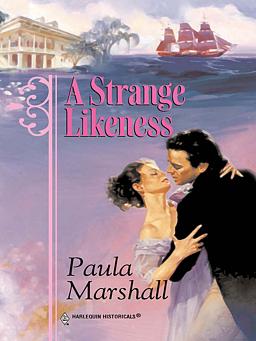

A Strange Likeness
Auteur
Paula Marshall
Lezers
19,7K
Hoofdstukken
14
FAMILY SECRETS. Something had gone wrong with the London end of the Dilhorne business empire, and Alan had been sent to England to make things right. But almost immediately after his arrival Alan met Ned Hatton, and to his total astonishment found that they were almost identical. It wasn't until he met Ned's sister, Eleanor, and learned more of their family background that he realized the likeness was more than a coincidence. The trouble was, as he grew to love Eleanor, the family secret could sweep away any hope he had of a lifetime with his true love.
Chapter One
London, 1841: Monde and demi-monde
Mr Alan Dilhorne, ‘the person from Australia’, as some butlers were later to call him, stood in the foyer of the Haymarket Theatre, London, on his second night in the capital.
Tired after the long journey from Sydney, he had gone straight to bed at Brown’s Hotel when he had arrived there, but a day’s sleep had restored him to full vigour and a desire to explore the land which had exiled his father. He looked eagerly about him at the fashionable crowd, many of whom stared at his clothing which, however suitable it had been in Sydney, branded him an outsider here.
Curious stares never troubled Alan. His confidence in himself, helped by his superb physique and his handsome face, was profound. It was backed by the advice offered him by his devious and exacting father.
‘Work hard and play hard’ was his maxim, which Alan had no difficulty in following. He had come to London to carry out a mission for his family which promised him a busy time in the old country. He was not going to allow that to prevent him from enjoying life to the full while he executed it.
He had walked through the demi-monde on his way to the theatre, and it was obviously much larger and livelier than its counterpart in Sydney.
A hand fell on his shoulder and spun him half around. A man of his own age, the late twenties, fashionably dressed, slightly drunk already, was laughing in his face.
‘Ned! What the devil are you doing here so early, and in those dam’d awful clothes, too?’
‘Yes,’ chimed his companion. ‘Not like you, Ned, not at all. Fancy dress, is it?’
‘Ned?’ said Alan slowly. ‘I’m not Ned.’
The small group of young gentlemen before him looked suitably taken aback.
‘Come on, Ned. Stop roasting us. What’s the game tonight, eh?’
‘Not roasting you,’ said Alan firmly. ‘I’m Alan Dilhorne, from Sydney, New South Wales. Don’t know any Neds, I’m afraid.’
He had deepened his slight Australian accent and saw eyes widen.
‘Good God, I do believe you’re not Ned,’ said his first accoster.
‘Bigger in the shoulders,’ offered one young fellow, who was already half supported by his friends. ‘Strip better than Ned, for sure. Bit soft, Ned.’ Other heads nodded at this, to Alan’s amusement.
The first speaker put out a hand. ‘Well, Not Ned, I’m Frank Gresham, and you’re like enough to Ned to deceive anyone. I’d have taken you for him on a fine day with the hounds running.’
Alan liked the look of the handsome young man before him, whom he took to be younger than he was—in contrast to himself; he looked more mature than his years.
‘I’d like to see Ned. Ned who?’
‘Ned Hatton. Not here yet, obviously. Always late, Ned. Look here, Dilhorne, is it? Meet us in the foyer in the first interval and you shall see him. And if this play is as dam’d boring as I expect it will be, we’ll make a night of it together.’
Most of them looked as though they had made more than a night of it already.
‘You got that shocking bad hat and coat in Australia, I suppose?’ said Gresham’s half-drunk companion, introduced as Bob Manners. ‘Better get Ned to introduce you to his tailor—won’t want his face walking around in that!’
‘Shame on you, Bob,’ said Gresham genially. ‘Fellow can’t help where he comes from.’
He put his arm through Alan’s—he had obviously been adopted as ‘one of theirs’ on the strength of his likeness to Ned—whoever he was. ‘Buy you a drink before the play, Dilhorne—girls’ll look better with a drop inside.’
Bells were already ringing to signal the start of the entertainment, but Gresham and his chums took no notice of them. The man at the bar knew him.
‘Yes, m’lord, what is it tonight?’
So Frank, who had walked him over, was a lord and Ned, who had still not arrived, was his friend. The foyer emptied a little, but Alan’s new friends continued to drink for some time before they decided that they were ready to see the play.
He made his way to his seat as quietly as he could, so as not to disturb the audience or the others in the box. Frank and his companions, who were a little way away from him, were not so considerate. They entered their box noisily and responded to the shushing of the audience by blowing kisses and, in Bob Manners’ case, by dripping the contents of a bottle of champagne on to the heads of the people below.
Alan, looking eagerly around the garish auditorium, expected them to be thrown out, but the other people in his box, half-amused, half-annoyed, knew the revellers.
‘It’s Gresham’s set again,’ said one stout burgher wisely to his equally plump wife.
‘Disgusting,’ she returned. ‘They should be thrown out, or not allowed in.’
‘Manager can’t throw Gresham out—too grand.’
The spectacle on the stage amused Alan, although it did not engage him. Half his mind was on his recent encounter, and when the curtain fell at the first interval he was down the stairs in a flash to see Ned, who wore his face.
Gresham’s friends, who had quietened a little after their entrance, had further annoyed the audience by leaving noisily before the first act ended, and were already busy drinking when Alan arrived in the bar. He was loudly greeted, and he guessed, correctly, that his new acquaintances were bored and needed the diversion which he was providing.
Well, that did not trouble him—who knew how this odd adventure might end?
‘It’s “Not Ned”, the Australian,’ proclaimed Gresham. ‘Here, Ned, here’s your look-alike.’ And he tapped on the shoulder the tall man standing beside him.
Ned Hatton turned to confront himself. And it was a dam’d disturbing experience, he reported afterwards. All he said at the time was, ‘Jupiter! You’ve stolen my face.’
Alan was amused as well as startled by seeing his own face without benefit of his shaving mirror.
‘As well say you’ve stolen mine.’
‘Not quite your voice, though,’ offered Manners. ‘Nor your clothes. But, dammit, you’re even the same height.’
‘I’m Alan Dilhorne, from Sydney, New South Wales,’ said Alan, putting out a large hand to Ned for it to be grasped by one very like his own. Yes, Manners had been right: Ned was softer.
Fascinated, Ned shook the offered hand. ‘Well, Alan Dilhorne, what you most need is a good tailor.’
‘And a good barber,’ commented Gresham critically. ‘Although nothing could improve the colour—as shocking as yours, Ned.’
General laughter followed this. Alan’s amusement at their obsession with his clothes and appearance grew.
The bells rang for the start of the next act. None of his new friends took the slightest notice of them. Alan debated with himself. Should he go back, alone, to his box? Or stay with this chance-met pack of gentlemen and aristocrats whom in normal circumstances he would never have met at all?
Fascination at meeting his exact double kept him with them. Almost exact was more accurate, for Manners was right: Ned was certainly not in good shape, would not strip well, and was, in all respects, a softer, smoother version of himself.
‘Well, my boys, let’s be off,’ said Gresham. ‘A dam’d dull play, and a dam’d unaccommodating audience. Give it a miss, Dilhorne, and come with us. Let’s find out if you can hold your drink better than Ned. Looking at you, I’d bet on it.’ He clapped the protesting Ned on the shoulder. ‘Come now, Ned, you know you’ve less head for it than Manners here, and that’s saying something!’
He removed the stovepipe hat which Ned had just put on and tossed it into the street. ‘Last one to leave pays for the rest. First one buys Dilhorne a drink.’ And the whole company streamed convivially out of the theatre, bound for another night on the town.
A couple of hours later Alan found that he could hold his liquor better than any of them, including Ned, which was not surprising, because although he appeared to keep up with them he took care, by a number of stratagems taught him by his father, not to drink very much.
They had been in and out of several dives, had argued whether to go on to the Coal Hole or not, and at the last moment had become engaged in a general brawl with some sturdy bruisers guarding a gaming hell just off the Haymarket. Ned expressed a wish to go to Rosie’s. Gresham argued that Rosie’s was dull these days. Alan intervened to prevent another brawl, this time between the two factions into which the group had divided.
His suggestion that they should split up and meet again another night met with drunken agreement. He announced his own intention to stay with Ned.
‘Mustn’t lose my face,’ he announced, and accordingly the larger group, under Gresham, reeled erratically down the road, to end up God knows where. Ned and another friend, whose name Alan never discovered because he never met him again, made for Rosie’s, which had the further attraction for Ned of being near to where they were, thus doing away with the need for a lengthy walk or a cab.
Rosie’s turned out to be a gaming hell-cum-brothel similar to many in Sydney, though larger and better appointed. Hells like Rosie’s were sometimes known as silver hells, to distinguish them from the top-notch places to one of which Gresham had led the other party. Ned, though, liked the easier atmosphere of these minor dives rather than the ones which the great names of the social world patronised. Besides, they were rarely raided by the authorities.
The gaming half of Rosie’s was a large room with card tables at one end and supper tables spread with food and drink at the other. The food was lavish, and included oysters, lobster patties and salmis of game and salmon. The drink was varied: port, sherries, light and heavy wines stood about in bottles and decanters.
Alan, who was hungry, sampled the food and found it good. The drink he avoided, except for one glass of light wine which he disposed of into a potted palm, remembering his father, the Patriarch’s, prudent advice.
Disliking bought sex—another consequence of his father’s advice—he smilingly refused Ned’s suggestion that he pick one of the girls and sample the goods upstairs.
‘I’m tired,’ he said. ‘Much too tired for exhausting games in bed. I think that I’d prefer a quiet hand of cards—or even to watch other people play.’
‘Suit yourself,’ said Ned agreeably. He was always agreeable, Alan was to find, and this was a handicap as well as a virtue, since little moved him deeply.
‘Play cards by all means,’ Ned continued. ‘Girls are better, though. I always score with the girls, much more rarely at cards. Don’t wait for me, Dilhorne. I’ll see you tomorrow afternoon at Stanton House.’ He had earlier invited Alan to visit him at his great-aunt Almeria’s, his base when he was in London.
He went upstairs on the arm of the Madame, a pretty girl in tow, leaving Alan with the other highly foxed member of the party slumped on a bench near the gaming tables. Alan made himself comfortable in a large armchair which gave him a good view of the room. Sitting there, half-asleep, he watched two well-dressed members of the ton enter. One of them flapped an idle hand at him, and murmured, ‘Evening, Ned.’
Alan did not disabuse him. He could tell that they were both slightly tipsy, at the voluble stage, and when they seated themselves at a table near him the larger, noisier one began chaffing the other about a visitor he was expecting to arrive at his office on the following morning—‘Or rather, this morning, to have it proper.’ He had apparently reached the pedantic stage of drunkenness.
‘From New South Wales, I understand, Johnstone.’
The other laughed humourlessly. ‘Yes—if it isn’t bad enough that I have to earn a living at all, I’m expected to dance attendance on a pack of colonial savages who have set up in London and are sending one of their cubs to tell us our business. I understand that Father Bear went out there in chains. What a set!’
‘And when do you expect Baby Bear?’
‘Tomorrow, as I said. He sent me a note today, telling me that I am to have the honour of his presence at ten. The honour of his presence! And at ten! I don’t recognise the time. Well, Baby Bear will have to wait. He proposed the time, not me. The honour of his presence, indeed!’
He choked with laughter again, spluttering through his drink, ‘Young Master Alan Dilhorne must fancy himself.’
Alan had early begun to suspect exactly who Johnstone was speaking of, and this last sentence confirmed it. The true son of his devious father, he gave nothing away. Johnstone had risen, looked over at him and said, ‘A game of cards, Ned?’
Alan nodded. At some point he would have to speak. He, and not his older twin, Thomas, had inherited their father’s talent for mimicry. He tried out Ned’s voice in his head. It was light and careless, higher than his own, a very English upper-class drawl. He thought that he could pull it off. Impersonating Ned would be harder than some of the tricks he had played at home—but it would give him a different form of amusement.
Meantime, he warned himself, he must watch his vowels—it wouldn’t hurt to appear to be a little drunk. Johnstone and his pal called in another man so that they could sit down in pairs to play piquet. Johnstone against Alan, and his friend against the stranger. Alan prayed that Ned would not return; he had said that he would not, but one thing was very plain: he was not reliable and said whatever pleased him at the time.
It soon became equally plain that, for Johnstone, Ned was a pigeon to be plucked. He assumed that Ned was both drunk and careless and his manner was lightly contemptuous. Well, he might be in for a surprise. Alan began by knocking over his glass of light wine and dropping his cards. He fell on to his hands and knees in order to pick them up, exclaiming, ‘The devil’s in them tonight.’
He heard Johnstone and his friends, Lloyd and Fraser, laugh while he continued to offer them the picture of incompetence which they both expected from flighty Ned Hatton. All three, indeed, obviously regarded Ned as little better than a fool. Lloyd even winked at Johnstone when Alan dropped his cards again.
By the end of a couple of hours, though, they were all frowning. Stupid Ned Hatton was having the devil’s own luck, and was far in advance of the game, having consistently won despite muttering and moaning, losing his cards and once depositing all his gaming counters on the floor.
‘Hands and knees business, again,’ he announced cheerfully. ‘Rising like Venus from the waves,’ he drunkenly told them all, before he began winning again. In his last hand, before he broke Johnstone completely, he even Rubiconed him—a feat rarely performed.
‘By God, Ned, you’ve got the cards tonight,’ exclaimed Johnstone, unable to credit that it was skill and not luck which was defeating him.
‘Fool’s luck,’ muttered Alan, picking up yet another of Johnstone’s IOUs with shaking hands. His father’s tuition and his own mathematical skills, honed by several years of running the money-lending side of his father’s business, gave him a good edge over most card players—even those as skilful as Johnstone, who was obviously unused to losing.
Towards the end Alan began to suspect that Johnstone’s friend was shrewd enough to guess that there was something odd about Ned Hatton that night, and when Lloyd’s game came to an end, with him as winner, Alan announced that he was too tired to continue. Since Johnstone had also had enough, they finished playing in the early hours of the morning.
Stone-cold sober, as he had been all along, Alan was careful to stagger out of Rosie’s some little distance behind Johnstone and his friends. The Haymarket was alive with light and noise—he was in the midst of the demi-monde about which his father had warned him. Chance and his strange resemblance to Ned Hatton had brought him here—and had also given him a strange opportunity.
He laughed to himself all the way to Brown’s. Not only would he be better prepared to meet Johnstone in the morning, but he was relishing the prospect of watching the other man’s reaction when someone with Ned Hatton’s face walked into Dilhorne and Sons’ London office.
And in the afternoon he was due to visit Stanton House off Piccadilly. It should be an interesting day.
Although perhaps not quite so surprising as the one just past!
‘You’re up early today,’ Eleanor Hatton commented to a yawning Ned, who had come down for breakfast in the middle of the morning and not at its end.
He took a long look at her and said inconsequentially, ‘I still can’t get used to how much you’ve changed.’
Eleanor smiled somewhat ruefully. She was remembering the first occasion on which Ned had visited Stanton House after her great-aunt Almeria had taken her over. She had only been away from Yorkshire for three months—the longest three months of her life, she had thought at the time.
At first she had fought and argued in her determination not to be turned into a fine lady. She had hated London and longed for her carefree life in the country. Worst of all had been to be told to forget notions of educating herself beyond the mere demands of most fashionable women’s lives.
Finally she had confronted her great-aunt with an ultimatum. ‘If you will allow me to spend a few hours each week with Charles and his tutor, Mr Dudley, then I will agree to be groomed for the life of a fine young lady. Otherwise…’ And she had shrugged.
Almeria Stanton, faced with a will as strong as her own, had capitulated.
‘A bargain then,’ her aunt had agreed, amused by Eleanor’s strange mixture of learning, and athleticism, both qualities totally unsuitable for the lady of fashion which she was destined to be.
Charles was Lady Stanton’s grandson, a lively twelve-year-old who had been left behind in England when his soldier father had been ordered to India. His tutor, an earnest young man, had been pleased to teach her once Eleanor had proved that her interest in learning was genuine. He had also, much against his will, fallen in love with the lively young woman who was so far beyond his reach.
Eleanor kept her promise. Ned, meeting her again after nearly two years, had barely recognised her. She had entered the room where he’d been reading the Morning Post, stripped off her gloves, pulled off her poke-bonnet to reveal her fashionably dressed hair, and smiled at him in the cool, impersonal way she had learned from her great-aunt.
‘Oh, Ned, how nice to see you,’ she’d murmured, graciously offering him two fingers and her cheek.
Ned had been lost between admiration and horror. Where had tomboy Nell gone to?
‘Good God, sister, what have they done to you?’
‘I’m a lady now, Ned. I’ve had my come-out and two proposals of marriage. Both unsuitable, I hasten to add. I’ve also got a marquess dangling after me. Not that I care about him; he’s as old as the hills.’
Almeria had surveyed her transformed charge approvingly. ‘Well done, my dear—although we could have done without the bit about the Marquess.’
‘Well done?’ Ned had exclaimed scornfully. ‘What do you think that Stacy will have to say about this?’ He had flipped his hand derisively in his sister’s direction. ‘I thought that you, at least, were a girl of sense. Never thought that propriety would overtake you, Nell.’
‘Eleanor,’ she’d said automatically, colouring faintly and moving away from him. ‘Nell’s days are over. Sir Hart was right. My behaviour was not proper. In any case, I have to leave now. I need to change for Lady Lyttelton’s soirée.’
‘Oh, you’ll come about, I’m sure,’ Ned had said uneasily, but she hadn’t. Some of their old rapport had returned, but the Nell who had romped with Ned, Nat and Stacy had gone for ever.
Now, sitting opposite to her, months later, drinking coffee and nursing a thick head after the previous evening’s debauchery, he asked, somewhat blearily, ‘Going to be in this afternoon, Eleanor?’
She looked up from her plate. ‘I shall be with Charles and his tutor until four-thirty, and then I’m free. Why?’
‘I’ve invited an Australian friend I made last night to meet me here around half past four. I promised to take him to Cremorne Gardens this evening. Thought that you might like to meet him before we go.’
He did not say so, but Ned was hoping to play a jolly jape—his words—on his sister when Alan arrived. It was all that she deserved for turning herself into such a fashionable prig.
‘An Australian?’ said Almeria Stanton doubtfully. ‘Is he a gentleman, Ned?’
‘As much as I am,’ returned Ned ambiguously. ‘Which isn’t saying much, I know. But I think that you’ll like the look of him.’
He laughed to himself when he said this, and watched Nell rise gracefully from the table. She and Great-Aunt Almeria were about to spend the morning shopping in Bond Street, an occupation which the Nell who had once been Ned’s boon companion would have rejected completely.
Never mind that, though. Ned nearly choked over his coffee when he thought of the shock she would get when she met Alan Dilhorne. He wondered idly what his new friend might be doing on this bright and shining early summer morning.
Alan was enjoying himself by combining business with pleasure. He rose early, ate a large breakfast and arrived at Dilhorne and Sons’ London office promptly at ten. They were situated in one of the rabbit warren of streets in the City, at the far end of a filthy alley. This appeared to signify nothing, since several of the dingy offices sported brass plates bearing the names of businesses equally if not more famous than Dilhorne’s.
He still wore his disgraceful clothes, and the clerk in the outer office gave him a look which could only be called insolent.
‘Yes?’ he drawled, not even putting down his quill pen. His contemptuous look dismissed this poorly dressed anonymous young man.
‘I have an appointment with Mr George Johnstone at ten of the clock,’ Alan announced without preamble.
‘Doubt it.’ The clerk’s drawl was more insolent than ever. ‘He never gets in before ten thirty, mostly not until eleven.’
‘Indeed.’
Alan looked around the untidy, disordered room, and listened to the staff chattering together instead of working. He noted the clerk’s languid manner and the idle way in which he entered figures into a dog-eared ledger. He reminded himself that his father, always known to his family as the Patriarch, had sent him to England with instructions to find out what was going wrong with the London end of the business.
He wondered grimly what the Patriarch would do in this situation. Something devious, probably, like not announcing who he was in order to discover exactly how inefficient the business had become. Yes, that was it. They could hang themselves, so to speak, in front of him. Yes, deviousness was the order of the day.
‘I’ll wait,’ he offered, a trifle timidly.
‘I shouldn’t,’ said the clerk, grinning at Alan’s deplorable trousers. ‘He won’t see you without an appointment—and I’ve no note of one here.’
Alan forbore to say that, judging by the mismanagement he could see in the office and its slovenly appearance, the clerk’s list might be neither accurate nor reliable.
Time crawled by. When the clock struck eleven the clerk looked at Alan and said, ‘Still with us, then?’
‘Nothing better to do.’ Alan was all shy, juvenile charm, which the clerk treated as shy, juvenile charm should be treated by a man of the world: with contempt.
‘Pity.’ The clerk’s sympathy was non-existent.
Everyone stopped work at eleven-thirty. One of the junior clerks was sent out for porter. Alan looked around, identified where the privy might be, used it, and came back again to take up his post before the clerk’s desk.
‘Thought you’d gone,’ tittered one of the younger men, currying favour with the older ones, waving his pot of porter at him.
No one offered Alan porter. He resisted the urge to give the jeering young man a good kick and sat back in his uncomfortable chair.
It was twelve-fifteen by the clock when George Johnstone entered, blear-eyed and yawning. The clerk waved a careless hand at Alan. ‘Young gentleman to see you, Mr Johnstone.’
Johnstone looked at Alan in some surprise.
‘Good God, Ned, what are you doing here? Still wearing those dreadful clothes, I see. Lost all the Hatton money?’
‘I came to see how hard you businessmen work.’
Alan’s imitation of Ned’s speech was perfect enough to deceive Johnstone.
‘Come into my office, then. Thought that I’d have a visitor waiting to see me. Some colonial savage—but he’s obviously given me a miss. Or he’s late. You can entertain me until he arrives.’
Alan followed him into his office. It was little cleaner or tidier than the one which the clerks occupied.
‘Have a drink,’ offered Johnstone, going immediately to a tantalus on a battered sideboard. ‘Must get ready for Baby Bear.’
‘Not in the morning,’ said Alan, still using Ned’s voice.
‘T’isn’t morning,’ said Johnstone, sitting down and swallowing his brandy in one gulp. ‘By God, that’s better. Hair of the dog. But have it your way, Ned.’
‘I fully intend to,’ returned Alan, in his own voice this time. He rose abruptly: now to do the Patriarch on him. He leaned forward, seized Johnstone by the shoulders and hauled him to his feet with a jerk. He let go of the astonished man and stood back.
‘Stand up when you speak to me, you idle devil!’
His cold ferocity, so unlike Ned Hatton’s easy charm, was frightening in itself. Coming from someone with Ned’s face it was also overpoweringly disconcerting.
‘You aren’t Ned!’ squeaked Johnstone, beginning to sit down again.
‘How perceptive of you. No, I’m not. And stand up when Baby Bear speaks to you.’
‘Oh, by God, you weren’t Ned Hatton last night, were you?’
‘No, I wasn’t Ned Hatton last night, either. I am your employer, Tom Dilhorne’s son Alan, come over without his chains to find out what has gone wrong with the London end of the business. I only needed to look at you to find out. Would you care to explain how a worthless fine gentleman like yourself came to be in charge here?’
‘But why do you look exactly like Ned Hatton? Are you his cousin?’
Alan surveyed Johnstone wearily. ‘No, I’m not his cousin. It’s just a strange likeness, that’s all. Pure chance. And I’m not a pigeon for the plucking like poor Ned, either—which you found out last night.’
‘Doosed bad form that, pretending to be Ned Hatton.’
‘You called me Ned first. You were so dam’d eager to fleece him that you couldn’t look at him properly. You haven’t answered my question.’
‘What question?’
Alan sighed. ‘How you came to be in charge here? Good God man, where’s your memory?’
‘I was Jack Montagu’s friend. He knew I needed to find work so he made me the manager here when he married his heiress.’
‘I suppose you think that you’ve been working. Good God, man, you don’t know the meaning of the word, but you will by the time that I’ve finished with you.
‘I want to inspect all your books and papers. I want to interview every clerk in your employment, see all contracts, bills of sale, be given a full account of all transactions, wages, rents, and what you’re paying for this hole—it had better be cheap. In short, I want a full account of the whole business, and I want everything ready for inspection by ten of the clock tomorrow. Not ten-thirty, mind, but ten. You take me, I’m sure.’
This last sentence was delivered in a savage imitation of Johnstone’s own gentlemanly drawl.
Johnstone blenched. ‘I can’t, Dilhorne, you’re mad.’
‘Sir, to you,’ said Alan, in the Patriarch’s hardest voice. ‘You can and you will, or it will be the worse for you.’
‘Good God, sir, it will take all night.’
‘Then take all night. You and the rest of the idlers in the other room have wasted enough of the firm’s time and money. Now you can make some of it up.’
Johnstone sank back into his chair, his face grey.
‘I didn’t give you leave to sit, you idle devil. You’ll remain standing until I leave.’
Mutinously Johnstone rose, silently consigning all sandy-haired young Australians to the deepest pit of Hell.
‘Now mind me,’ said Alan pleasantly. ‘You’ll jump when I say jump, and you’ll say please nicely when I ask you to if you don’t want instant dismissal. And if you think that Baby Bear plays a rough hand I can’t recommend you to meet Father Bear. He’d not only eat your porridge, he’d eat you, too.’
He strolled into the outer office, leaving behind him a stunned and shaken man. The clerk, quite unaware of what had taken place in Johnstone’s room, gave him yet another insolent grin, and said, ‘Got your interview, did you? Not long, was it?’
‘Yes,’ said Alan sweetly. He looked judiciously at the clerk, registered his leer, leaned forward, picked up his inkwell and slowly poured its contents over the page of ill-written figures which the clerk had been carelessly copying from various invoices, receipts and notes of hand.
‘What do you think you’re doing?’ yelped the clerk. ‘That’s my morning’s work ruined.’
‘Well, you ruined my morning’s work,’ said Alan reasonably, head on one side, surveying the havoc he had wrought. ‘You can do it again, legibly this time.’
He turned and shouted at the door behind him, ‘Johnstone! Come here at once!’
To the clerk’s astonishment the door opened and a respectful Johnstone appeared.
‘Sir?’ he said to Alan, and the office fell silent at the sound.
‘What is this man’s name?’ asked Alan.
He still had the inkwell in his hand and he leisurely began to pour the remains of the ink on to the clerk’s head. The clerk let out another strangled yelp and looked reproachfully through the black rain, first at Alan and then at the subservient Johnstone.
‘Phipps,’ Johnstone said. ‘Nathaniel Phipps.’
‘Phipps,’ said Alan thoughtfully. ‘Dirty, isn’t he?’ He critically surveyed the ruined ledger and the ink dripping down Phipps’s face.
‘Yes, sir,’ agreed Johnstone nervously.
‘You did it,’ squealed Phipps at Alan. ‘He did it, Mr Johnstone. Not I.’
“‘You did it, sir,” is the correct usage,’ said Alan, putting down the empty inkwell. ‘Say it after me, please.’
‘Mr Johnstone, sir,’ roared Phipps desperately. ‘Please stop this madman.’
‘Madman? Tut-tut,’ said Alan. ‘And if I am mad you’ve driven me into that condition, what with making me wait over two hours in a dam’d uncomfortable chair and enduring your insolence while I did so. I’ve a short fuse, which anyone who works for me soon finds out.’
This was a lie, but Phipps was too agitated to care.
‘Works for you! I don’t work for you! I work for Mr Johnstone.’
‘And he works for me,’ said Alan gently. He picked up the clerk’s quill pen, and with the whole office and Johnstone watching him silently, breath drawn in, he rolled it in the ink and negligently wrote his initials on Phipps’s forehead.
‘Yes, he works for me, and so do you now. You’re mine, Phipps. Alan Dilhorne’s property so long as you’re in this room. Unless, of course, you care to resign.’
The silence in the room grew more deathly, broken only by the clerk’s whimpering while he scrubbed at his face with his handkerchief. ‘This can’t be true, Mr Johnstone.’
‘Oh, but it is,’ said Alan. ‘Now clean up your disgusting person and your disgraceful work and do it again: properly this time.’
‘It’s not fair,’ said Phipps tearfully. ‘You should have told me who you were.’
Alan’s face was suddenly like stone. ‘Ah, but you see, I needed to know how you would treat someone whom you didn’t know was your employer’s son, and I found out, didn’t I. Didn’t I, Phipps? And if you can’t see what was wrong with what you’ve just said, then we shall never get Dilhorne and Sons’ London branch straight again, shall we?’
He swung round and addressed his staring staff. ‘The rest of you can get down to it immediately, and do an honest day’s work for once. You’re none of you fit to work in my Sydney office. Mr Johnstone will tell you what I expect of you by tomorrow, and God help you all if it’s not ready by ten.’
He walked to the door before turning and delivering his parting shot.
‘Oh, and by the by, mid-morning porter is out, from today!’