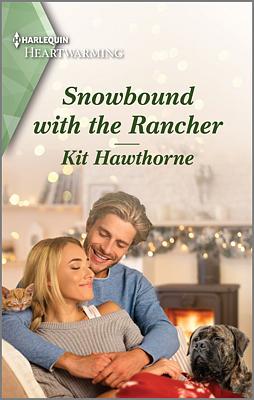

Snowbound with the Rancher
Автор
Kit Hawthorne
Прочтений
19,6K
Глав
20
A rancher and a city girl… Trapped together by a storm. Dirk Hager's Texas property is under siege by city folk who know nothing about ranch life. That includes his new neighbor, Macy Reinalda, who is just looking for peace and quiet in her new home. When a storm leaves them snowbound, they try to find common ground. Can an old-school cowboy and an outsider looking for serenity learn to share the land — and love again?
CHAPTER ONE
DIRK HAGER SCANNED the northern horizon as he made his way along the fence, keeping his horse at an easy walk. Thick gray clouds covered the sky, heavy with the threat of snow. The bleached buffalo grass rippled in a breeze that was getting colder by the minute.
Monte’s flaxen mane stirred against his thick, copper-colored neck. He was a big horse, over sixteen hands, with a good bit of Belgian Draft mixed in with his quarter horse ancestry.
Not for the first time, Dirk wished there was a way to truly and permanently coyote-proof a long fence—although, nowadays, it wasn’t so much coyotes he was worried about; it was dogs. A coyote didn’t normally want to come too close to the house, but a dog didn’t care. And with all the newcomers in the area, there was bound to be an uptick in the local population of marauding dogs. He’d seen it before. People moved to the country and thought it was fine to let their dogs roam all over, with never a thought as to the havoc they’d wreak on nearby poultry or livestock. Problem was, folks like that didn’t think of their dogs as dogs—predator animals with the capacity, suppressed but never wholly bred out of them, to hunt. They didn’t believe their family pets could ever steal chickens or kill calves. Once the inevitable happened and their dog got shot by some rancher defending his livelihood, they wrote aggrieved letters to the editor of the local paper, casting themselves as the innocent victims of barbaric, trigger-happy cowboys eager to relive the days of the Wild West.
It was all a matter of respect—for other people’s property, and for the dogs themselves. The same qualities that made a vicious, undisciplined dog into a menace also made an asset of a good, well-trained dog—like Fletch, Dirk’s old Aussie–border collie mix, with his tireless work ethic and almost intuitive grasp of what Dirk wanted him to do at any given moment. Fletch was smarter than most hired hands, and far better company.
Some wild turkeys had gathered around a concrete watering tank just beyond a dip in the land. Dirk saw them fan their tails, then did a double take. Amid the subdued spreads of brown-and-chestnut feathers was a brilliant semicircle of turquoise, purple, royal blue and gold.
“Huh,” he said aloud. An actual peacock was out there in his pasture, hanging out with the wild turkeys like a city slicker on a dude ranch. A newcomer’s pet, no doubt. Dirk was no expert on peafowl but seemed to recollect that they weren’t especially cold hardy. That fancy bird had better skedaddle on home if it didn’t want to freeze to death come nightfall.
All that was assuming the Extreme Winter Weather Event that the weather folks kept yammering about didn’t turn out to be so much hot air. Dirk didn’t trust weather forecasters, always piling on the drama with all their fancy talk. But he’d heard at the feed store that a lot of hunters and trappers had reported seeing unusually thick fat reserves on game animals this fall, and in his experience, that was usually a good indication of a hard winter to come.
So he was hoping for the best while preparing for the worst, which was pretty much business as usual. He hadn’t bought a gas generator or made a panicked grocery run to H-E-B, but he’d laid in a good supply of feed and checked that his pantry was full. For country folks, being prepared was a way of life. Stuff happened. Roads and gravel driveways got washed out, power failed. And when it did, official help wasn’t always close to hand. Country folks had to rely on themselves, and take care of their neighbors.
The word neighbor, though—that was a relative term. Alex Reyes, now, over on Corbett Road, was a terrific neighbor and friend. He and Dirk, and their grandfathers before them, had helped each other out loads of times over the years—and worked together to help other folks, for that matter. Just yesterday, the two of them had gone to check on Miss Ida, who lived alone a mile or so down the road and didn’t get around so well anymore. They’d brought some hay for her horse, Peaches, and spent an afternoon splitting firewood, stacking it on the front porch, recaulking some windows and replacing a rotten porch step. Miss Ida had fed them on cornbread, turnip greens and pot liquor and sent them both home with thumbprint cookies packed in slightly battered vintage tins with snowy landscapes printed on the lids.
That was good old-fashioned neighborliness, on both sides.
But the horde of outsiders currently overrunning Limestone Springs and the surrounding countryside—that was another thing entirely. Those weren’t neighbors; they were an infestation.
Dirk halted his horse and dismounted. A dead tree branch had fallen onto the fence, stretching the space between the strands of barbed wire. He pulled the branch free and set it by the fence post, then used his fence tool to crimp the slack out of the wires.
As he walked back to Monte, he automatically looked around for Fletch. He had his lips primed for a whistle before remembering.
His heart seized up with a sharp pang. He wouldn’t ever again see that lithe body, with its long blue merle and copper coat, weaving its way through the grass toward him. In a year that had been full of losses, that one was the most recent and the most fresh.
He swung himself into the saddle and checked the sky again. Still no snowfall, but those clouds were looking thicker and heavier.
And away to the north, a dark smudge rose up from somewhere behind the tree line.
Dirk frowned. Wood smoke—and from the look of it, coming from not too far off, in one of the new lots in Masterson Acres. A cozy fireplace blaze in one of the newcomers’ houses? Or the early stages of a grass fire heading his way? That’d be real cute, if a devastating fire swept through the area just ahead of the Extreme Winter Weather Event.
Probably just chimney smoke, he told himself. But he’d go take a look to make sure. If he had to guess, he’d say the smoke was coming from Lot Eight, but he wasn’t yet familiar enough with the new houses to be able to mentally place their chimneys from across the creek. He wasn’t even sure they all had chimneys. In this climate, most folks didn’t bother with fireplaces.
It had been a dry fall in Seguin County, and a dry summer before that. All the weed stalks and parched grasses amounted to so much tinder, ready to catch in a spark from a passing car. Dirk hadn’t forgotten the fire that had threatened the Ramirez ranch, La Escarpa, a few years back. It could have been catastrophic, if Tony Reyes, who was both a volunteer firefighter and intimately familiar with that particular ranch, hadn’t seen the fire in its early stages, called Dispatch and gotten the Ramirez cattle to safety.
Dirk followed the trail to the spot where, for decades, he and his father and grandfather had forded the Serenidad Creek into the old Masterson place. The banks sloped gently here, angling the trail down to a dry creek bed littered with fallen leaves. On the far side, he opened the gate without dismounting his horse.
The Masterson ranch hadn’t actually been lived on in decades. Generations of teenagers had partied on the deserted property since the seventies at least; Granddad used to keep a plastic trash bag tied to his saddle horn for all the empty beer cans that got left behind. In those days, and going back before that as long as Dirk could remember, his family, the Hagers, had leased the Masterson place for their own cattle. It was a good deal all around; the Mastersons got to keep their ag exemption, and the Hagers got to increase the size of their herd without having to buy more land.
Not that the Hagers were opposed to owning more property. Far from it. Buying the Masterson place outright would have more than doubled their acreage, providing additional grazing and water and road access. Eventually, once Granddad had built up enough capital, he’d made an offer.
The Mastersons had turned him down, saying they weren’t quite ready to part with the old family homestead. The following year, he’d offered again, and had again been turned down, in what soon became an annual tradition. The problem was that the property was jointly owned by the dozen or so descendants of the last Masterson who’d actually ranched. Whenever one bunch was ready to sell, another bunch wasn’t, and by the time the reluctant ones came around, the others had changed their minds. But they’d always said that once they were all in agreement, the Hagers would be their first call.
That call had never come. When the Mastersons finally did decide to unload their property, they’d gone a different route altogether, carving up the old ranch into parcels of mostly twenty acres or so, and selling them off piecemeal.
Dirk could still taste the bitter disappointment. He’d had to watch as a whole parade of people came through—first the Mendozas with their earth-moving equipment, followed by the surveyor, and then the Realtors, showing the land to dewy-eyed city folks in shorts and flip-flops. Within an unbelievably short period of time, the lots had all sold and construction had gotten underway. The houses had been finished and occupied for a while now. Dirk’s grandmother would be appalled that he hadn’t yet gone to welcome his new neighbors with a covered dish in hand, though not as appalled as she’d be by what had happened to the place.
In fact, Dirk had met some of the new folks—a family called Hansen, with a spindly, pasty-faced teenage son who looked like he’d been raised in a basement and never seen sunlight before. But the encounter hadn’t been a social call, and it sure hadn’t been friendly.
Anger churned hot in his belly at the memory, ready to boil over if he let it, but he pushed it down. No sense in getting worked up all over again.
Used to be, Dirk knew how most everyone in this town was connected to everyone else. His own family of hardworking German immigrants had been on their land since before the Texas Revolution, and an ancestor of Alex’s had been among the Tejano freedom fighters under Juan Seguin. True, Alex’s wife was some sort of hippie from one of the northern states, but she’d never made a nuisance of herself—besides which, she was the one who’d found the missing will that had saved the Reyes place from being carved up and sold off, just like the Masterson place, so Dirk supposed he ought to feel grateful to her.
But he didn’t have the energy for gratitude. The truth was, he was fed up with outsiders. He was worn out from trying to hold on to his own place, much less defend it from encroachers.
Nobody said life was fair. That’s what Granddad used to tell him. But Granddad was gone now. Just about everyone and everything he’d ever cared about was gone.
For the past year Dirk’s life had been one blow after another. No sooner had Granddad’s will been read than Granddad’s second wife’s grandson—Dirk refused to call him his cousin—had driven down from New Jersey to claim his inheritance and try to insinuate himself into the ranch where he’d never truly belonged to begin with. Not long after that, the last and biggest parcel of the Masterson land had sold, crushing Dirk’s hope that he might manage to buy at least that much for himself, and raise hay on it if nothing else, and not be forced to reduce the herd he’d been building up with such tender care over the past several years.
Then Kyra had left him. Well, technically he supposed he’d left her, since he was the one who’d moved out, but that was only after she’d served him with divorce papers. She’d made herself out to be the injured party, claiming he had no room in his life for anything but his unhealthy obsession, by which she meant the ranch, but they both knew that was just an excuse. By that point, though, Dirk hadn’t cared enough to fight back. So he’d packed up the few belongings that mattered to him, and he and Fletch had left the house in town where he’d never truly felt at home anyhow, and moved into the old stone house that had been in his family for the past hundred and seventy years.
Fletch had died a little over a month ago, and in all honesty, Dirk missed his dog a whole lot more than he missed his ex-wife.
Another quick stab of hurt passed through his chest, almost taking his breath away, and for an instant the grief felt almost like panic. He was stretched to the breaking point already. He couldn’t take another disaster.
Please, God, please don’t let it be a wildfire.
He had almost reached Lot Eight. The smoke was thicker now, blue-black against the overcast sky. He could just make out the shape of a house, with a length of shiny new steel pipe, topped with a metal cap, rising from the back of the roof. Chimney pipe.
But the smoke wasn’t coming from there. Up ahead, he could hear something crackling, and a flash of orange flame showed through a break in the trees at ground level.
Dirk’s mouth went dry as he and Monte rounded the last turn in the trail and emerged from the woods.
What he saw was not an uncontrolled fire racing through the grass and brush. It was only a cozy little blaze, ringed with stones.
A campfire. A picture-perfect campfire, complete with Adirondack chair.
Dirk hadn’t known just how scared he’d been until now, when it was evident that there was nothing to be scared of. His legs went weak and his stomach felt queasy.
The house on this lot was on the small side, probably not even fifteen hundred square feet. Raw as it was, it didn’t look as jarringly out of place to Dirk’s eyes as most of the new construction in Masterson Acres. Give it five years, and it might pass for an authentic old farmhouse. A Kia Soul was parked around back, near a pair of French doors.
He took in all this in an instant. Then his gaze went back to the fire.
There was a woman curled up in the Adirondack chair, a slender, pretty woman with her hair gathered into a loose bun. In her oversize plaid shirt, skinny jeans and weird, chunky, fleece-lined ankle boots, she could have been a model in an ad for winter clothing. All she needed was a steaming mug of hot chocolate. Maybe she had one. Maybe she was getting ready to roast hot dogs and marshmallows, here at her festive little fire that had nearly stopped Dirk’s heart.
Her eyes met his. They were almond-shaped eyes of some dark color beneath softly rounded brows. They opened wide at the sight of this stranger on horseback who’d turned up without warning in her backyard, but surprise quickly gave way to suspicion and possibly hostility. Dirk could see it in the vertical crease that formed between the eyebrows and the sudden tightening of the mouth. Her whole face seemed to close off as if she’d just slammed a door shut.
Quickly she got to her feet. She was tall, long-limbed and broad-shouldered.
“Can I help you?” she asked, in a tone that really meant, Get out.
Dirk didn’t answer. It wasn’t that he didn’t trust himself to speak. At that point he simply wasn’t capable of it.
A garden hose stretched from the hydrant at the side of the house all the way to the campfire, and judging from the way the sprayer nozzle was quivering, there was plenty of water pressure built up inside. Dirk walked Monte over to it and dismounted.
“Sir,” the woman said, “this is private property. I’m going to have to ask you to leave.”
Still Dirk didn’t answer. He picked up the sprayer, aimed the nozzle into the cute little campfire and pulled the trigger.
A broad cone of water shot out of the nozzle and into the flames. Clouds of steam rose with a hiss.
Behind him, he could hear the woman saying, “What...? What...? What do you think you’re doing?”
Still dousing the fire, Dirk said over his shoulder, “I’m doing you a favor, ma’am. If that fire of yours was to spread, you could end up in jail, and I reckon you’d stay there a mighty long while, cause none of the folks at the local bail bonds companies would spot you the money to get out, seeing as you’d’ve burned down their houses, along with half the county.”
She made a huffing sound. “I wasn’t burning down anyone’s property! It was just a little fire.”
There was something in her voice that he didn’t like, a sort of northeastern sound to the vowels. He glanced again at the Kia Soul. New York plates—he might’ve known.
“Yeah,” he said, “most fires are, to start with. But the thing about fires is, they spread. Seguin County hasn’t had a drop of rain in five weeks. The entire landscape around here isn’t much more than a bunch of kindling right now, ready to go up in flames at the tiniest spark. That’s why the county commissioners declared a burn ban. That means no bonfires, no burning of brush piles or household trash, no fire pits, no open burning of any kind—not even cute little campfires like this one of yours. Nobody wants another Bastrop.”
There was a pause. Then she said, “Another what?”
A hot coal of anger burned in his chest. Even now, over a decade after the Bastrop County Complex Fire, the memory was enough to make him sick. Fifty-five days of raging wildfire, thirty-four thousand acres burned to the ground, sixteen hundred houses lost, along with ancient pine forests, innumerable wildlife habitats, four human lives and untold horses and cattle.
And Little Miss Don’t-I-look-cute-in-my-plaid-shirt-and-fleecy-boots? She’d never even heard of it.
He released the nozzle’s trigger and turned to face her. “Oh, of course. What was I thinking? You wouldn’t know about Bastrop, would you? You’re not from around here. Well, how about California and Australia? You’ve heard of those places, haven’t you? You’ve seen videos of fires there, right?”
A violent struggle showed itself on her face. It was a strong face, the kind that stuck in your memory a long time, with those broad cheekbones, that firm jaw, those piercing eyes.
Something shifted in her right hand. It was a two-by-four, and she was holding it like a potential weapon—as if Dirk was the one who posed a threat in this situation.
She drew herself up tall. “I’ve already said this once. I won’t say it again. Get off my land.”
Exactly what he’d have liked to say to her. But in the eyes of the law, she was the one who actually had the right to say it.
Dirk turned back to the fire. It was thoroughly extinguished by now, but he gave it one more blast with the spray nozzle, more for show than anything, before dropping the hose.
“Happy to,” he said.
He stepped back over to Monte and swung himself into the saddle. Looking down on the woman from his superior height, he pointed back the way he’d come.
“See that line of trees back there? That’s the Serenidad Creek. Just across that creek is my ranch. That makes us neighbors. I don’t like that any more than you do, and nothing would please me better than for the two of us to never speak or lay eyes on each other again. But I will defend my property against anything or anyone that threatens it. So do us both a favor, and don’t give me a reason to come back.”
At that exact moment, a swift dark blur came racing around the corner of the house and planted itself in front of the woman. It was a dog—a huge, deep-chested dog with a black-and-gold brindled coat and tiny yellow eyes in a broad head. Facing Dirk, it let out a barrage of booming barks that matched its appearance.
Dirk could feel Monte shift into a high state of vigilance, but the horse held his ground. The dog stayed in a low crouch, with tail tucked, ears back and hackles raised.
An aggressive dog—of course the new Yankee neighbor had to have an aggressive dog.
Dirk pointed at the animal. “Another piece of advice. You get that dog under control, and put up a fence to keep him contained. If he goes onto other people’s land and kills their stock, he will be shot.”
The woman lifted the two-by-four a little higher. “Is that a threat?”
“It’s the truth. You’re in the country now, ma’am, and around here, people defend what’s theirs.”
He turned Monte and rode away. The dog didn’t come after them, but its barks followed them to the Serenidad.
All the earth-moving, tree-clearing and fence-reconfiguring had broken up the lines and contours of the landscape. Everything once familiar to him was now reshuffled or gone.
Dirk didn’t feel the cold anymore; his anger heated him through. But before he’d reached the cover of the trees, the first flakes of snow began to fall.