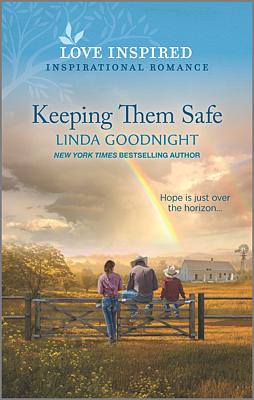

Keeping Them Safe
Autor:in
Linda Goodnight
Gelesen
17,6K
Kapitel
17
Hope is just over the horizon in this novel. Will giving them refuge heal their damaged past? Focused on his business and charity work, rancher Bowie Trudeau can't afford a distraction. Then his childhood crush, Sage Walker, returns home after thirteen years with her niece and nephew in tow. Helping the troubled kids and their aunt might put his career — and heart — in jeopardy. But uncovering her secrets and convincing Sage to stay might give him the family he's always wanted.
Chapter One
She was pretty sure kidnapping was a federal offense. Or did that only count if the kids in question were strangers?
This worry nagged Sage Walker something fierce the evening she drove into Sundown Valley, Oklahoma, the town she’d sworn never to see again. But anytime she said never, life would laugh out loud and then force her to do that very thing. She’d learned from experience that the world had a way of kicking you when you’re down.
So here she was, back in the small Kiamichi Mountain town, hoping and praying that Ms. Bea would take them in for a few days until she could figure out where else to go.
“Please understand,” she prayed under her breath.
Considering her actions of the past couple of days, the good Lord probably wasn’t even listening.
“What?” Ryder, her eight-year-old nephew, unsnapped his seatbelt for the tenth time and leaned between the seats. “What did you say?”
“I was praying.”
“Oh.”
“Please sit back, Ryder. And buckle up.”
He sat back, but Sage didn’t hear the buckle click. With a beleaguered sigh, she slowed the car, pulled into a convenience store driveway and stopped, turning her head to look into the back seat.
Ryder’s eyes met hers. “Mama doesn’t make me.”
Sage wasn’t opening that can of worms. His mama didn’t make him do a lot of things. Like go to school on a regular basis.
“Put on your seat belt, please. I want you to be safe.”
Paisley, the silent, big-eyed four-year-old watched the mental wrestling match with concern and clutched her scrap of a security blanket against her cheek in a death grip.
Ryder glared, rebellious, for a full fifteen seconds before reaching for the belt. When the satisfactory snick sounded, Sage pulled back onto the road and aimed the car toward Main Street, hoping the bakery was still open. The kids hadn’t eaten, and if Ms. Bea was at the shop she’d fill them with leftovers.
At least that’s what she would have done in years past. In Sage’s mind, Ms. Bea was not allowed to change, though it had been nearly thirteen years since their last face-to-face meeting. Shame would do that to a person.
Sage squinted a doubtful eye at the clock on the Jeep’s dash. It was almost six, closing time at the Bea Sweet Bakery.
She suffered a grinding twist of guilt that her phone calls to her former foster mom had become so sporadic that she knew next to nothing about Ms. Bea—or the Bea Sweet Bakery—anymore.
She should have called before leaving Kansas City, but she’d been afraid to. Of what, exactly, she wasn’t sure, but she was taking no chances. Not with the kids in tow.
They’d needed to get out of Missouri fast.
Main Street came into sight. Though it was still light outside, darkness arrived early this time of year, and the streetlights had already come on. The diagonal parking spaces outside most businesses were empty. The stores were closed or in the process of locking up. That much, at least, hadn’t changed.
Sundown Valley rolled up the streets early, so only convenience stores and a few eating places remained open past six. She wondered if the town was big enough yet for any big box stores? She hadn’t seen any driving in.
Lights remained on at the bakery but the only vehicle parked outside was an oversize silver-and-black pickup, the kind of four-wheel drive vehicle driven by ranchers in the area. Those fortunate souls with a little jingle in their pockets.
As she pulled in beside the truck, a well-built cowboy in crisp new blue jeans, gleamingly polished boots and a white dress shirt removed a tool belt and tossed it into the back. Though his shirt was tieless and unbuttoned at the top, he wasn’t exactly dressed to be a handyman.
Unable to see his face, Sage didn’t know if she recognized Mr. Tool Belt, but he was taller than she was. In a town as small as Sundown Valley, not many were.
Before she could stare at the cowboy another second, Ryder had his seat belt off, had unbuckled Paisley’s and was out of the car yanking on the glass entry into the bakery.
The boy was like a caged pup and she couldn’t blame him. All those hours in a car had taken a toll on her. She was sure the kids were exhausted from the long drive and needed to stretch their legs.
“I’m hungry.” Holding Paisley’s hand, Ryder barreled into the shop.
Not knowing how the kids would behave, Sage dragged her attention from the stranger to her niece and nephew and hurried inside too.
The smell hit her first. So familiar and fragrant, the sweet, yeasty scents she’d forever associate with home and love, though she’d only lived with Ms. Bea and Mr. Ron for four years.
Ms. Bea exited the kitchen area, dish towel over one shoulder. She’d aged. The once spritely baker now shuffled like a woman with painful knees or feet. Those weren’t something a caller could see on a video chat, and, not surprisingly, Ms. Bea had never said a word.
When Bea spotted Sage, she stopped, blinked twice, and then broke into a smile. “Sage, honey, is that you?”
“It’s me, Ms. Bea.” To save the other woman from the effort of coming to her, Sage hurried behind the glass display counter for a welcome hug.
The older woman’s plump, fleshy arms, warm as sunshine, enveloped her. When was the last time anyone had hugged her with real feeling? As if they actually cared for her?
And wasn’t she being pitiful today?
She, who’d made her own way most of her life, who’d battled back from the brink of destruction more than once, who knew how to stiffen her spine and get on with life, refused to feel sorry for herself. Most of her troubles were of her own making.
Except for this time.
She cleared her too-full throat and stepped back. “You still give the best hugs in the world.”
“Oh, honey, it’s so good to see you. Let me look at you.” Ms. Bea held her at arm’s length, this caring woman who was nearly a foot shorter and half a body wider gazed at her with genuine affection in lively brown eyes.
Sage didn’t want Ms. Bea or anyone else to look too deeply. A lot of miles had passed and a lot of mistakes had been made since she’d last eaten in the Bea Sweet.
“You’re still the prettiest thing I’ve ever laid eyes on. After you left, Ron and I used to talk about that. You’d be a big success out there in the Big Apple with all your tall green-eyed beauty.”
Another shot of guilt. “I should have been here when Mr. Ron passed. I’m sorry.”
Bea waved a hand, though those sparkling brown eyes grew sad. “It was fast, honey. One minute my Ron was in the kitchen frying doughnuts and the next he was gone. That’s the way he wanted to go, doing what he loved most, and the good Lord saw fit to let him have his wish.”
Still, she should have come. But again, shame had kept her away. Shame, no money and being in a place that would shock the godly, wholesome and decidedly old-fashioned Ms. Bea to the tips of her flour-coated fingers.
“I hope you don’t mind the unannounced visit.”
“Any way I can get a visit from you is fine with me.” Bea’s kind gaze moved to the children. “These little darlings must be Amy’s babies?”
Ryder and Paisley stood in front of the display cases, faces pressed against the glass, expressions clearly stating their desire for every kind of sweet pastry in the building.
“Yes.” Sage put a hand on each child’s shoulder. “This is Ryder and this is Paisley. Kids, this is Ms. Bea. She raised your mama and me.”
Or tried to.
Kids, as inclined to do, cast a quick look at the baker and returned to drooling over the day’s remaining pastries.
Ms. Bea chuckled. “I think they’re hungry.” Taking control as she’d done with many foster children, including Sage and Amy, she guided the duo toward the back of the bakery. “You can choose anything you want after we get something nourishing in you.”
Ms. Bea was still the same nurturing, motherly soul, and her kindness warmed a cold place in Sage’s middle. She’d been cold for days. Maybe here she could get warm again.
She’d needed this. Needed the assurance that someone on this planet still cared.
“Thank you, Ms. Bea,” she said as the kids and Bea disappeared into the back.
She was about to follow when the bell over the door jingled and the tall cowboy entered.
“Ms. Bea—” he started but the words died on his lips as his very dark brown gaze fell on her. Thick, spiky black lashes blinked at her. “Sage?”
“Bowie? Bowie Trudeau?”
“Long time,” he said, his voice velvety soft the way she remembered.
No wonder he’d looked familiar. The oldest three Trudeau men were all taller than her, and Bowie was the tallest. He’d always been the quiet, steady Trudeau while the others had been rowdy and sometimes a little wild.
Sweet memories unfurled beneath her breastbone. She wondered if Bowie was still everybody’s best friend? He’d been hers.
Shifting on his expensive boots, a slight darkening on his already-dark cheekbones, Bowie asked, “You doing okay?”
“Just dandy.” If you could call running from authorities dandy. But then she’d always been the rebel, and Bowie knew it as well as anyone. Or he had back in the day. Sweet, kindhearted Bowie. “You?”
“Good. I’m looking for Ms. Bea.”
Bowie had never been a big talker. Apparently, that hadn’t changed.
Just then, Bea shuffled through the doorway leading from the back kitchen area.
“I thought I heard your voice,” she said to Bowie. “Did you forget something?”
“Yes, ma’am. I’ve got to run to the city in the morning, but I’ll stop by tomorrow evening and check that hot water heater again to be sure it’s still working properly.”
Ms. Bea flapped a hand. “Now, don’t you give that another thought. It’s bad enough I dragged you away from Wade’s wedding. I imagine it was beautiful.”
“Real pretty. Your cake was good too.” A dazzling grin accented the dimple in his chin. “I ate two pieces.”
Ms. Bea’s wrinkles softened into a pleased smile. “I don’t make many wedding cakes anymore, but you Trudeau boys are special. You’d better hurry up and settle down yourself before I’m too old to bake yours.”
Bowie’s grin just widened. He started out again, pausing only to touch the brim of his hat and say, “Nice to see you again, Sage.”
Before she could ask about Wade’s wedding or any of the other Trudeaus, Bowie slipped out the door and ambled with long, easy strides to his truck.
Sage realized, then, that she was staring and that the tall, shy boy she’d known in high school had grown into a gorgeous, kindhearted man who probably made a few hearts in this town flutter.
And he wasn’t yet married.
Interesting. Not for her, of course. They’d been buddies, nothing more, but Bowie was definitely a catch.
What was wrong with the women of this town?
Sage Walker was back in Sundown Valley.
Bowie aimed his truck toward home. It had been a long day, a good one filled with love and people and a beautiful wedding, but he was eager for some solitude in his workshop.
Running into Sage Walker had shaken him. It had also shot a bolus of energy through his bloodstream stronger than a can of Red Bull.
“Sage,” he murmured to the air freshener dangling from his rearview mirror, a joke from Wade’s new wife after he’d tracked cow manure into the bunkhouse where she’d lived for the last year. The freshener smelled like his favorite cologne so he’d left it hanging there.
But it was Sage he was thinking about, not the air freshener. Somebody at his cousin’s wedding earlier today said they’d seen her at a gas station outside of town. After his initial shocked reaction, he considered it a case of mistaken identity.
“What’s she doing in Sundown Valley after all these years?”
Straight out of high school, she’d left to take the modeling world by storm. He’d looked online a few times in hopes of seeing her, but whatever she’d done in New York, she’d kept a low profile. Not that he was into social media all that much. He was too busy.
Back in the day, she’d easily been the prettiest girl in Sundown Valley High School, especially to a shy, gangly teenage boy with a big crush.
Now, her youthful beauty had blossomed and Sage was even more stunningly beautiful today than then, a beauty who nearly stole a man’s breath right out of his lungs. Tall, shapely and graceful with sleek black hair down her back, the palest green eyes on earth and a perfect face, she was an artist’s dream. He’d tried to paint her once, but his talent lay elsewhere. No one knew about the painting except him.
Although he was no longer gangly or all that shy, he’d gone tongue-tied the minute he’d recognized her. He, a grown man of thirty-two, still let Sage Walker make his heart jump.
She’d never known, of course, never had an inkling. He was her buddy, her best friend, her shoulder to cry on.
But that was a long time ago.
He was a man now and he knew better. Sage was a walk-away Joe. Or in her case, a runaway with a heart as restless as an Oklahoma wind.
He liked people, enjoyed a date now and then, but putting his heart out there was not going to happen. At least, not with Sage.
Though why he was even thinking this way bothered him.
Turning off the highway leading out of town, he followed a gravel road that wound up and around a low mountain toward the sprawling ranch he owned with his cousins, Wade and Yates Trudeau. Except Yates, like Sage, had been gone for a long time. He hadn’t even bothered to attend his younger brother’s wedding.
The neglect had hurt Wade, which in turn hurt Bowie. He’d do about anything for the men he considered brothers. Daily, he asked the Lord to mend the brokenness between Wade and Yates and to bring the oldest brother home to the Sundown. Like Wade, he shot off texts and made calls that invariably ended in voice mails, rarely connecting with the mysteriously absent Yates.
Family troubles. Bowie hated them. Had his fill of them. Like Wade, he was helpless to change any of it. He hadn’t seen his own mother since she’d left him at a shelter in New Orleans at the age of ten.
If not for the kind folks in that shelter, he’d never have ended up here on the Sundown.
He rubbed a hand over the back of his neck. Today was a day of celebration. Wade had married a wonderful woman who loved his three babies and her new husband with a love that anyone could see if they had eyes. Bowie had no business digging up old, buried bones and getting melancholy.
No one should feel low in autumn, his favorite season, when God’s glory flamed the hills and valleys, the hay harvest was in for the winter, and cooler temperatures made outdoor work and play enjoyable.
He had a good life, thanks to the aunt and uncle who’d not only taken him in, they’d made him a joint heir with his cousins. Regardless of the aloneness that sometimes plagued him, he had no right to complain.
Heather and Brett Trudeau had accepted him with open arms and hearts when the shelter had contacted them. For all they knew, he wasn’t a Trudeau at all. But the woman who’d birthed him claimed he was the son of Brian Lee Trudeau, Brett’s late brother, and that was good enough for Brett and Heather.
They’d given him a home, a family, love and an equal share of the Sundown Ranch. Most importantly, they’d given him a faith in Jesus. Though he’d strayed a few times, messed up, failed, he prayed they’d never known. He owed them too much, had loved them too deeply to hurt them. Not after they’d taken in a stray and made him their own.
It wasn’t their fault he still thought of himself as an outsider, the odd man out, who didn’t quite fit. Heather and Brett had done their best. He was the one with the baggage he’d never been able to shed, though they hadn’t known. At least, he hoped they hadn’t. He wouldn’t hurt them for the world.
Sometimes he still got misty-eyed, missing them, wondering why good people seemed to die early and the bad ones were left. But he was a man who trusted that the Lord knew what He was doing even if humans didn’t.
His was a simple faith. Trust Jesus, be good to people and everything else would work out.
Once or twice after Brett and Heather died, he’d considered striking out on his own, accomplishing something for himself by himself. He never had.
After Yates took off, he couldn’t have left no matter how much he might have wanted to. Wade needed him. He and his cousin were the only ones remaining to run the Sundown and carry on Brett and Heather’s legacy. He owed them too much to leave, then or now.
So he’d remained. And he’d learned, as the Bible directed, to be content.
When the ranch’s main house came into sight, lights blazed from the windows. Mrs. Roberta, the widowed, part-time nanny Wade had hired last year was in charge of the triplets while the newlyweds took a honeymoon. Bowie would check in on the babies tomorrow and every day thereafter, but the grandmotherly Roberta would hold down the fort and call him if she needed him. Tonight, he needed time in his workshop, time to untangle the day’s worries, to talk to Jesus, and create something beautiful with his hands. Lately, he’d found little time for his art, his passion.
He had a bunk in the shop if he wanted to spend the night and tonight, he wanted to.
Now that Wade and Kyra were married and she’d moved her things into the main house, maybe it was time for him to move out of the main house for good. They hadn’t asked him to, didn’t expect him to, but they were a growing family and he was a third wheel.
He’d always intended to build his own house someday. He’d started making plans a few times, but the cattle market would take a dip, and he’d worry about finances.
Supporting the New Orleans mission that had saved his life was more important than building a house for himself.
There was always the bunkhouse. He could move his belongings out there now that Kyra had made it livable, if a little girly for his tastes. She didn’t need it anymore. It was plenty good enough for a single cowboy with minimal needs.
Yet, the idea of being alone, totally alone, brought on the empty gnawing in his belly. He loved the noise and togetherness of family. Unlike his old mountain man friend, Jinx Vanderbilt, he was not a loner.
Pulling his truck up next to the long metal building he’d built as a workshop, he parked. A security light glowed yellowish white above the door. Exiting the truck, he went to the door and unlocked it.
In the country quiet, he heard a rustling sound and paused to look around. The ranch sometimes had issues with the neighboring Keno family, a father and sons who bore some kind of grudge against anyone named Trudeau. Bowie never had figured out why, but he’d learned to keep his eyes peeled for trouble.
He wouldn’t put it past one of the Kenos to cause trouble today when they’d likely heard that Wade was off on his honeymoon and Bowie was the only Trudeau on site.
Seeing nothing near the front, he opened the flashlight app on his cell phone and walked around the building. His favorite horse, Diesel, whickered a greeting from the nearby pasture. Otherwise the night was still.
As he stood in the deepening darkness, watching the moon rise over the mountain, thinking about today’s wedding and how happy he was for his cousin, the noise came again.
Frowning, he circled the building and then went inside, flipping the lights on to cautiously scan the interior. Nothing seemed out of place.
Birds? Bats? Rats? This was country. Could have been any kind of critter.
Shaking off the episode, Bowie went to his workbench and took up the leather wallet he’d begun crafting days ago. He’d been so busy with Wade’s wedding preparations, ranch work and helping widowed friends that he’d not had time for this. He’d missed it.
Working the soft leather, inventing designs and crafting usable products gave him a sense of satisfaction he got nowhere else.
His cell phone pinged. Frustrated at another interruption, he nonetheless slid the device from his back pocket and read the text message, concerned it could be Mrs. Roberta or Wade.
Expect a call from a friend of mine, a big-time buyer. I showed her the things you made for us. She was especially impressed with Angi’s purse and is interested in seeing more.
Bowie frowned in thought at the message, pondering his Colorado friend’s words. Jim and Angi ran an Aspen resort, and, as such, knew many highly successful people. Like big-time buyers and investors.
Bowie’s pulse hit double time. Did this mean what he thought it meant? That his dream of doing more than hobby work with his leather craft could become a reality?
He shot a quick text in reply.
A big-time buyer of what?
I don’t have details. Just a contact for you. Expect a call tomorrow.
He wouldn’t get his hopes up too high, but he would be waiting for that phone call.
After allowing a momentary thrill to filter through him, Bowie picked up the wallet and got back to work.
The smell and feel of supple new leather filled his senses as he took up a swivel knife and began to carve the horse head design into the leather. He forgot that he hadn’t eaten. Forgot that he’d been the best man at his cousin’s wedding. Forgot even that Sage Walker was back in town. As he always did, Bowie got lost in his art.
When he heard someone sneeze, he had to shake his head to decide if the sound was real or imaginary. Blinking around at the long workshop, he saw no one. But someone had to be in here.
A charge, like electricity, shot down his spine. “If that’s one of you Keno boys, come out and show yourself. I’m on to you.”
Nothing stirred.
“Who’s in here?” He began a search.
Though the only other walled room in the building was a bathroom and he kept his shop tidy, there was a storage cabinet beneath the sink, a huge tool chest and two tall metal cabinets a person could hide behind or, possibly, inside. There was also the bunk he slept in, though none of the robust Kenos would fit under there.
Taking a cobbler’s hammer in hand, Bowie searched the shop, coming up empty. Just when he’d decided he’d imagined the sneeze, he heard a rustling sound, as if someone had moved but was trying not to make noise.
It came from his bunk.
Crouching low, hammer ready, he peered under the bed.
Two pairs of eyes, wide and frightened, stared back at him.
Two kids. A boy and a girl. Very young. What in the world were they doing in his shop? How had they gotten here? The only kids he knew out here in the country were Wade’s triplets.
The little girl began to snivel. The boy wiggled until he could get a hand on her shoulder. “Shh, sissy, it’s okay.”
Something in the boy’s protectiveness toward the little girl touched a bruised place in Bowie’s chest.
He put the hammer aside and lay flat on his belly the way the children were. “Come on out. I won’t hurt you.”
The boy hesitated, uncertain, untrusting. Bowie waited, quiet and easy as he would with a skittish colt. He could practically smell the boy’s anxiety, understood it and waited, letting the child call the shots.
The little girl whispered something Bowie couldn’t hear. The boy sighed and crawled out, turning to assist the girl.
“You got a bathroom?” he asked. “My sister needs to go. She don’t wait real good.”
Bowie escorted them to the bathroom and took note that the boy stood outside the door like a guard.
Dipping a shoulder against the wall adjacent to the bathroom, he intentionally struck a relaxed pose in hopes of putting the boy at ease. “What’s your name, buddy?”
The little boy swallowed and looked away, arms stiff at his sides. The kid was scared, but he had grit. His sister was inside that bathroom, and he wasn’t budging from his post.
“I’m Bowie Trudeau. You can call me Bowie. This is my shop. Want to tell me what you’re doing out here alone?”
He heard the toilet flush and water run. Then the little girl came out and huddled behind her brother, a plush cloth against her face. Bowie recognized the type of security blanket the triplets called their “lovey,” only this one had a fluffy white lamb’s head at one end.
Bowie crouched in front of her. “What’s your name, little one?”
The boy used his slender body to block his sister from Bowie. “She’s only four. She won’t talk to you.”
But she talked to her brother.
“How old are you?”
“Eight.”
Too young to be out here alone. “Where were you headed when you ended up in my workshop?”
“Home.”
“Tell me where that is, and I’ll take you there. Sundown Valley? Or out here in the country somewhere?”
The boy looked confused. He blinked, his eyelashes touched his overlong bangs. “The city.”
The city? That didn’t make any sense. “How did you get here?”
The boy didn’t answer. With a sigh, Bowie racked his brain. What was he supposed to do with two stray kids?
The moment the word stray entered his head, he slapped it down. Kids were not strays. He, of all people, should know that. Feeling like a stray wasn’t good for anyone. He also knew that from experience.
His belly rumbled, and it occurred to him to ask, “Are you hungry?”
The boy shrugged. “My sister is.”
Which meant he was too.
Bowie went to the small dorm-size refrigerator that served his needs and took out sandwich fixings.
“Ham and cheese okay?” he asked as he placed a plate on the wall-mounted counter that held both the fridge and microwave for those times when he wasn’t in the mood to go to the main house to eat. He lined the plate with bread slices.
“Thanks, mister.”
“Bowie.” He handed the kid a sandwich. “Sure you won’t tell me your name? It would help me find where you belong.”
“Ryder.”
Now they were getting somewhere.
Ryder handed his sandwich to the girl and waited. The piercingly sweet gesture moved Bowie to rummage around in his storage cabinet for a half bag of Cheetos closed with a rubber band and three bottles of water which he toted to the long wooden bench next to his worktable.
When they’d gobbled down their sandwiches, and their fingers were orange from the chips, Ryder wiped his hands down his jeans and looked around the shop.
“Is this your place?”
“Yes. My workshop.”
“Do you live here?” He aimed his gaze toward the corner bunk.
“No. Sometimes I work late, though, and don’t want to drive home.”
The boy pointed toward his work area and the leather piece lying across the tooling stone. “What are you making?”
“A wallet.”
“I didn’t know people could make a wallet.”
“How did you think they came into existence?” Maybe that was too complicated a question for a boy of eight.
Curious brown eyes, darker than the boy’s sandy hair, moved from the worktable to Bowie. “Can I look?”
“Yes, but I’d rather you didn’t touch until you wash your hands.”
Ryder glanced down at his orange fingertips and said, “Oh.”
With his sister in tow, the boy hustled into the bathroom and returned with clean, damp hands to stand next to Bowie at his workbench.
Bowie didn’t know much about kids this age. His relationship with children was limited to his cousin’s two-and-a-half-year-old triplets. Somehow he had to get these two talking and figure out where they belonged. If they didn’t speak up soon, he’d have to call the sheriff. For some reason, he didn’t want to do that, though the county sheriff was a good guy.
He figured it stemmed from those childhood days in New Orleans when street people scattered at the sight of a cop.
“Do you like horses?” In his book, horses were one of those topics everyone likes, a natural conversation starter.
“I never saw one in real life.”
“You’ve never seen a horse?”
“Uh-uh. Just on TV.”
Well now, that was just real sad. If it was daylight, he’d take the kid out and introduce him to Chigger, the sweetest old horse on the place.
“This is pretty.” The boy pointed to the horse’s head and neck Bowie had been carving into the leather.
Bowie let him feel the leather and then demonstrated a carving technique. The boy was surprisingly attentive for a little guy, though he kept a watch on his sister.
The tiny girl had plopped down on the floor at her brother’s feet and leaned her head against his shoe, clinging to his leg with one hand while she clutched her lovey with the other.
Slowly, like settling a wild horse, Bowie thought he was winning the boy’s trust.
After a few minutes, he casually hitched his chin toward the little girl. “Your sister’s sleepy.”
Ryder glanced down and then up at Bowie. “Can we sleep in here tonight? I got money to pay you.”
He dug in his jeans pocket and extracted a dime and four pennies.
Bowie’s heart clutched. He reached out and curled the boy’s fingers over the coins. “Keep your money, Ryder. You might need it. I’ll get you home to your family. They’ll be worried about you.”
“You said you was going to the city tomorrow. Can me and Paisley ride with you?”
Bowie blinked. “How do you know that?”
The boy clammed up again.
Weeding through his brain cells, Bowie tried to recall when he’d told anyone about his plans to make the long drive to Oklahoma City.
“You were at the bakery, weren’t you? You heard me tell Ms. Bea that I was going to the city tomorrow.”
He hadn’t seen any kids, but they must have either been in Ms. Bea’s kitchen or somewhere on the sidewalk nearby.
And they must have hitched a ride in the back of his truck, under the tarp he kept there for wrapping sick calves.
The next thought hit him like a baseball bat to the head. Did Sage have kids? She was fresh into town, and last he’d heard, she lived in a city. Even though he’d seen no signs of children, she’d been at the bakery.
But if these were her kids, why had they run away? Why did they appear shaggy and unkempt?
“Tell you what, Ryder. You and your sister come with me into town, and we’ll figure this whole thing out.” To sweeten the deal, he added, “I’ll buy you an ice cream cone.”
The girl, Paisley, popped up from the floor, her big brown eyes round as silver dollars. She nodded at her brother with the most animation he’d seen from her since discovering them under his bunk.
It was settled. Back into town he’d go. If they weren’t Sage’s kids, Ms. Bea might know who they were.
No matter who they belonged to, he wanted some answers.
What had compelled two such young children to run away?