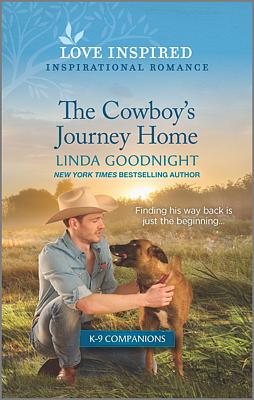

The Cowboy's Journey Home
Autor:in
Linda Goodnight
Gelesen
17,5K
Kapitel
16
Finding his way back is just the beginning. He'll make up for the past… But won't saddle anyone with his future. Medically discharged from the military, Yates Trudeau and his ex-military dog, Justice, return to the family ranch, vowing to make amends — and keep his prognosis hidden. Only, civilian life means facing reporter Laurel Maxwell, the woman he left behind but never forgot. Forging a new bond comes naturally, but when she learns the truth, will she risk her heart for an uncertain future?
Chapter One
The jig is up. We know you’re in there. You might as well come out.
Yates Trudeau stared at the text from his brother and released a word his mother would have washed his mouth out for saying.
The Belgian Malinois sitting on the grass at his side lifted his regal head in question. Quietly alert, the dog kept watchful eyes on his new handler, awaiting command.
“Position compromised,” Yates said softly as he slid the cell phone back into his camo jacket and buttoned the pocket. “No fish for us today.”
After reclaiming his rod and reel, he slowly turned the handle to bring in the spinner bait while he debated this unexpected turn of events.
Hidden Pond, as the Trudeau family had dubbed this wilderness water hole, was pristine today. Glassy calm beneath the overcast sky—perfect for snagging a bass or two.
The weather remained chilly, but the clean air held hints that spring was right around the corner. Pleasant days like this, after a long winter, got him up and moving, though his movements were not as fast or as precise as they’d once been.
He and his dog had been enjoying themselves in this tranquil, empty wilderness. Until the text.
Justice, too well disciplined to muddy the waters, had alternately perched on the grass at his side or romped through the tall dry weeds, disappearing occasionally into the underbrush. For once in his life, the MWD—or military working dog, to civilians—wasn’t ferreting out the bad guys. He was having fun.
This was only the second time since becoming a recon scout that Yates’s whereabouts had been detected. The first had ended his military career. Fortunately no one was shooting at him today. These weren’t enemy combatants. This was his brother Wade and his cousin Bowie, who was as near to being a brother as a man could be.
And Yates wasn’t hiding. Not at all. He was healing.
He dropped a hand to the dog’s upright, attentive ears, pondering his next move.
“What do you think, Justice?”
The Malinois turned golden eyes his way as if to say, “Time to go.”
Yates nodded. “Roger that.”
He’d planned to reveal himself in his own time, in his own way, when he was able to walk into the ranch house without so much as a limp or a grimace. He had wanted to appear hale and hearty again, not the pale, skinny creature the army had released a few months ago. A man had his pride. And Yates Trudeau had more than his share.
So no, he wasn’t hiding from anyone. He was doing things his own way.
If he’d really been hiding, they would never have spotted him. A recon scout didn’t survive long in terrorist pods around the world otherwise. He’d noticed Bowie’s hidden cameras weeks ago, though he’d hoped no one would recognize him just yet.
He wasn’t suffering from PTSD. He didn’t hate the world or the military. In fact, he’d loved his job, liked the military brotherhood. He’d enjoyed his lifestyle, had even dated now and then when he wasn’t on assignment, concealed in some dangerous spot with binoculars to his face.
Now he was just tired and at loose ends.
He’d had the rest of his life all planned out. Now he didn’t.
Like Jinx, the reclusive old vet who lived on a nearby hill, Yates had needed to be alone for a while. Alone to sort out what he’d do with the rest of his life. Alone to let his body heal—to hope it would.
Ah, well. His timetable was pushed up a bit. Adapt and assimilate.
He tossed his loose fishing tackle into the metal box and snicked it closed with the same stealth that he did everything. A soldier could get killed fast if he was noisy.
Picking up the box and shouldering his rod and reel and rifle, he turned to gaze toward the ranch. He couldn’t see it from here, but he could feel it.
With a silent hand signal to Justice, he began trudging through the thick pine-and-hickory forest surrounding Hidden Pond.
During the months in rehab when he’d been especially low, thoughts of Sundown Ranch had kept him sane. Going to the home where he’d grown into a man promised both pleasure and pain. Pleasure to see Wade and Bowie and his horses. Pain at the emptiness, the loss, the grief he’d left at Sundown Ranch. It would still be there because his parents and baby brother wouldn’t be.
He couldn’t have saved his parents. Fourteen-year-old Trent was a different matter.
Painfully aware that hurrying too much and stepping in a hole could prove disastrous to his damaged body, he paused to survey the terrain in front of him.
To dispel the melancholy that threatened any time he remembered his little brother, which was pretty much every single day, he pressed a hand against the rough trunk of a tall Ponderosa pine. Pressed until it hurt. Sticky sap stuck to his palm along with a few bits of splintery bark. He wiped the hand on his camo pants, inhaled the pungent scent.
Wade thought Yates blamed him for Trent’s death. Maybe he had at first, a deflection for his own guilt. But Wade didn’t know all the facts about that day.
Yates looked up into the gunmetal-gray sky. A noisy flock of blackbirds passed overhead, their combined wingbeats like distant clapping.
How would he be greeted? With joy? Anger? A million questions? Probably all three.
Yates started hiking again. He’d left his truck five klicks down the hill, beneath a stand of pines near an old, abandoned hunters’ cabin. He’d stayed there a few times to hunt and fish whenever weather allowed, but mostly he lived in his RV in Centerville. Far enough away from the town of Sundown Valley to remain incognito, close enough to feel home. He couldn’t deny the yearning for these woods and the familiar smells and sights. For family.
The dog heard the woman and kids before Yates did. Justice nudged his dangling hand, a soft whine issuing between canine lips. Friendlies, he seemed to say.
Yates was in no mood for company. Not yet. Not until he processed the homecoming he’d put off for years.
Silently, he slid into a stand of thick, tangled brush. Blackberry vines.
Yates allowed a wry smile. Of course he’d choose berry bushes. They had thorns. One dug into his thigh. He ignored it, could ignore pain for hours. What was a little thorn in the flesh to a well-trained soldier?
And wasn’t there a scripture verse that mentioned something about thorns in the flesh? Not that he’d opened a Bible in a while. A very long while.
He was distracted from thoughts of his abandoned faith when a small girl, maybe four or five, frolicked into view in the grassy clearing between the crowded stands of evergreen trees. A dark-skinned cutie with a giant red bow in her brown hair, she sang at the top of her lungs.
“Megan, stop yelling. You’ll scare away the wildlife.”
A slightly older and clearly wiser girl appeared from the evergreens. She, too, was dark of hair and skin but wore thick, purple-framed glasses and a cowgirl hat, also purple.
“I’m singing to Jesus.” Megan pointed a tiny finger toward the sky. “He likes it.”
“What if a bear hears you and eats us?”
Megan stopped singing, her eyes widening.
Three more children came into sight, followed by a slender woman in shiny waterproof sports pants and a snug windbreaker, with a messy, honey-colored mass of hair on top of her head. The way she tromped through the woods, she made enough noise in her practical hiking boots and swish-swish pants to ward off every bear within a hundred miles.
“Chelsey, don’t frighten her.” To the little one, the woman said, “Megan, singing is a great way to scare away bears. Let’s all sing. God likes it.”
In a charming, if slightly off-key, collaboration of voices, the little party joined a now-smiling Megan in a round of “He’s Got the Whole World in His Hands.”
Yates remembered singing that song in vacation Bible school as a kid. Back then, he’d been comforted by the thought that God was holding him in the palm of His hand, no matter what happened. That was the trouble with being a kid. The bad things came later, and since then, he’d not felt in tune with God at all. Even less now that his career was over and he faced an uncertain future.
The singing ended, and the woman shrugged out of a backpack and began unloading picnic supplies.
Great. He was stuck in a thorny blackberry bush, and they were settling in for the afternoon.
Something about his unwanted adult guest seemed familiar, but with these massive bushes in his line of sight, he didn’t have a clear look at her face. He had once known everyone in and around Sundown Valley.
The two older girls, maybe seven or eight—though he was no judge of kids—helped her spread a tablecloth. Then the five girls and one slender woman plopped down.
As she handed around sandwiches, the woman began to talk about Jesus being the creator of the universe.
“According to the book of John, ‘All things were made by Him, and without Him was not any thing made that was made.’” She laughed lightly at the end of the tongue-twisting scripture. Hers was a lilting laugh, warm and pleasant. And also familiar.
Something nudged at the back of his brain, though he couldn’t quite pull the memory forward.
“You mean Jesus made these sandwiches?” The older girl she’d called Chelsey lifted the top slice of wheat bread and gazed beneath as if expecting to see Jesus waving at her.
The thought amused him. In fact, the whole scene amused him.
The woman laughed again—that sunny, sweet sound that lit up the clearing. “He made the animals and plants that eventually became this sandwich. And the people who put it all together.”
“Cool. I’m eating a Jesus sandwich.” Chelsey took a big, exaggerated chomp.
Yates pressed his lips together to keep from laughing out loud.
For years, he’d been a silent observer, watching people’s movements, but suddenly he felt like a voyeur, as if he shouldn’t be here, though this was his property. They were the trespassers.
Still, he should make his presence known before one of the little girls accidentally stumbled upon him and he scared the dickens out of her.
But watching the exchange and listening to innocent childish chatter was pure enjoyment. Except the sandwiches made him hungry. When was the last time he’d actually felt hungry?
One of the other children, not to be outdone by Chelsey, pulled up a handful of grass. “Jesus made this grass too.”
“Yes. Look around, girls. Everything you see in nature was made by God’s creative genius. Plants and animals and clouds and all the colors.”
“Even different colors of people?” Megan looked at her tawny-brown arm.
“Absolutely.” The woman hooked an elbow around the girl’s shoulders and gave her a side hug. “All the different shades of people are like colorful flowers in God’s perfect garden. The world would be so dull without them.”
“Does God laugh?” Chelsey, the thinker, asked.
The messy bun wiggled as the woman nodded. “We laugh, don’t we? And we’re made in His image. So yes, I think He laughs a lot. He’s probably smiling right now at five little girls who love Him and are outside enjoying the world He created.”
A frown creased Chelsey’s brow. “What’s an ‘image,’ Miss Laurel?”
Miss Laurel?
The name stunned Yates. He only knew one woman named Laurel.
Laurel Maxwell?
Under cover of the continuing conversation, Yates shifted his position the slightest bit to enable a clearer view.
Sure enough. Ten feet away sat the woman he’d left behind, a woman he should never have been romantically involved with.
A woman who had every reason to despise him—and probably did.
Laurel passed around a handful of clementine oranges to the girls, answering questions and pointing out God’s beautiful world as they picnicked. Some of the questions the children asked both amused and amazed. The kids were smart and open and curious.
Today’s weather wasn’t as warm as she’d hoped and the sky was overcast, but the five members of her little Sunday school class didn’t seem affected. Their high energy kept them warm, and she had been promising this outing for weeks.
Getting away from the newspaper office and Gran took careful organization. Today, she’d managed. At the rate the Sundown Valley Times was failing, one Sunday afternoon away would not change the downward trajectory.
She dug a thumbnail into her fresh-scented orange and had begun peeling away the thick covering when the nearby brush rustled.
The picnic group froze, eyes sliding first toward her and then around the clearing. She could read their minds. Bears. And in this mountain wilderness, black bears were a real possibility.
She put her arms out to each side as if she could shield the girls from an attack. She might lose, but she’d try.
Suddenly, the bushes parted, and a shaggy animal came into sight.
Chelsey screamed, “Bear!”
The other four girls jumped to their feet and screamed. One of them yelled, “Bigfoot!”
Not Bigfoot. A dog, followed by a tall, thin man in camouflage pants, jacket and ball cap. He carried a fishing pole and a rifle.
Laurel squeaked. The girls screamed. The dog barked. The man rested the gear against his leg and tossed up both hands.
“I come in peace.”
The dog, a real beauty that looked like a smaller version of a German shepherd, stood guard at the man’s side. But his tail wagged faster than a windshield wiper on high.
Was he friendly? Was the man?
“Laurel,” the bearded stranger said.
He knew her name?
“It’s me,” he said through a thick beard. “Yates. I didn’t mean to startle you.”
All the blood drained out of Laurel’s head. She suffered a momentary dizzy spell.
“Yates?” Her voice came out shaky and bewildered. “You can’t be here.”
Yates Trudeau. The man she’d loved. The man who had left without a word.
Being a Bible-believing Christian, she couldn’t hate him. But she was sorely tempted to kick him in the shins.
Except the dog might attack if she did.
And she had her Sunday school class with her. The little group now huddled close to her side like chicks under a hen. One glance down revealed five pairs of eyes locked on the tall man.
He tilted his head. “This is still my property, isn’t it?”
She shook out the cobwebs. “I mean, you’re in the army somewhere a world away.”
With a hint at the old Yates’s humor, the man slowly lowered his hands, patted his arms and his sides and pretended to look himself over. “No. I think this is me, and I’m definitely here.”
He was Yates all right, but not Yates. The Yates she’d known was vibrant with life, strong and healthy, a clean-cut cowboy exuding charm and energy. This man was thin and wan, with shaggy hair and a long beard that made him look like some old survivalist living off the land.
Was he?
No wonder the girls had thought he was Bigfoot. Sightings of the creature in the Kiamichi weren’t that unusual. Sightings of long-lost loves absolutely were.
“What brings you home?” Was that the best she could do after eight years of wanting to scratch his eyes out?
Except she’d always loved his ocean-blue eyes—the way they softened right before he kissed her, the way they sparkled with laughter and intelligence.
“Mustered out.” He nudged his chin toward the dog. “Justice and me both.”
“You were a dog handler in the army?”
“No. Recon scout. But I knew him, and when he couldn’t serve as MWD anymore, I put in the papers for him.” He jerked a shoulder. “Didn’t want a good soldier going civilian without a familiar face.”
She had no idea what an MWD or a recon scout was, but a scout sounded like something on horseback, which would be right up Yates’s alley. Did the military still ride horses?
“Is he friendly?”
“When I tell him to be.”
She made a face. “That wasn’t encouraging.”
Yates squatted beside the dog and murmured something. Justice’s tail increased in RPMs.
“Ladies.” Yates looked up. “Justice won’t hurt you. Would you like to shake his hand?”
Five cute heads bobbed up and down like yo-yos on a string.
Yates instructed the dog again. Justice approached the children and offered a paw, pink tongue lolling. Giggling, each girl took a turn.
Emboldened, Chelsey asked, “Can we pet him?”
“He’d like that.” Yates reached into his pocket and pulled out a strange, bumpy-looking red rubber ball. “If you want to play with him, give this a toss.”
The girls apparently had conquered their fear of the man, the dog and unseen bears.
While they romped with the delighted canine, Yates watched the dog. Laurel watched Yates.
Being a detail-oriented newspaper woman, she noticed everything about him, even the pine scent emanating from his clothes. She’d never seen anyone stand so still and silent. He was intense, to say the least. This certainly wasn’t the Yates she had known.
There was pain in his eyes. The kind of pain she’d seen when his brother Trent had been tragically killed while feeding a pen of young bulls. But, either time hadn’t healed that awful wound—and she didn’t expect it would ever heal completely—or the military had added more pain for him to bear.
He appeared to be physically ill as well as in emotional pain. And he looked so terribly alone, like a lost soul.
What in the world had happened to him?
Every nurturing cell in her body wanted to rush into his life all over again and make everything better.
He was needy. She was a fixer.
And wouldn’t the confident, always-in-command Yates of yesteryear mock such an idea?
She was out of her mind to even consider getting involved with a Trudeau again.
“You don’t look well.” Why had she said that? Why couldn’t she keep her thoughts to herself?
Yates’s shaggy head snapped back to face her.
“Had a couple of surgeries.”
“What happened?”
He waved a hand as if shooing away the question. “No big deal. I’m okay now.”
In other words, don’t pry, which only made a newspaper woman more curious. Add to that the fact that he didn’t look okay and her nose for news fairly twitched.
“I guess Wade and Bowie are thrilled to have you home.” She was fishing for information the way she’d once done with big-city politicians. Ask the right, seemingly harmless questions, and sometimes the important stuff seeped out. But that was before Dad had died and she inherited a small-town newspaper.
“Haven’t seen them yet,” he said.
“You haven’t been to the ranch? Did you just arrive in town and suddenly decide to go for a hike before seeing your family? Who does that?” The words tumbled out, as they often did when she was interviewing. Which she wasn’t. “Sorry. Nosey reporter’s habit.”
“No problem.” His look was as solemn as a funeral. He did not, she noticed with suspicion, respond to either of her queries.
Had he really come to the woods before going to the ranch house? She had a feeling she was right and that he had. She wondered why—another habit of journalists. She needed to know everything, especially motives.
Yates’s gaze seemed glued to her face, and she fought off a blush that would let him know he still affected her on some unwanted, visceral level. People say you always remember your first love. Yates had been her first and only.
She’d spent the better part of a year waiting to hear from him and another year getting over him.
Now here he was in the flesh, stirring up old memories. At least for her.
The annoying blush deepened. Laurel turned her attention toward the children and the dog. With a smiling Justice in the center, they formed a circle of petting hands and eager chatter.
“Those aren’t all your kids, are they?”
A small pain pinched inside her chest. “Sunday school class.” To turn the focus away from her, she asked, “Was he really a military dog? Like a bomb or drug sniffer?”
“Explosives.”
“Did something happen to him? Why’d he retire?”
Yates’s face, already closed, tightened. “Stuff happens. Soldiers retire. Look, I should go. Enjoy your picnic.”
With a snappy military about-face, he started to walk away.
“Yates, wait.”
He paused, gazing back over his shoulder.
“After you get settled, come by the Times’ office. I’d love to interview you and the dog for the paper.” She put her fingers up in air quotes. “‘Hometown Hero Returns’ would make a great feature.”
“No interview. We’re civilians now. Nothing heroic about that.” Turning away, he gave a soft whistle. “Justice, come.”
Before she could say more, Yates and his dog disappeared into the foliage.