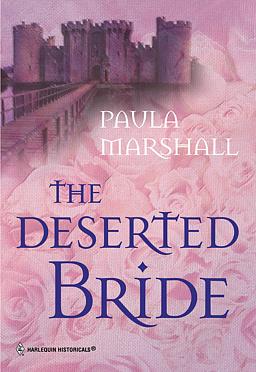

The Deserted Bride
Autor:in
Paula Marshall
Gelesen
16,5K
Kapitel
16
Bess was a girl when she first saw her husband on their wedding day. Andrew, Earl of Exford, left after the ceremony, and as Bess blossomed into a lovely woman, she reveled in the freedom afforded by her absent spouse. Yet she knew the day would come when she would come face-to-face with her long-estranged husband. On the day of his return, Drew found himself speechless at his wife's heart-stopping beauty and charm. Could it be that this once awkward girl was the bride he had deserted so long ago? Furthermore, could she ever forgive his cruel neglect and return his love?
Chapter One
He was her husband. He had been her husband for ten years, and all she had ever had of him was the miniature which had arrived that morning.
And the letter with it, of course.
The letter which simply, and coldly, said, “My Lady Exford, I am sending you this portrait of myself in small as a token of my respect for you. I am in hopes of paying you a visit before the summer is out. At the moment, alas, I am exceeding busy in the Queen’s interest. Accept my felicitations for your twentieth birthday now, lest I am unable to make them in person. This from your husband, Drew Exford.”
Elizabeth, Lady Exford, known to all those around her as Lady Bess, crumpled the perfunctory letter in her hand. All that it was fit for was to be thrown into the fire which burned in the hearth of the Great Hall of Atherington House. At the very last moment, though, something stayed her hand. She smoothed the crumpled paper and read it again, the colour in her cheeks rising as her anger at the writer mounted in her.
About the Queen’s business, forsooth! Had he been about the Queen’s business for the last ten years? Was that why he had never visited her, never come to claim her as his wife, had left her here with her father, a wife and no wife? She very much doubted it. No, indeed. Andrew, Earl of Exford since his father’s death, had stayed away from Leicestershire in order to enjoy his bachelor life in London, unhampered by the presence of a wife and the children she might give him.
The whole world knew that the Queen liked the handsome young men about her to be unmarried, or, if she grudgingly gave them permission to marry, preferred them not to bring their wives to court. And from what news of him came her way, the Queen had no more faithful subject than her absent husband.
How should she answer this? Should she write the truth, plain and simple, as, “Sir, I care not if I never see you again?” Or should she, instead, simply reply as an obedient wife ought to, “My lord, I have received your letter. I am yours to command whenever you should visit me.”
The latter, of course. The former would never do.
Bess walked to the table where ink, paper and the sand to dry the letter awaited her, and wrote as an obedient wife should, although she had never felt less obedient in her life.
And as she wrote she thought of the day ten years ago when she had first seen her husband…
“Come, my darling,” her nurse had said, on that long-gone morning, “your father wishes you to be wearing your finest, your very finest, attire today. The damask robe in grey and pink and silver, your pearls, and the little heart which your sainted mother left you.”
“No.” Ten-year-old Bess struggled out of her nurse’s embrace. “No, Kirsty. Father promised that I should go riding with him on the first fine morning, and it is fine today. Besides, I look a fright in grey and pink, you know I do.”
Her nurse, whom Bess was normally able to wheedle into submission to her demands, shook her head. “Not today, my love. I cannot allow you to have your way today. Your father has guests. Important guests. They arrived late last night after you had gone to bed, and he wishes you to look your very best when you meet them.”
Kirsty had an air of excitement about her. It was plain that she knew something which she was not telling Bess. Bess always knew when people were hiding things from her but, even though she might be only ten years old, she was wise enough to know when not to continue to ask questions.
So she allowed Kirsty to turn her about and about until Bess felt dismally sure that she looked more like a painted puppet dressed up to entertain the commonalty than the beautiful daughter of Robert Turville, Earl of Atherington, the most powerful magnate in this quarter of Leicestershire. She disregarded as best as she could Kirsty’s oohings and aahings, her standing back and exclaiming, “Oh, my dear little lady, how fine you look. The prettiest little lady outside London, no less.”
“My clothes are pretty,” said Bess crossly, “but I am not. I am but a little brown-haired thing, and all the world believes that fair is beautiful, and I am not fair at all—as well you know. And my eyes are black, not blue, so no one will ever write sonnets to them.”
Useless, quite useless, for Kirsty continued to sing her praises of Bess’s non-existent beauty until aunt Hamilton, her father’s sister, came into the room.
“Let me look at you, child. Dear Lord, what a poor little brown thing you are, the image of your sainted grandam no less.”
Far from depressing Bess, this sad truth had her casting triumphant smiles at the mortified Kirsty, who was cursing Lady Hamilton under her breath. Fancy telling the poor child the truth about herself so harshly. It couldn’t have hurt to have praised the beautiful dress m’lord had brought from London for her, instead of reminding her of the grandam whom she so resembled.
For Bess’s grandam had been the late Lady Atherington, who had always been known as the “The Spanish Lady”. She had accompanied Catherine of Aragon when she had arrived in England to marry the brother of the late and blessed King Henry VIII, the present Queen’s father. The then Lord Atherington had fallen in love with, and married her, despite her dark Spanish looks, and ever since all the Turville daughters had resembled her, including the brisk Lady Hamilton. Brown-haired herself, and black-eyed, she had still made a grand marriage, and the sonnets which Bess was sure would never come her way, had been showered upon her.
“Golds,” she was exclaiming, “and vermilions, or rich green and bold siennas, are the colours which your father should have bought you. Trust a man to have no sense where women’s tire is concerned! Never mind, child, later, later, when I have the dressing of you, we may see you in looks. This will have to do for now. Come!”
She held out a commanding hand, which Bess took, wondering what the fuss and commotion was all about. She had been living quietly at Atherington House as she had done for as long as she could remember—which admittedly at ten was not very long—until yesterday, when her father had arrived suddenly, with a trunkful of new clothes for her, and a train of visitors who had stared at her when she was brought into the Great Hall after they had dined.
Bess had never seen so many people all at once, but she had smiled at them bravely, relieved when, after being seated on her father’s knee for a little space and been fed comfits by him, she had been allowed to retire to her room.
And now, if Kirsty was to be believed, another bevy of guests had arrived. Oh, she had heard the noise just as she was going to sleep, and could not help wondering what all the excitement was about. It seemed that she was soon to find out.
For, as she descended the staircase into the Great Hall, she saw that all the servants were assembled at one end of it, and a large body of finely dressed men and women were at the other. Her father was standing a little in front of them, her uncle, Sir Braithwaite Hamilton, by his side, with a pair of attendant pages hovering in their rear.
“Come, my lady,” her father said, smiling at her as her aunt Hamilton let go of her hand and pushed her towards him, “we are to go to a wedding. In the chapel.”
At this, for some reason unknown to Bess, the company all laughed uproariously, led by uncle Hamilton. All, that was, except aunt Hamilton, who primmed her lips and shook her elegant head. Like all the guests she was richly dressed and Bess could only imagine that it was her father’s wedding to which they were going with such ceremony.
Gilbert, the Steward, importantly carrying his white wand of office, marched solemnly before them. Tib, the smallest page, with whom Bess daily played at shuttlecock, was his attendant, looking as solemn as Giles, not at all like the rowdy boy who was her shadow.
The processional walk to the chapel did not take long. Not all the guests would enter it with them, for it was small. Above the altar was a painting brought from Italy, beneath a stained glass window showing Christ in his glory. Master Judson, the priest, stood before it.
But where was the bride?
Bess looked about her. Where the bride should stand were several richly dressed men—and a tall boy who appeared to be about sixteen years old.
The boy was as beautiful as Bess was plain, and he was as fair as the god Apollo on the tapestry in the Great Hall. His hair was silver gilt, and curled gently about his comely face. His eyes were as blue as the sky on a summer morning, and the pink and silver colours of his doublet, breeches and hose not only suited him better than they suited Bess, but also showed off a long and shapely body. He resembled nothing so much as one of St Michael’s angels come down to earth to adorn it.
As she entered on her father’s arm the boy was looking away from her. The man at his side, no taller than he was, whispered something in his ear, and he turned to look at her.
His eyes widened. The handsome face twisted a little. He swung round to the man who had whispered to him and muttered, “Dear God, uncle Henry, you are marrying me to a monkey!”
No one else but Bess, and the man, heard what he said. Bess’s father was a little hard of hearing and aunt Hamilton and the train behind her were too far away to catch his words.
But Bess heard. She heard every bitter syllable. And from them she learned two things. That it was not her father who was to be married, but herself…
And the beautiful boy to whom she was to be tied for life thought that she was ugly and had not hesitated to say so to his attendant.
No! She would not be married to him. She hated him. She hated his beauty, and his unkindness. He had not meant her to hear what he had said, and he was not to know that her hearing was abnormally acute. Even so, he should not have spoken so of her, and she would not marry him, no, never! Never!
Bess wrenched her hand from her father’s grasp, swung round on him, and said, as loudly as she could, her voice breaking between shame and despair, “If you have brought me here to be married, sir, then know this. I have no mind to be married. Indeed, I will not be married. Least of all to him!”
And she sat down on the stone floor of the chapel.
Such a hubbub followed, such an uproar as had never before been heard in Atherington’s chapel. Master Judson looked down at her, astounded, nearly dropping his prayerbook at the sight of such unmannerly behaviour. The boy—and who could he be?—looked haughtily down at her as she sat there, now weeping bitter tears. He said, his voice like ice, “And I have no mind to marry you, either, but I obey my elders and betters at all times—which plainly you have never been taught to do.”
Oh, the monster! She hated him. Yes, she did. A monkey! He had called her a monkey. Well, she would dub him monster.
“Handsome is as handsome does—and says,” she flung at her as her father put his strong hands under her arms and lifted her up.
“Shame on you, daughter, for behaving so intemperately. You shall be beaten for this, I promise you. But only after you have married Andrew, Lord Exford, whom you have so vilely insulted. And since you are so free with maxims, let me remind you of one which you have forgotten, ‘Little children should be seen and not heard.”’
Sobbing now, and trying to hide her face, for she felt so humiliated that she could look no one in the eye, Bess found herself being gently lifted away from her father. It was her aunt Hamilton who set her upon her feet again, and bent down to speak softly to her so that none other should hear what she had to say.
“Come, niece. I told your father that he should have prepared you for this day, but he believed that it would be better for you not to be forewarned. See, it is a handsome boy you are marrying, and a great family. Your father has done well for you. Now do you do well for him. Dry your tears and behave as a great lady should.”
A great lady. She wasn’t a great lady. She was simply poor Bess Turville who was to be married against her will to someone who despised her.
What of that? Could she not despise him? After all, it was likely that, after today, she would not see him again until she was old enough to be truly his wife and able to bear his children.
Slowly Bess nodded her head—to her aunt’s great relief—to say nothing of her father’s. The only person not relieved was Andrew Exford himself, who had been hoping that this unseemly child’s equally unseemly behaviour might rescue him from this marriage which had been forced upon him by his uncle and guardian, the man who stood at his elbow.
It was all very well to talk of money and lands and the right to give the title of Earl of Atherington to his eldest son when the father of the heiress whom he was marrying died, but his uncle wasn’t having to marry a midget who resembled a monkey. Useless for his uncle to murmur in his ear that the child would grow and might, when older, come to resemble her handsome aunt.
As Bess already knew, blonde was beautiful in Andrew Exford’s world, and Bess was far from blonde.
But Andrew—as he had told Bess—knew his duty, and since his duty was to increase the lands and wealth of the Exfords, he would do it. But the good God knew that he would not enjoy the doing.
Her eyes dried, a cup of water brought to her to drink, her aunt’s comforting hand in hers, and Bess was ready to be married. Her father snorted at Master Judson, “Begin, man. Forget Lady Elizabeth’s childish megrims—she will soon grow out of them—and do your duty.”
Thus was the Lady Elizabeth Turville married to the most noble the Earl of Exford. Later that day, after a banquet of which she tasted nothing, for all the beautiful food put before her might as well have been straw, she was ritually and publicly placed in her husband’s bed, a bolster between them. For this short public occasion they had been granted the Great Bed of Honour in which Robert, Lord Atherington, usually slept.
Neither Drew Exford nor his bride had spoken a word to the other since the wedding ceremony. It was quite plain to Bess that he had tried to avoid looking at her at all. Bess, on the other hand, when she did allow her eyes to stray to his face, glared her hatred at him.
That he should be so beautiful—and she so plain! His beauty, which she should have joyed in, hurt her. She lay stiff in the bed, her back to him, and when, a little time later, the ritual having been performed, her aunt returned to take her away, she gave him no farewell.
Nor did he say farewell to her.
Two days later Bess had watched his train leave the House, making for the distant south which she had never visited. Before he left he had taken her small hand and placed a kiss on it. His perfect mouth had felt as cold as ice, so cold that she wanted to snatch it away, but dare not.
“I shall see you again when you are grown, wife,” were his last words to her.
Bess had nodded at him, and curtsied her farewell. She could not speak, and sensed her father’s exasperation at her silence, but for once she would not obey him. All that she could think of was that she would soon be rid of her unwanted husband, whom she would only see again when, as he had said, she would be grown, ready to be his true wife and bear his child.
Once he had disappeared down the drive, Bess knew that she must face her father’s anger at her misbehaviour. Before Andrew Exford’s arrival it would have saddened her to be at odds with him, but, all unknowingly, he had lost the power to distress her. It was, Bess thought, back in the present again, as though in one short moment in the chapel she had grown up, had learned the arbitrary nature of her life, and that her father’s love for her had its limits.
What her aunt had said was true. He should have warned her, prepared her for such a major change in her life, but he had, as he told his sister when the Exfords had left, “No time to trouble with a child’s whimwhams. She should be grateful for the splendid match I have made for her—and for Atherington.”
“And so I told her,” Mary Hamilton said, her voice sad, “but she is only a child after all, and for some reason which I cannot fathom, and which she will not confess to me, she has taken against him. Which surprises me not a little, for he is a beautiful youth, well-mannered and courteous. I would have thought she would have received him as happily as though he were a prince who had wandered out of a fairy tale, not met him with hate.”
“Hate!” exclaimed Robert Atherington. He was a choleric man, who loved his daughter but would never understand her. Since neither he nor his sister had heard Andrew Exford’s harsh words about her, Bess’s dislike of him seemed wilful and beggared belief. They were both united in that.
“Hate,” he repeated. “Well, Lady Elizabeth must learn to tolerate her groom. It will not be many years before he returns for her, and she must be ready for him.”
But Andrew Exford did not return. The years went by. Bess’s father died of an ague, leaving Bess mistress of the House and all the Atherington lands, with her uncle Hamilton as her guardian. Soon afterwards he had a fall in the hunting field, and became a cripple, helpless and confined to his room. Aunt Hamilton became her niece’s constant companion, and if Bess was a queen in Leicestershire, much as her namesake, Queen Elizabeth, was Queen of England, aunt Hamilton was in some sort her Queen Mother.
With the help of the vast staff, numbering over three hundred souls, which Robert Atherington had trained, Bess reigned over her small kingdom. Accounts and details of the estate which he owned, but never saw, were sent to her husband, and occasional monies which he needed to keep up his position at court. They were all acknowledged by his secretary, never by him. So far as Bess was concerned, he did not exist, and she had no wish to see him.
Looking back over the years to her wedding day, Bess stifled a sigh. How different her life would have been if she had not overheard Drew Exford’s sneering comment. Not that she had any quarrel with her life. There was always so much to do, so little time to do it. She had become expert in the running of her estate, and enjoyed herself mightily in performing all those duties which her husband would normally have carried out. Never having known him, she did not miss him, and hoped that he would stay away forever, as her distant cousin Lucy Sheldon’s absent husband had done.
One thing which she never did was look in a mirror. And if, occasionally, aunt Hamilton said, “Bess, my dear, you grow more handsome every day,” Bess put such an unlikely statement down to her aunt’s kindness. Her aunt had mellowed with age, and she and Kirsty were a good pair of flatterers, as Bess frequently told them.
And now Drew Exford was proposing to visit her—if she could believe him. Useless to worry about how she was to greet him. “Sufficient unto the day is the evil thereof,” she said aloud. “I’ll think about that when he arrives.”
“Damn it, Philip. Why can’t I be like you, unencumbered?”
Drew Exford was towelling himself off after a hard game of tennis against Philip Sidney, who had been his friend since they had spent part of the Grand Tour of Europe together shortly after Drew had been married.
Philip smiled wryly. “Unencumbered is it, dear friend? I think not. I am most encumbered since the Queen took Oxford’s part against me after our recent fracas on the tennis court. I am encumbered by her disfavour and her dislike, particularly since she knows that I am much against her flirtation with the notion of a marriage to the French Duc d’Alençon. I am thinking of retiring to Wilton. Why not come with me? The air is sweet there, and most poetical. But what is it that troubles you? After all, you retain the Queen’s favour, you are your own master and may do as you please.”
Drew buried his face in his towel. Philip was a good fellow, and although his pride was that of the devil he had a sweet nature, and a kind heart.
“If you must know, I am envying you your single state.”
“Eh, what’s that?” Drew’s voice had been muffled by the towel and Philip was not sure that he had heard aright. “I thought that you were single, too. And I am beginning to lament my single state.”
Drew emerged from the towel. “Oh, I was married in a hugger-mugger fashion ten years agone, before we posted to Europe together and spent our wild oats in Paris.” He paused, and made his confession. “I have not seen the lady since.”
His friend stared at him. “Ten years—and not seen her since? That beggars belief. Why so?”
He might have known that Philip’s reaction would be a critical one. Philip Sidney liked—and respected—women. If he had affairs, he was so discreet that no one knew of them. His kindness and gentleness in his relations with the fair sex were a byword.
“She was but ten,” Drew said, almost as though confessing something, he was not sure what. He could not tell Philip that for some little time his adventurous life had begun to pall on him, and the game of illicit love, too. He had begun to dream of the child he had married. Strange dreams, for she was still a child in them, who must now be a woman. A woman who could be the mother of his children. His uncle had railed at him recently for not providing the line with an heir.
“She didn’t like me,” he said, somewhat defiant in the face of Philip’s raised brows, “and she…” He stopped. He could not be ungallant and repeat exactly what he had said ten years ago to his uncle— “You are marrying me to a monkey”—but he thought it.
“And all these years, whilst you jaunted round Europe and sailed the Atlantic, and ran dangerous diplomatic errands in France for that old fox Walsingham, I thought you single! Was she dark or fair, your child bride who didn’t like you? I thought all the world, and the Queen, liked Drew Exford!”
“Well, she did not. And she was dark. I remember at the banquet after the wedding ceremony, she ate little—and rewarded me with the most basilisk stare. I thought that the Gorgon herself had brought forth a child, and that child was trying to stare me stone dead!”
“And did you bed the Gorgon?”
“After the usual fashion. They put a bolster between us for some little time. She turned her back on me, and never looked at me again. For which I was thankful. She was not pretty.”
“Poor child!” Philip’s sympathy for Drew’s neglected child bride was sincere. “And where is she now? I suppose you know.” This last came out in Philip Sidney’s most arrogant manner, revealing that he thought his friend’s role in this sad story was not a kind one.
“At Atherington House, in Leicestershire. Her father died; her uncle acts as a kind of guardian to her in my absence.”
He strolled restlessly away from Philip to stare across the tennis court and towards the lawns and flowerbeds beyond. He remembered his anger at the whole wretched business. His uncle had sprung the marriage upon him without warning, and had expected him to be overjoyed. He had not felt really angry until that fatal morning in Atherington House’s chapel when he had first seen his bride.
An anger which had finally found its full vent when he had been left in the Great Bed with his wife. I have been given a child, he had thought savagely, not yet to be touched, and what’s more, a child who will never attract me. I do not like her and I fear that she does not like me because, somehow, she overheard what I said of her.
Lying there, he had made a vow. In two days’ time he would journey to London to take up his life again, leaving his monkey wife in the care of her father until she was of an age to be truly bedded. Once he had reached London and the court he would make sure that he never visited the Midland Shires again, except on the one occasion in the distant future when he needed to make himself an heir.
Now, in his middle twenties, that time had come, compelling him to remember what he had for so long preferred to forget. For to recall that unhappy day always filled him with a mixture of regret, anger, and self-dislike. His friendship with Philip Sidney had made the boy he had once been seem a selfish barbarian, not only in the manner that he had treated his neglected wife, but in other ways as well.
“Preux chevalier”, or, the stainless knight, he had once mockingly dubbed Philip—who was not yet a knight—but at the same time he had been envious of him and his courtly manners.
Drew flung the towel down, aware that Philip had been silently gazing at him as he mused.
“What to do?” he asked, his voice mournful. “The past is gone. I cannot alter it.”
“No,” returned Philip, smiling at last. “But there is always the future—which may change things again. A thought with which I try to reassure myself these days. We grow old, Drew. We are no longer careless boys. I must marry, and I must advise you to seek out your wife and come to terms with her—and with yourself. The man who writes sonnets to imaginary beauties, must at the last write one to his wife.”
“Come,” riposted Drew, laughing. “Sonnets are written to mistresses, never to wives, you know that, chevalier Philip. But I take your point.”
“Well said, friend.” Philip flung an arm around Drew’s shoulders as they walked from the tennis court together. “Remember what I said about visiting me at Wilton some time. It is on the way to your place in Somerset. Tarry awhile there, I pray you.”
“Perhaps,” Drew answered him with a frown. For here came a page with a letter in his hand which, by his mien, was either for himself or for Philip. He stopped before them to hand the missive to Drew.
“From my master, Sir Francis Walsingham,” he piped, being yet a child. “You are to read it and give me an answer straightway.”
Drew opened the sealed paper and read the few lines on it.
“Simple enough to answer at once,” he said cheerfully. “You will tell Sir Francis that Andrew Exford thanks him for his invitation and will sup with him this evening.”
Philip Sidney watched the boy trot off in order to deliver his message. “Well,” he said, smiling, “at least, if Walsingham knows that you are already married, he will not be inviting you to supper in order to offer you his daughter, who is still only a child!”
Drew made his friend no answer, for he suspected that Sir Francis Walsingham was about to offer him something quite different. Something which might require him to journey to the Midland Shires which he had foresworn, and to the wife whom he had deserted ten years ago.