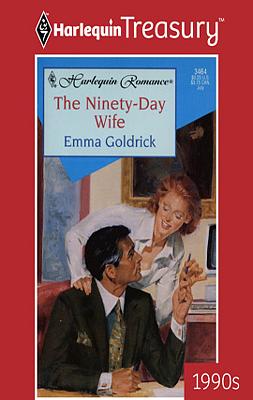

The Ninety-day Wife
Auteur·e
Emma Goldrick
Lectures
19,0K
Chapitres
10
A contract wife! Dr. Harry Mason was a man with a mission and a nine-year-old daughter. He needed a wife, and Laurie Michelson seemed just perfect! He'd proposed a marriage of convenience and, to save her family home, Laurie had reluctantly accepted. But her disastrous first marriage had made her wary, and so she had insisted on a temporary contract — ninety days with an option to buy! Unfortunately, Laurie had reckoned without Harry's charm and her new stepdaughter's powers of persuasion. Within days she had fallen in love with them both! Now all she had to do was convince Harry to take her on a more permanent basis — like the next sixty years or so!
Chapter 1
THE cluster of aged gray wooden buildings clung high on the flank of the Appalachian Mountains, above the town of Grandell. The houses hid under the cliffs, from which a century of mining had taken the coal and the heart. The mountain leered at the town, laughing through its dozens of empty mouths, and the city cringed.
Once the houses had been clean and multi-colored and full of life. Now they were all uniformly gray, and the tired, worn forty thousand citizens, mostly unemployed, lived in a city that once sheltered eighty thousand. But a small core of determined men and women were doing their best to refurbish Grandell.
The worn hospital had the colossal nerve to call itself Grandell Teaching Hospital. Harry Mason—Dr. Harry Mason—sighed as he set a careful foot on the rotting steps of the verandah, and wondered if his five years’ experience as a military surgeon hadn’t all gone to waste. But jobs, even for doctors, were hard to come by, now that the massive reduction in military forces was well under way. And the Grandell Hospital was a bootstrap attempt to increase the medical strength for the future.
“Do you plan to buy that stair?” A lovely contralto voice from behind him, loaded with sarcasm. Harry looked over his shoulder. She was a slim little thing, wrapped tightly in a heavy Mackintosh raincoat. The autumn wind was nippy, rustling through the tight cap of red curls that clustered around the blue knit hat she wore. Nippy, he told himself, but not that cold.
“It’s a wide stair,” he rumbled. “You could go around.” Even to himself the voice sounded threatening. Normally a smooth baritone, his head cold had dropped him into the bass range.
The girl flinched, and then bit her lip as she looked from the stair back to him. “Not on your life,” she said firmly. “You must be new around here.”
“Fresh off the boat,” he said, chuckling. “I’m the new administrator.”
She backed off one step as her face rushed to redness. “Do you know who I am?”
“No, I don’t,” he replied.
“Well, thank God for that,” she said pertly as she squeezed around him and ran up the stairs. The screen door marked “Admissions” slammed behind her.
Harry Mason ran two fingers through his thick salt-and-pepper hair and laughed at himself. Cute, no doubt about it. Cute? Beautiful. He modified his thoughts. I’ll catch up to her one of these days.
Laurie Michelson went down the main corridor at flank speed. One never ran in a hospital corridor, especially with one eye cocked over one’s right shoulder. She overran the plain little door marked “Staff”, and had to come back a few steps before she could dive into the room’s safety. The door closed behind her with a pneumatic sigh and she leaned back against it to catch her breath. The conversation in the room stopped. A nurse and two aides concentrated on this new marvel.
“Laurie,” Nurse James said. “I’ve never seen you rush before. Somebody after you?”
“Fate,” she said softly. “Dr. Crinden told me that I’d best keep out of sight until he could explain me to the new administrator.”
“And?”
“And I ran into him on the parking lot side stairs this morning!”
“Not to worry,” one of the aides commented. “I knew his mother. She said he’s as amiable as a—”
“Yeah,” Laurie said. “As amiable as a black bear. I saw the size of his teeth. Perhaps he thought he was showing his good nature, but it looked to me as if he was searching for a place to bite. I suppose he loved his mother. Most of these big male terrorists have that sort of attachment.”
“You might be right,” Nurse James reflected solemnly, hiding the teasing gleam in her eyes. “I’m just relating what his mother told me, a long time ago.” She paused for reflection. “But she’s dead, you know.”
Laurie Michelson, thirty-two years old, still as naïve as a girl could be, shuddered and struggled out of her winter coat. “I really need this job,” she said mournfully.
“You’ve got a whole year of university left?” Nurse James asked.
“Six additional credits after this semester,” Laurie admitted. “I have two semesters to go and I need the money.”
The electric clock-alarm on the wall buzzed.
“Day shift,” the nurse announced, and she, and her two aides, swept out into the hall. As soon as the staffroom door closed behind them, they broke out in giggles. Teasing Laurie Michelson was one of the few delights left in the almost bankrupt hospital. And she was so easily teased.
Laurie paced the long narrow room twice, then dropped into a comfortable chair. The green wall paint soothed her. She fumbled in her shoulder bag for a cigarette, without luck. With shaking fingers she dumped the contents of the bag out onto the low coffee table. Everything in her bag had a purpose; at the moment she just couldn’t remember what that purpose might be.
In a far corner of the mess was a rumpled cigarette. She picked it up, disgusted. She had quit smoking four times this year, and it was only September. Footsteps thundered down the corridor outside the door—and went past.
Laurie crumbled up the cigarette and threw the remnants into the waste basket. Not for anything was she going to break her vow against smoking. Well, not at this particular moment. But the footsteps had shaken her, disturbed her minuscule pot of bravery. She took a deep breath, stood up, and headed for her locker in the far comer.
Her uniform needed cleaning. Much to her surprise the diagnostics department had called on her services with considerable frequency lately. All this from a department that had once claimed her idea as pure idiocy. She was grinning as she slipped into her uniform: a pair of cuddly pink flannel two-piece pajamas and slippers to match, with little red tassels on the toes. The hospital robe which covered it was deadly dull green. She slipped into it with a little moue of disgust.
Her schedule hung on a clipboard on the wall. She checked the day’s requirement and the usual dialogues. Three appearances—two for beginning four-man residents. One appearance for a group of three would-be nurse-practitioners.
Laurie groaned at that one. The nurses were hard to fool. Another wall buzzer sounded. She checked her watch, shrugged, tucked her script inside her robe, and headed for the examination room.
Dr. Harry Mason moved along so rapidly that the head nurse had difficulty keeping up. The good doctor was displeased with his inspection. Nurse Hart had only to look at the thunderclouds on his brow to know. Not that she was perturbed. At sixty-three, two years away from retirement, Alison Hart knew all there was to know about Grandell Hospital, and where all the bodies were buried, so to speak.
“And what’s in here?” he asked grumpily..
“That’s one of the classrooms,” she said. “Diagnostics. A practicum. A basic course.”
He almost passed it by. It was getting close to lunchtime and he could smell something good wafting down the hall. But he was a man of duty, nothing less.
“Practicum? How the hell do you practise a diagnostic?” He nodded at the door. She shrugged and opened it. Doctors didn’t open doors if there were others available to do so. Not even in practically bankrupt hospitals.
He brushed by her and took a seat in the rear of the room. “Ah,” he said softly. The girl who had dodged him on the outside stairs was leaning against a corner of the teacher’s desk—dressed in pajamas?
So that’s where I made my mistake, he thought. A patient, not an employee! He leaned back in his chair to listen, barely noticing the broad grin on Nurse Hart’s face. The lecture room was arranged as a circular pit. Down on the floor four students and one instructor were gathered around a desk.
“Just how do you feel?” The student doctor had seen the new administrator come in, and he flushed a little, attempting to put on a show.
“Feel?” Laurie used her best worn-out voice. “Oh, I feel tired. All the time tired. I ain’t but nineteen years old, and I’m all the time tired. Maw says it’s just bein’ lazy, but I ain’t, ya know. Tired.”
“Tired,” the student reflected as he scribbled on the chart attached to his clipboard.
“Yeah, tired,” Laurie repeated.
“Anything else?” The older student stared at her suspiciously.
“Thirsty,” Laurie said. “I drink like a fool. Water, you know. My mouth is always dry. I hafta run to the bathroom all the time.” She wiggled into a different position against the desk. “All night long, runnin’ to the bathroom. Awful, ya know?”
They all nodded. Dr. Mason chuckled and extended his feet under the row of chairs in front of him.
There was a moment of quiet. “Are there any other questions? Any other tests?” the instructor asked.
“I’d like to check her vital signs—and listen to her heart,” the third student said. “Turn around, miss.”
“That young man was a medical corpsman in the Marine Reserves,” Nurse Hart whispered. Mason nodded.
“Unbutton your pajama top, please.”
“Unbutton my—what?”
“Unbutton your pajamas, please. I want to listen to your heart.”
Laurie reluctantly complied, looking over her shoulder at him as he pulled her top up and applied his stethoscope to the middle of her back.
“Take a deep breath and hold it,” he commanded.
She squealed. “Cold,” she complained. It wasn’t in the script, but from time to time she liked to vary the lines.
“Deep breath,” the student commanded sternly. Laurie giggled and complied. “And exhale.”
“I guess it ain’t important, you bein’ a doctor and all,” she said, and squealed again as the instrument touched down at another point.
“Deep breath,” he commanded. “And exhale. Turn around please, and—”
“Now just a dam minute,” Laurie huffed. “You ain’t gonna put that thing on my—”
“All necessary if you want to get better.”
Laurie sighed and turned slowly, closing her eyes as he tried to get more readings. Now the student seemed more embarrassed than Laurie as he pulled the pajama top up and traced a line under and between Laurie’s firm, sizable breasts. Dr. Mason jumped, and then settled down again. His own actions bothered him. Doctors of necessity had to touch bare flesh. So why should this little bit of clumsiness upset him? He shifted uneasily in his narrow chair as the student quickly withdrew. Laurie managed to re-button her pajamas and settle her pajama top.
“Any more tests or readings?” the instructor asked. “In that case you are required to make a list of any lab readings you might require, and your possible diagnosis.”
“I’d like to see those preliminary diagnoses,” Dr. Mason murmured.
“I’ll bring the papers to you as soon as the instructor has checked them off. Shall we go?” Nurse Hart asked.
Harry Mason had a little problem untangling his feet in the narrow row. The head nurse blinked a quick look at his semi-dazed face, and recognized the symptoms. She put a hand on his arm as if to guide him, and steered him out into the hall.
Down in the pit of the classroom the four students shook their heads and took their best guesses. The instructor collected their papers. Laurie Michelson tightened the belt on her pajamas, struggled into her hospital robe, and checked her wristwatch. She had two more classes left before her drama class down at the university in the center of Grandell, and she had been late three times this month already.
She raised an eyebrow to the instructor when they were all finished. He nodded. Ignoring the students, she climbed up out of the pit and went out into the hall. Dr. Mason was chatting with the head nurse, standing by the front door.
Laurie had been working at this job for six months, and was accustomed to the hospital’s routine. But this tall, lean man bothered her. Embarrassed her, for a fact. Besides, she hadn’t time to change back into her street clothes. Not that that mattered back at the university, where the drama department spent more than a little time teaching its students how to disguise themselves. But here, under the eye of the administrator? And her mother the doyenne of society in Grandell?
Laurie gulped, licked her lips, and started down the hall at full speed. Nurse Hart turned and went off down the corridor to the office wing. But Laurie had caught the doctor’s eye.
“Miss,” he called, and offered his best smile. Laurie, Michelson managed to avoid him and his smile, and turned left toward the staffroom. There was no time to dress. She shrugged into her heavy coat, picked up her remaining clothing, and went back out the door like an Olympic runner doing the hundred-yard dash. Dr. Harry Mason was still standing idly by the big swinging doors.
“Young lady,” he said in his best commander’s voice. “We don’t run—” And by that time she was halfway through the outer doors. His voice dropped to a conversational level. “We don’t run in the hospital corridors.” He shook his head at the back of her and muttered, “I must be getting old.”
“Me too,” she called back at him as she slipped by him and hurried down the rickety stairs.
“Just a darn minute,” he called after her. The wind whistled around the corner of the hospital, spraying her with the red-gold of maple leaves. She shrugged her coat more closely around her. Her bra fell out of the bundle of clothing tucked under her right arm.
“Hey, stop!”
“In a pig’s eye,” she muttered to herself as she swooped downward to snatch up the bra, and then increased her speed.
There was a pay-telephone booth in the lobby of the arts building at the university downtown. She stepped into it and slid the door shut just in time. A pair of rushing male freshmen shouldered their way up to the door and rapped on the glass. She ignored them with the cool disdain of a senior class member, and fumbled in her purse for change. Three rings and her mother answered.
“I’m at the university,” she said. The pair of freshmen knocked at the door again. She slid the door partway open. “Get lost,” she commanded. “This phone is reserved for seniors.” And then turned back to the instrument.
“No, not you, Mom. You left a note at the hospital for me to call you. What’s up?”
“Something I had entirely forgotten,” her mother told her. It was no surprise to Laurie. Her mother was running close onto sixty-five years old, and forgetting was one of the things she did really well. “There’s a little welcoming get-together at the country club. Six o’clock cocktails and then dinner.”
“No problem,” Laurie said. “Whom are we honoring?”
“I—ah—don’t seem to remember,” her mother said. “Somebody new in town—from the—No, I just don’t remember. Somebody important, I’m sure.”
“I’m sure he must be,” Laurie said. “Or she. Not to worry, love. I’ll be home by four-thirty, and we’ll just bomb right out to the club in our glad rags, and honor the devil out of him. Or her.”
“Yes,” her mother agreed, momentarily distracted from her multitude of problems. “Bomb right out? Not in that car of yours! Every time I ride in that car I panic!”
“It’s not the car,” Laurie lied, “it’s my driving.”
“Oh, well, in that case...” Her mother sighed and put down the handset. Laurie did the same and pushed her way out of the booth, her bundle of clothing trailing behind her.
“And don’t let it happen again,” she admonished the two freshmen as she dashed by them, heading for the elevator.
“Hey, lady,” the taller one called after her. “You dropped your—”
Laurie turned around. “My bra. You can’t play on the football team if you don’t know the names.” The shorter man ran over, carrying her dropped articles, and choked on an apology. The elevator door opened behind her and Laurie backed in.
“And don’t believe anything a senior tells you,” she called out at them as the door closed. And then added to herself, Especially a senior!
Laurie sat through two hours of classes, bored almost to tears. With two years behind her in community theater she had discovered the truth behind an old adage: Those who can, do. Those who can’t, teach. But the magic words in today’s world were “Get a degree,” and the words behind those were “class credits.” So she labored in the vineyard, daily hoping that the grapes would not all be sour. She dreamed a little between the lecturer’s exclamation points. About Dr. Mason—large, dependable Dr. Harry Mason.
When a girl had a hankering for marriage and a baby or two, solid, dependable men were hard to find. Long ago she had discarded the good-looking part of the equation, substituting employed instead. And who could be better. employed than a doctor? Not that Harry Mason was homely, mind you. But he had lived a good many years in the military, a profession that was noted for damage and destruction. She wondered exactly how many years.
She was so determined to find out that when the buzzer rang, signaling the end of the class, she sat still, dreaming, while her classmates tumbled out into the hall, chattering away about their own Dr. Masons. And since that was pure poppycock—there couldn’t be twenty-six of him, could there?—she snapped out of her fantasies and struggled down to the parking lot and her ten-year-old car. Which brought her home to the outskirts of town—almost, in fact, out of town—at just four-thirty, as promised.
“Just in time,” her mother greeted her. “Hurry up and change.”
“Hurry up? For drinks at six?”
“Well, we wouldn’t want to be late, would we?”
Laurie shook her head and then grinned. Her father, who had been a great big drink of water, had always referred to her mother as Mrs. Featherbrain—but with deep affection. Both the Michelson ladies missed him, but four years was a long time dead, and memories had long since faded around the edges.
It was a big house, half paid for before her father died, with more closet space than clothes. He had scrupulously made the mortgage payments for the house. Well, half of them, anyway, and as a result had left nothing else behind him, except for Mrs. Michelson’s insurance fund.
It was enough to feed them, but her mother had never forgotten her salad days in high society and spent as if she had inherited the Duchy of Lancaster. And that left nothing for Laurie’s education or clothes. A Cinderella situation, minus the Fairy Godmother. So Laurie paid most of the bills from her miscellaneous jobs, and her mother paid the mortgage monthly from his insurance.
Laurie was never one for feeling sorry for herself. Since high school days she had found odd jobs, part-time jobs, summer jobs, years of baby-sitting, occasional modeling jobs at a local boutique. All of which, combined with her scholarships, had carried her through three years of college. Three years and four months, to be exact, searching for a piece of paper signifying her degree, or Prince Charming, or both or whichever came first. If there were such a fellow.
There were two dresses hanging in her closet. One a basic black that was perhaps just a smidgen too tight around the hips, the other a solid brown with a low boat collar that was, in the conservative southern mountains of Tennessee, just a touch too modem for comfort. Laurie flipped a mental coin; the black won. It was either wear it without a slip or tear the seams out. She dressed cautiously and brushed her hair.
That was the easy part. Twenty strokes with a brush and her curls snapped back into tight little ringlets, and would not be budged, except perhaps by a tropical rainstorm.
Her mother was waiting for her in the living room, with her usual drink in one hand and a large, official-looking envelope in the other. “Ready, my dear?”
Laurie collapsed into an elderly stuffed chair, and consulted her wristwatch. “Ready, but we have an hour to spend, Mother. What’s in the envelope?”
“Oh, nothing important.” For the first time in years Laurie saw her mother blush. Unusual, she thought. “Something from the bank, dear. They keep sending me these things every month.”
“But you don’t want to buy any?”
“No. They are so persistent. Stand there by the door,” her mother directed.
Laurie got up slowly, already worn out from the day’s frenetic activity. The sun, normally cut off by the tail end of the mountain range, had managed to penetrate Culver Gap, and when Laurie stepped into the open doorway it silhouetted her.
“Oh, my dear, you can’t wear that!”
“It’s not a question of can’t,” Laurie said. “That’s all there is.”
“But I can see you right through—at least wear something underneath.”
“I can’t, Mother. There’s not enough room for me and ‘something underneath’. And my other dress is too—open at the top. It’s either this or I’ll have to stay home. You could always go without me. And I could use the rest.” For the first time in years Laurie was on the ragged edge, and unwilling to jump. Her mother fluttered and then gave up.
“No, I can’t go without you. Everyone would talk. We’ll just have to hope—you’ll just have to not stand in front of any lights, my love. Lord, pressures, pressures, pressures. I don’t know how I put up with them. I believe I’ll take a little nap.”
Laurie settled back into her chair and watched as her mother walked out of the room. She’s old, she told herself. You have to make allowances. Her father raised her to be a lady, a Southern Belle, and she doesn’t know anything else.
“What I really have to do,” Laurie muttered, “is resign from all this high society and find friends who’ll accept me for what I am. And just think what Mother would say about that!”
The Michelson ladies arrived just before six o’clock, Laurie’s old car gasping as it climbed the slight hill to the golf course. There were a dozen or more cars parked outside the clubhouse. “More than the last meeting,” Mrs. Michelson said. “Maybe there’s something to this bootstrap business. Establish the upper crust, and the town will rise to it.”
“Oh, Mom. Three quarters of the town are coal miners. Are you suggesting they join?”
“Nonsense, girl. I don’t know where you get these crazy ideas. Coal miners’ wives in the country club? Preposterous.”
“Democracy,” Laurie amended. “That’s what it’s called. Do the town a world of good, it would. During World War II didn’t all the women join the club and welcome?”
“Yes, but that was different, dear, and a terribly long time ago. Why, I was just a girl in those days. Enough of that. There’s a goodly crowd inside. Let’s go in.”
So, led in by the nose, so to speak, Laurie Michelson followed her mother inside the gingerbread construction that had served Grandell for more years than many of its neighbors had lived. The reception room had served as a basketball court during the 1980 depression years. A few bedraggled sets of bunting hung from the arched roof. A few tables had been gathered together on a narrow platform, signifying a dais—a place for the leaders to plume themselves.
As they moved across the room, Mrs. Michelson kept introducing her daughter, as if it were her first appearance in society, rather than her three hundredth. Laurie took it all in good humor, and hoped things would get better almost immediately. Which they didn’t.
“I must present you to Hans Depner—he’s here.” Laurie’s head came up with a start. Not Hans! It was too late to stop her mother. She was well and truly hooked!
“Mother,” Laurie whispered urgently. “You knew he would be here. I’m never going to forgive you for this. Never.”
“It was a silly misunderstanding,” Mrs. Michelson maintained stoutly. “Boys will be boys. One expects that. I’m sure he treated you like a lady!”
“Lady, hell!” her daughter snapped. “He practically tried to rape me. If it hadn’t been for Max, the night watchman, he might easily have succeeded.”
“Now, now, Laurie, it couldn’t have been all that serious. His mother is the chairwoman of the ladies’ auxiliary. The Depners have been pillars of our community since the beginning of the century. Now don’t make a scene.”
“If that man comes near me I’ll make such a scene as you’ve never seen before—right in the middle of the floor.”
“Well, if that’s the way you’re going to act, we might as well go home,” the dowager said huffily. “It’s no way for a lady to act. Your father would be shocked beyond reason!”
“Roll over in his grave, I’ll bet,” Laurie added. Her mother glared at her, and by that time Hans Depner had come close enough to make his bows.
“Mrs. Michelson, Miss Laurie—it’s been a long time since I’ve had the pleasure of your company.”
“And it will be a long time before it happens again. I have a long memory, Mr. Depner. A very long memory.”
“Are you suggesting that I did something out of the ordinary?” he asked pleasantly.
“Bingo,” she said forcefully. “Attempted rape is considered beyond the pale, Mr. Depner.”
“Perhaps you might like to discuss this with me, Mr. Depner.” Laurie whirled around, startled. Dr. Harry Mason—all one hundred and eighty pounds of him. All five feet ten inches and over of him, offering Hans Depner a choice of death in the late afternoon.
“Oh, really,” Mrs. Michelson interjected. “Not here in the club. Hans Depner is the son of the county clerk. People already speak of him as the next county registrar, a political plum where little work brings a handsome income.”
Mothers with unattached daughters considered him to be a fine catch. Mothers such as Mrs. Michelson, whose flighty concerns had nothing to do with her daughter’s happiness, thought Laurie.
“I’m not much concerned about where and how,” the good doctor declared. “Just about when and why.”
And that, Laurie Michelson told herself, is a whole bunch of good news. This is a man who—And her mind whirled around like a computer hard disk, listing all the dozens of reasons why Dr. Harry Mason was a damnably good man to have around.
But Hans Depner had a considerable concern for his neat nose, and felt it threatened. He backed off a step or two and held up both hands in abject surrender. “Look,” he said. “I’m in the market for a conversation, not an assault. You’re the new doctor, aren’t you?”
Mason nodded.
“I certainly wouldn’t want to do anything nasty to your face. It might scare off the customers,” Depner said.
“That’s kind of you,” Mason said. “Only I’m a surgeon. You ought to worry about my hands. Fragile, you know. So now, if you would just apologize to the young lady and then go away, everything would be just fine. Right?”
Red-faced, deciding the better part of valor was to give in, Depner complied.
“Doctor?” Laurie’s mother could be swayed. A surgeon in the hand was worth two county registrars in the bush. She nudged her errant daughter.
“Dr. Mason,” Laurie supplied. “My mother, Mrs. Michelson.”
“Harry,” the doctor said, extending a hand.
“Maybelle,” Mrs. Michelson returned, taking the offered hand. “A surgeon. How exciting. My late husband was in the medical profession as well. A pharmacist, you know. We owned the largest pharmacy in Grandell.”
The doctor nodded in recognition; birds of a feather, he seemed to indicate. Team members, so to speak. Maybelle Michelson blushed, and, had she been forty years younger, would have curtsied. Laurie blushed as well. For herself and her mother, and prayed that the roof of the old building might not collapse. It didn’t.
Laurie was nursing a ginger ale in her hand. Prepared with infinite skill by the elderly bartender to look like a whiskey and soda, iced to perfection, and just what she needed at that embarrassing moment.
“Dear Lord, what are you doing?” Dr. Mason snatched at her glass, but it had sweated down its sides, and his hand slipped. Laurie added another hand around it, and struggled to get the cool liquid to her mouth. Almost in desperation the doctor swung a flat palm at the glass and at her, and knocked the drink off to the floor, where it shattered.
Shards of glass bounced and scattered. The ice cubes broke up into tiny splinters and joined the confusion. Mrs. Michelson turned pale and almost fainted.
Laurie, caught between two emotions, grabbed at her mother and glared at Harry Mason. “Oh, my,” Mrs. Michelson said as she gasped for breath.
“Just what the hell are you trying to do?” Laurie muttered.
“Stupid,” the doctor roared. His quarterdeck voice overrode all the conversations in the room. Silence pounded in and seized control. Mrs. Michelson hardly knew what to say. She looked meekly at the doctor.
“Your daughter,” he said in a steel-like voice, “came into the hospital today and was plainly diagnosed as a diabetic. And now you let her drink alcohol? Stupid!”
“She what? Diabetes? No Michelson would ever have that. Only poor people—”
“Which we are,” Laurie interrupted. “There’s hardly anyone in town who’s poorer than we are.”
“Nonsense, Laurie Lee. Maybe the man is right. Stupid! I told you and I told you, don’t be messin’ around with those people down on South Water Street.”
“Mother, you are about as batty as he is. You don’t catch diabetes by going down to South Water Street. It’s not an infectious disease you catch from poor people. And as for you, Dr. Mason, if that’s the way you diagnose patients in the hospital the cause is lost. I did not come to the hospital to be diagnosed. I mean—I did, but not the way you think.” She whirled away from him and headed for the door.
“Laurie,” her mother called feebly. And then she turned to the doctor. He was, after all, a man of authority—a surgeon. “Now see what you’ve done,” she moaned as she searched for a handkerchief which ought to have been in her purse. Ought to have been, but wasn’t.
“What have I done now?” Mason asked belligerently.
“How do I know?” Maybelle Michelson said, crying into the handkerchief he’d offered. “But somebody did something. My baby never, ever acted like that before! Never!”
“Yes, I see that,” Harry Mason said, sighing. “I wish I understood women!”