

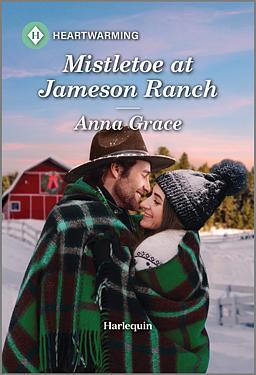
Mistletoe at Jameson Ranch
highlight_author
Anna Grace
highlight_reads
19.8K
highlight_chapters
18
CHAPTER ONE
THE CAT SAT UP, alert in the middle of the empty two-lane highway running through Pronghorn. She turned her head briefly at the sound of the car door slamming, then twitched her crooked tail.
“How are you still here?” Harlow asked the cat.
Connie narrowed her eyes.
Par for the course. Harlow Jameson was used to being watched with suspicion in Pronghorn.
Harlow checked her makeup in the reflection of the driver-side window. Less polish, more residual dust than her normal look, but it would do for Pronghorn. Clothing and makeup served as her armor in Nashville: shiny, expensive and denoting status. People didn’t mess with a woman who could afford bespoke Miron Crosby boots.
But around here, they’d take potshots at her no matter what she was wearing.
Harlow glanced down the street. Nothing had changed. The weathered wood of Mac’s store looked like a parody of a ghost-town building. The Restaurant was bizarrely still in business, still had the same sandwich board out front informing prospective patrons of the two choices offered that day. Or warning them. Connie the cat still lounged in the road in front of the school, glaring at strangers.
Of course, Harlow wasn’t a stranger. She’d grown up in Pronghorn, still owned the family ranch outside of town. But if she hadn’t fit in around here as a young person, relocating to Nashville had sealed her fate.
Moving away was a mortal sin in these parts. It suggested there was a better life elsewhere. The cat didn’t like her any more than anyone else in town.
“You know you’re going to get smushed one of these days,” Harlow said.
Connie stretched out, impossibly long, in the middle of the highway.
“Suit yourself.”
Harlow readjusted her wool and cashmere coat and turned in the direction of the store. She took two decisive steps, then stopped cold.
Are those Christmas lights hanging outside of the sheriff’s office?
Harlow stepped into the road to investigate. Christmas lights and a handmade garland of pine and juniper hung under the eaves of the brick building that housed the sheriff’s office and the post office.
Weird.
Harlow took another step toward the store when something else funny caught her eye. Over the door of the old school someone had painted:
Pronghorn Public Day School, Proud Home of the Pronghorn “Pronghorns”
Harlow leaned back so she could see the parking lot. Sure enough, a few old trucks were lined up in the faded parking spots, and a collection of bicycles had been haphazardly attached to a brand-new bike rack.
“I thought the school closed down,” she said to the cat.
Connie rolled onto her back, exposing her belly to the weak December sunlight.
Something was off. Harlow was standing in Pronghorn, but also not Pronghorn.
She pulled off her sunglasses and turned slowly, examining the town. She let the details come to her, as she would when studying the evidence in a legal case.
Holiday lights and fresh, elegant garlands adorned every one of the old brick buildings on Main Street, not just the sheriff’s office.
Mac’s store had a sign affixed to the side advertising ice cream. Underneath was another sign:
Coming soon! Espresso!
And pinned to the second sign was a sheet of paper that read Maybe.
The restaurant still bore its title—“The Restaurant”—in yellow paint on the side of the building. But it, too, was decorated for Christmas. It also included a snug outdoor seating area with heaters. Harlow squinted as she read the sandwich board out front. There were three choices of entrée. Half again as many choices as had ever been offered there before.
Harlow’s heart sank a little. She didn’t like the proprietress, Angie. And Angie didn’t like her, but three choices on the menu? Something must have happened to the surly woman who ran the one restaurant in a fifty-mile radius. She might be hurt or sick or no longer with them. Harlow didn’t wish ill on anyone, not even Angie, and certainly not on the three boys the cantankerous chef was raising on her own. But if dining at The Restaurant now included choices and ambiance, Angie was no longer in charge.
Harlow shook her head.
Or maybe she was dreaming, because this couldn’t be Pronghorn. Pronghorn was sad and beleaguered, on the verge of vanishing completely. Pronghorn was not cheerful. It was not cute and Christmassy. Pronghornians weren’t the type of people to put up Christmas decorations only to have to take them down a month later. If one needed evidence of what Pronghorn had become, the old City Hotel was the perfect symbol. Once bustling and glamourous, the building was now an empty shell, falling apart at the seams.
For confirmation, Harlow spun around to face the City Hotel.
It did not comply with her memories.
Sparkle lights hung from the eaves. A colorful garland of pine, juniper and dried flowers framed the entrance to the courtyard. Fresh wreaths hung outside the upstairs windows facing the street.
What in the sagebrush was going on here?
“Can I help you, ma’am?”
Harlow lifted her head, ready to demand an explanation as to why her hometown, which was supposed to be dying, was all gussied up like a California spa. Then she locked eyes with the speaker.
It was a cowboy sauntering out of the hotel, wearing jeans, boots and a canvas jacket. The dark eyes she was staring into shone from under his Stetson. He stopped in front of her, a charming and almost shy smile spread across his face.
Was that a Gibson guitar slung across his back?
“You look lost,” he continued.
Emotionally lost? Or metaphorically?
Lost in the multiverse, maybe.
Also, why was the world’s most gorgeous cowboy asking her if she was lost? He should know better; Pronghorn was no place for interesting people.
She slapped around in her befuddled brain for her manners and managed to come up with what she hoped was a self-assured smile. “I was heading to the store.” She pointed to Mac’s.
His grin grew conspiratorial. “I’ll warn you, the espresso machine has arrived, but Mac hasn’t quite figured out how to use it yet. He’s been serving real strong instant coffee until he’s got it all under control.”
Harlow laughed. “Now that sounds like Pronghorn.”
“It’s not bad if you put a scoop of ice cream in it.” He held her gaze, his smile growing hopeful. “My treat if you’re brave enough to try.”
Who was this handsome, funny, guitar-wielding guy with espresso advice? The cowboys around these parts were supposed to be like Pete Sorel or Ed Gonzales, old and grumpy.
Harlow allowed her gaze to connect with the decidedly not old nor grumpy cowboy. A spark lit, and color rose to his face. He kicked the toe of his boot against the sidewalk.
But as much fun as flirting with this man was, she still needed answers.
“Mac actually has ice cream?”
“Oh, yeah.” He nodded toward the school. “When school lets out, the kids swarm the place.”
She glanced over her shoulder at the cat, as though Connie could corroborate his story. The feline stood and stretched, then walked over to the cowboy and rubbed against his legs. He bent and scooped up the cat.
“Have you met Connie?” he asked, scratching around her ears, then rubbing her chin. Connie gave Harlow a smug look, then rubbed her furry nose against the man’s chin and purred loudly.
“We’re acquainted.”
“Connie’s our welcome committee here in Pronghorn.”
She gazed at the man, snuggling a cat in front of the holiday-decorated hotel. Part of her wanted to play along and let the handsome stranger show her around. But in twenty seconds, some Pronghorn native was going to wander into the street and recognize her, and it would all be over. Or worse yet, Sheriff Weston would start yammering about her cattle again.
The cat shot her a look, reminding Harlow she’d already been recognized. Then she jumped from the man’s arms and returned to her post in the middle of the highway.
It was probably time for Harlow to rip off the Band-Aid.
“Look, I’m not lost. There’s only like ten buildings in the whole town, so even if I was, I could probably find my bearings pretty quickly.”
He laughed and kicked the toe of his boot against the sidewalk again. “Yeah, I know. I was just excited to help a stranger.” He looked into her eyes and smiled as he added, “Get my local cred by helping out a pretty newcomer.”
Pretty newcomer? That was probably the nicest thing anyone had ever said to her in Pronghorn. As a child, she’d been awkward and self-conscious to an extreme. Over the years she’d learned to embrace her larger frame and curves, cultivating a style a former boyfriend had described as Nashville Goddess. But as a kid she’d felt like a giant among pixies. Her parents didn’t believe in spending money on frivolous things like stylish clothes, or even new clothing. No one thought to help her manage her tempestuous teenage complexion, or work with her thick mane of hair.
In college, she figured out how to present herself, as quickly as she’d figured out how to ace her classes. But as she’d changed and grown more confident in herself, Pronghorn seemed to resent her more and more. By reaching for more for herself, she’d betrayed those who didn’t do the same.
So how was it she now stood in the middle of a festive Pronghorn street with an adorable cowboy calling her pretty and asking to buy her instant coffee with a scoop of ice cream in it?
Harlow’s heart reached out to tug on her frontal lobe, asking if it could run outside to play.
No.
Harlow was no stranger to charming men. In Nashville, the streets were swarming with well-mannered, good-looking people who used every skill at their disposal to scale the cliffs of the country music industry. To those in the know, Harlow was an up-and-coming intellectual property lawyer. She’d earned a reputation for fiercely protecting the work of big-name stars, as well as working overtime to care for fledgling singer/songwriters in a system rife with wolves. She knew how to wear her Wranglers and didn’t have any dreams of fame herself. Harlow was an artist’s dream date.
So yes, she’d been flirted with a time or two. But not like this. Not with a chivalrous cowboy on the spruced-up streets of her hometown.
Not with someone who had her heart spinning ahead of her good sense like a tumbleweed.
“You’re new to town?” she asked.
“Yep.” He grinned, like living in Pronghorn could possibly be considered a good thing.
“And you want to gain your local status?”
“Of course.”
“Then explain this to me.” She waved a hand, indicating the holiday cheer.
He looked around, confused. Right. He was new to town. He didn’t understand that tasteful, handmade garlands, glittering twinkle lights and even the possibility of espresso didn’t fit the town’s MO.
She tried again. “I thought the school had closed down.” And put all future Pronghorn teens out of their misery.
“Oh, no. Well, yeah. It did. But we got it up and running at the end of August.”
“We?”
He gave her the biggest grin yet. “I’m one of the new teachers.”
A teacher? This guy was wasting his charisma teaching? She stared at him expectantly, waiting for him to explain that education was a stopover career, like how Harrison Ford was once a carpenter before he became Harrison Ford.
His smile was slow and easy as he gazed into her eyes. “I teach science.”
It was not a sentence anyone should have found attractive, but somehow it transported her to a dreamy place of Bunsen burners and plastic safety goggles.
Yeah, she could certainly believe the guy knew a thing or two about chemistry.
Harlow broke eye contact and fixated on Mac’s maybe espresso sign. “You’re a teacher?” she clarified, then gestured to his guitar. “Not a musician.”
“No, I’m on my prep period. I came to grab my guitar because my physics students are struggling with linear momentum, so I wrote a song about it.”
She shook her head, laughing. It was all so absurd.
“Music can be really helpful in the classroom,” he defended himself.
“Sorry. No. That’s amazing. You’re writing songs to help your students learn. I love it. I’m just a little thrown off by—everything. I need to put all the facts in order here.”
“I’m happy to help.”
“The school is open again?”
“Yeah, it’s doing great. Kids are back in class, and we even have a few exchange students.”
Kids from other countries came here on purpose?
“And how did they find you?” Or rather how did they manage to get someone like you to come to the middle of nowhere for what has to be abysmal pay?
“I’m one of five new teachers recruited to work here. We live at the hotel.” He gestured over his shoulder.
“The hotel is gross and dilapidated,” she reminded him.
He shook his head. “No, it’s all fixed up. It’s great. We love it.”
How long had it been since she was home last? She’d spent some time at her ranch in the spring but managed to avoid coming into town. Come to think of it, she hadn’t set foot in Pronghorn for well over a year. Things had changed, but why? And how?
“Whose idea was it to revive the school?” she asked.
“I think a lot of people were invested in the idea. Colter Wayne put up seed money, and most folks in the area donated. Then, well, do you know who Loretta Lazarus is?”
“Yeah, I know Loretta.”
Everyone knew Loretta.
“She kinda Frankensteined a school together.”
“I bet she did.”
And this guy was the lightning bolt that brought it to life.
A LOT OF good things had happened to Vander when standing in this very spot. It was where he got off the bus and saw the town for the first time. His coworkers, the people he now considered his closest friends, had vowed to face the challenge of reviving the small school here.
He had his first herding experience in this spot, wrangling a group of curious pronghorn out of the hotel courtyard and back into the fields surrounding the town.
It was where he’d been offered his second job, assistant to the foreman at Jameson Ranch.
But standing here, talking to a smart, beautiful woman? The best. He needed to get back to his classroom, but he had about twenty minutes before fourth period started. And since there were only six students in physics, getting the class settled down and taking roll wasn’t a big ordeal.
“What brings you into town?” he asked.
“Not espresso.”
Vander laughed. He hadn’t asked out a lot of women in his life. As an introvert, he was possessive about his free time. His last relationship had taught him he didn’t have the best instincts when it came to women. But he intended to see what this woman thought about very strong instant coffee with a scoop of chocolate caramel ice cream in it. “Sure you don’t want to give Mac’s substitute creation a try?”
“Tempting. But honestly, I’m feeling like my understanding of linear momentum is a little shaky.” She flipped her shiny dark waves over one shoulder. “If I could just hear a song about it, that would probably clear it right up.”
He laughed again. “You’re welcome to join my class. Anytime.” Every day, as far as he was concerned. Unless...wait. He might not be correct. “I mean, you might need a background check or something. I don’t really know much about it, but I’m sure Aida can run it for you.”
“You’re on a first-name basis with the sheriff?” she asked, implying that she, too, was on a first-name basis with the sheriff.
“Yeah, she’s great. She’s actually engaged to my friend Tate.”
“Aida Weston is getting married?!” She looked around, as though this were proof that the universe was unraveling. “Like, to an actual person? Tate’s not a soccer ball.”
Vander threw his head back as he laughed. This woman, for all she’d been standing bewildered in the street, clearly knew the area. Aida Weston was a local soccer legend.
Which meant maybe she lived nearby. Maybe they could get together and talk about linear momentum outside of class.
“Tate’s a real person. He’s a PE teacher, a great guy. He’s crazy about Aida.”
“Wait, there’s more than one attractive male teacher in town?”
Vander coughed. Did she just call him attractive?
Maybe he needed to reel this back in? His last relationship had broken down over a lack of shared values, and his student-teaching experience made him wary of trusting anyone he didn’t know well. But there was something about this woman’s absolute confidence that drew him to her. Besides, he was only thinking about ice cream and coffee, it wasn’t like he was considering opening up a joint checking account.
He glanced at her again, but she was looking across the street at the sheriff’s office, eyes narrowed.
“Weeelll, I’ll tell you, Aida Weston knows all about my past.”
Okay, so maybe she grew up around here. Was she visiting family?
“What brings you to town?” he asked.
“I’m hosting some friends at my ranch in a few weeks. I want to make sure the place is in order, and I like to take a few weeks every year for some solitude and reflection.”
Solitude and reflection? This was clearly the woman he was meant to spend his life with. Vander kicked the toe of his boot against the sidewalk, trying to think of some kind of date he could ask her on besides the coffee. Maybe she liked horses?
“And I’m here, specifically in Pronghorn, to get some groceries.”
Vander winced on her behalf. She laughed.
“Your reaction suggests that a cute little deli with an olive bar has not yet opened up in Pronghorn, despite the alarming changes elsewhere.”
“It’s still just canned soup and crackers,” he said. “Two new items a year is probably max growth for the store.”
She nodded, as though expecting this.
Should he invite her over for dinner? Willa Marshall, the school’s English teacher and the first person Vander turned to with any kind of a problem, had put stew ingredients in the slow cooker before they left for work. The teachers planned to warm up some rolls to go with it that evening. His friends wouldn’t mind one more person at the table, and certainly not someone as interesting as this woman.
Vander opened his mouth, contemplating the best way to phrase the invitation. By this point in their brief meeting, he wanted to take her out for instant coffee, sing to her about linear momentum and serve her a bowl of his friend’s stew. Vander had never been real smooth with women, but even he could tell this wasn’t anyone’s dream date. If Tate were here, he could help him plan something, but this seemed like a moment he was supposed to seize.
She sighed before he could get started. “My housekeeper got sick, so she wasn’t able to fly ahead and stock the house like she normally does. I’ll roll into Lakeview tomorrow, but right now there is literally no food in the fridge.”
Vander had managed to put together seven words of a dinner invitation, but something stopped him.
Housekeeper.
“I mean, it’s not her fault she’s sick,” Harlow continued. “But I’m seriously not happy with whoever sneezed around her.”
“You travel with a housekeeper?”
“When I come back to the ranch.” She readjusted the black leather bag on her shoulder. A gold clasp and detailed stitchwork caught his eye.
Vander studied the woman more carefully. She probably didn’t wake up with perfect glossy brown hair and careful eye makeup. Her clothes were understated, but the long wool coat and soft-looking sweater underneath coordinated expertly.
Vander knew he had a tendency to be judgmental. He used up a lot of his grace and goodwill for people under the age of eighteen and tended to be critical of the choices adults made. It wasn’t his best trait.
He tried to look at the situation from her perspective. So she had some money. Not a big deal. She could afford to have someone grocery shop for her. That was fine.
It was just kind of disappointing since it meant they weren’t going to fall in love over rapidly melting chocolate caramel ice cream in Folgers coffee.
“I try not to come into Pronghorn when I visit, but I tried fasting once, and it did not go well.” She glanced over her shoulder at the store, then sighed. “Crackers and soup it is.”
Now Vander was confused. “Why wouldn’t you come into town?”
“Why would I?” She gestured to the adorable, quirky place Vander had come to call home. “This place is dead.”
“It’s not dead. The Warner Valley is home to forty-two species of mammal wildlife and is part-time home to the largest population of pronghorn in the US.”
She raised her hands in emphasis, like they were sharing a joke. Which they weren’t. “Exactly. There are more antelope than people.”
How did she not see that as a positive?
Vander had never fit in anywhere until he came to Pronghorn. From the moment he stepped off the bus in this tiny town in the middle of nowhere Oregon, he knew he was home. The lack of reliable internet, and thus lack of a relentless dependence on social media by the inhabitants, cemented the feeling. That didn’t mean the last few months had been easy. Within the first two weeks of classes, a community group had tried to shut down the school. The students had to readjust to in-person education. Negotiating the realities of a small town was no joke. But never in his life had anything felt more important than the work he was doing. In Pronghorn, he’d met his closest friends, was respected as a teacher and was learning to handle horses.
It was a blessed shelter after the emotional hurricane that had blasted everything he thought was sacred and solid in his life.
“Pronghorn is thriving,” he said. If she didn’t live here, she couldn’t know. He led with what seemed to be the most important recent event to native Pronghornians. “We tied the league championships in soccer.”
She gave him a deadpan look.
“We tied with Westlake Charter,” he clarified. “Those kids were good.”
She laughed. Not the beautiful, sparkling fun laugh he’d heard moments before but something hard and intentional. It was a laugh meant to dismiss. It was the laugh of a mean kid playing keep-away in grade school, seeking differences to point out in junior high, taming sycophants in high school.
As an adult, Vander had been disappointed but not surprised to find that the cliques still existed. There were still people who believed in social rank and did their best to sort everyone into it as they kissed up and kicked down. He’d been pretty uninterested in these folks for most of his life, until one of them came after him.
A frisson of discomfort ran down his spin. Vander twitched off the uncomfortable feeling. He was in Pronghorn to get away from people who laughed like that.
It wasn’t that everyone around these parts got along all the time, not by a long shot. But they understood they were in this together. At any given time, one person’s skill set might be what another needed to survive. The school had given them ample evidence of the difficulty but ultimate value of coming together.
“Pronghorn is fantastic,” he said. “I wouldn’t want to live anywhere else.”
“The town goes dark at 6:00 p.m.—”
“Because we’re part of the world’s largest Dark Sky sanctuary.”
She tilted her head to one side, baffled.
Vander tried to explain, but how did she not know this already? “Two and a half million acres of the Oregon outback is free from light pollution. You can see the Milky Way from here.”
“Sounds like a party,” she said dryly.
“It can be.”
It actually had been a party in the hotel courtyard when he and his friends first discovered how much they could see in the night sky. Tate had nearly gotten a ticket for disturbing the peace from his own fiancée that night, he was so excited about seeing their galaxy stretch through the sky like something out of Star Wars.
Her brow furrowed. “Pronghorn is tiny. It could get absorbed by the sagebrush and prairie grass at any minute.”
“Not if people work together to save the town.”
“Why does it need to be saved? Towns die. It happens. That’s the natural cycle of things.”
“Towns go through good times and bad,” Vander corrected, really wishing Luci, the social studies teacher, was here to back him up. “And this town is perfectly healthy.”
“And the evidence of that would be?”
It really was too bad she hadn’t been here for the Westlake Charter game. Instead he gestured toward the store, but even he understood the possibility of espresso wasn’t the most compelling argument.
She shook her head. “Even on its best days, you have to admit Pronghorn is weird.”
“Interesting is a better word.”
“This town literally has a commune—”
“It’s an intentional community,” Vander reminded her.
“Intentional community,” she repeated. “Where everyone wears orange and walks around talking about the sun like it’s taking care of them.”
Vander’d had a few run-ins with the Open Hearts Intentional Community early on, as their beliefs didn’t always mesh perfectly with modern scientific thought, but they’d worked it out.
“Technically, the sun is taking care of us. There’d be no life without it.”
She sniffed and twitched one eyebrow, as though the argument were beneath her.
“I’m not saying Pronghorn is perfect.” Vander glanced around. “But it’s full of good people—”
“It’s full of stubbornly bizarre people who seem to think their way of life is somehow special.”
As though to prove her point, Pete Sorel’s big, white, double-wheeled truck rumbled by, waving both an American and a Senegalese flag, a multitude of international flag bumper stickers on the back.
The woman watched the truck, brows furrowed. Then she gave her head a sharp shake.
“I think this town is great,” Vander said. “I’m sorry you don’t agree. I really am. But if you don’t like it, that’s your problem.”
Her face fell, as though he’d hit the one sensitive nerve she had. Like it was fine for her to insult his home, but by suggesting that was her problem he’d somehow crossed a line.
He’d said the wrong thing, again. But so had she, and he wasn’t going to apologize to someone who’d started the argument in the first place.
“Sorry.” She brushed her pretty hair off her shoulder. “I shouldn’t have said anything. Enjoy this weird, small town and its weird, small inhabitants.”
“You got it.” Vander backed away across the street, making sure to step carefully over Connie. “Have fun judging everything you don’t understand.”
She waved. “I intend to.”
“Mr. V?”
They both turned to look at the steps leading up to the school.
Mav, a student wearing the orange of Open Hearts, leaned out the front door. “Ms. Marshall wants to know if you’re available to help her. A couple of pronghorn got into the library, and they’re scaring the hedgehogs.”
“I’ll be right there,” he said. Vander took one last look at the beautiful woman.
She crossed her arms, as though Mav had proved her point.
Vander kept his gaze steady, like he’d learned to do with the horses he worked with. “Enjoy your stay.” He tipped his hat and stalked up to the school.
It would have been perfect if he could have kept it at that. But something in him rebelled against the high road. He wanted to know if his words had affected her. There was no reason for him to care. Elegant women who didn’t like Pronghorn weren’t his concern. She had zero positive qualities, and if she did her best to never set foot in Pronghorn, he’d likely go his whole life without seeing her again.
And yet.
Vander’s excuse was he wanted to take a moment to compose himself before entering the school, which he did. But he didn’t need to take one more look at the pretty woman to do that.
He glanced back in time to see her take three decisive steps toward the store. Then she stopped. After a second of hesitation, she spun around and tried to shoo Connie out of the middle of the street. When the cat refused to move, she picked her up and set her on the sidewalk.
“Lounge on the sidewalk,” she commanded.
Connie twitched her crooked tail in annoyance.
The woman readjusted her handbag and sunglasses, then resumed her journey toward the store.
Connie watched her walk away, then sauntered back to her spot on the warm pavement and stretched out again.
Good cat.