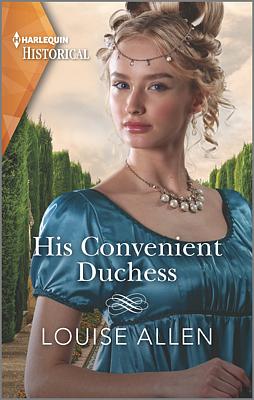

His Convenient Duchess
Autor:in
Louise Allen
Gelesen
15,7K
Kapitel
19
A witty Regency romp "You are a lady of breeding… And would make an excellent duchess…" Not the most romantic of proposals, but Marcus Cranford knows it will be accepted for Lady Rose Trafford desperately needs a convenient husband to protect her and her beloved younger sisters. It also saves the new duke from the horror of a London season! Rose is courageous, hardworking, often exasperating… So what Marcus doesn't expect is this new spark of lust — and the hope that she's feeling it too…
Chapter One
The Princess Rosalinda sat in her turret and gazed across the assure (azzure?) ripples of the river towards the far bank. She was yearning to be free from her wicked uncle (stepfather??) the King. When would her gallant knight (prince??) come to rescue her from durrence vile?
Lady Katherine Trafford sucked the end of her much-chewed pencil and frowned down at the notebook spread open on a board across her knees. ‘How do you spell durance? And do you think I should put something about Rosalinda’s long flaxen tresses at this point, or keep that until later, when gallant Sir Marmaduke first sees her?’
‘One r. And it’s an a, not an e. And one z in azure.’ Her elder sister Lady Chloe looked over her shoulder as she passed, the starched apron over her neat sprig muslin dress weighed down by hens’ eggs, still warm from the nest. ‘Rosalinda and Marmaduke? Are you certain about that, Kat?’
‘I am basing my heroine on Rose, but that isn’t a romantic enough name,’ Kat explained earnestly. ‘And Marmaduke has glamour. Or not? What do you think, Rose?’
Lady Rose Trafford, perched ten feet up the wreck of the spiral staircase of a small turret, now in such ruin that only half of its outer wall remained, looked down at her younger half-sisters. ‘What do I think about what?’
‘Marmaduke as a name for the hero.’
‘He sounds like the kitchen cat, to be frank,’ she said. ‘Although Oswald would be worse. Is this your new romance, Kat?’
‘It is and I am going to make our fortunes with it,’ Kat stated confidently. ‘It is called The Knight and The Imprisoned Princess, although I may make him a prince. What are you doing up there, Rose? It is a very good place, because if a knightly hero comes galloping across the meadows to our rescue you could see him from up there and wave a spangled scarf to attract his attention.’
‘That would be difficult, as I do not possess a spangled scarf,’ Rose said. ‘I’m afraid I would make a very unsatisfactory heroine, Kat because what I am doing is contemplating setting fish traps in the moat.’ She studied the turgid green water, stirred by the wake of a small flotilla of ducks. ‘We do not have time to sit dangling rods in it in the hope that something will bite, but a few traps might catch something. Probably only a very muddy-tasting carp.’
She gathered up her divided skirt, revealing boots and breeches beneath, and picked her way down carefully from her favourite, but precarious, perch. ‘Time for breakfast and I am sorry to disappoint you, Kat, but the only men in sight are Billy Austin taking his plough horses down to the forge and that lad from the village, the one with the sniff. He’s leading a goat on a string which must be the one I bought from Widow Lambton last market day. The one thing we are not going to see riding up to our drawbridge is a gallant knight, let alone a prince.’
‘Where is my castle?’ the Fifth Duke of Northminster demanded. He stabbed a long tanned finger at the rows of folders spread out on the library table, each neatly labelled with the name of one of his many newly inherited properties. The Burmese ruby set in the ring on his left hand flashed in the sunlight like a baleful eye. ‘I do not see it among these.’
‘Er...here, Your Grace?’ Mr Barclay, his land agent, ventured, making a vague gesture towards the arrow slit high in the library wall.
‘Not this one, Barclay. And while we’re on the subject, what confounded idiot put a library in a round tower? No, don’t answer that. I suppose it has been in here since fifteen seventy. I mean Chalton Castle.’
Marcus was still sizing Barclay up, as he was all his newly acquired staff and servants. The man looked like a nervous mole, but at least he stood his ground under pressure. Presumably he’d had enough practice with the last two Dukes.
‘Oh, that was sold last year, Your Grace.’
‘Sold?’ Marcus looked up, eyes narrowed, and Mr Barclay swallowed visibly. ‘Entailed property may not be sold or otherwise alienated.’ He might know more about ships’ lading and the import duties on silk than he did about the inheritance of land, but he was very clear on that point.
‘You are quite correct, of course, Your Grace. But Chalton was not included in the entail for some reason and the Fourth Duke and his father sold all the non-entailed property.’
‘When?’
‘Over the last seven years, Your Grace. As you know matters became a trifle... That is to say, there was the need to secure ready money for...er...various reasons.’
His cousins’ debts, in other words. Father and son appeared to have been alike in reckless extravagance. ‘Do stop calling me “Your Grace” every second sentence, Barclay,’ Marcus said, more moderately. ‘It makes me feel like an archbishop.’ It wasn’t the poor devil of an agent who was at fault here: he would have had to follow orders or lose his position and there was nothing illegal about selling non-entailed property.
Marcus frowned down at the spread of folders. ‘Why were the properties that were sold not entailed?’
‘All of them except Chalton Castle were recent purchases, made at the end of the last century by the Second Duke, Your Gr...er...sir. They were small farms or parcels of land, for the most part. I assume the intention was to add them at some point. Chalton was acquired in the fifteenth century when it was already in a very poor state, I understand, and the farmland was never significant. For some reason it appears never to have been included in the entail.’
‘It came with Isabelle de Chalton in 1491,’ Marcus said. ‘Only the gatehouse towers were in any state of repair even then and they were turned into a house by the farmer who leased the land. He built a dwelling of sorts in the space between the towers where the entry had been. The last time I saw the place the curtain walls around the bailey were tumbling down, but the moat was still there.’
Marcus blinked and the image of sunshine on water, of the deep shade cast by ancient ramparts, swam back into his mind. For a moment he felt again the thrill of learning to fish, to use a bow and arrow; the magic of weaving fantasies of knights and battles. The balm of pure serenity and healing, uncomplicated, happiness.
‘You knew it well, sir?’
‘Yes, very well. Buy it back, Barclay,’ Marcus said. ‘The castle and all the rest of the land that was sold. Offer five per cent over what was paid, that should do it.’ The peace that followed Waterloo had triggered an agricultural decline and farmers would be glad to sell at a profit.
‘I am sure I can secure the agricultural lands, but I doubt very much we will be able to buy back the castle, sir,’ the agent said doubtfully. ‘The lady who purchased it seemed to have very definite plans in mind.’
‘A woman bought Chalton? A farmer’s widow or some such, I assume.’
‘No, sir. A single lady. Quite a young one, in fact: the Lady Rose Trafford. A home for her and her sisters, she said. It seemed very strange to me, her being the daughter of the late Earl Wighton. I could understand a spinster in middle age investing in land, but this...’
‘I will speak to her myself.’ It was, indeed a mystery. Young, unmarried, female aristocrats did not go purchasing rundown castles with some scrubby farmland attached. Marcus took an old copy of the Peerage from the shelf and paged through it until he found Lady Rose, born 1792, daughter of the Second Earl. No sign of sisters, but then, this edition was ancient. His late cousins were not men who could ever have been described as bookish and the library was in a shocking state of neglect.
He did some rapid mental arithmetic. Lady Rose was aged twenty-five. Ridiculous that she should be buying land for herself at all, let alone a tiny tumbledown castle and a few acres.
Clearly this was some spoiled chit either sulking after a family row or with delusions of playing at being Marie Antoinette on her fantasy farm. Her brother must be out of his mind to allow it.
The two castles were a mere eight miles apart across country. Not so very far to ride in order to travel back in time more than fifteen years, Marcus thought as he put the nervy chestnut at the first gate.
He had inherited his second cousin’s stables as well as everything else, and William’s choice of horseflesh did nothing to change the poor impression he had of the man. William Cranford had been the Earl of Milbrook and twenty-two when Marcus had last set eyes on the man, and as arrogantly pleased with himself then as only the over-indulged heir to a dukedom could be.
For anyone who read the newspapers it would have been impossible to miss William’s transit through society, marked as it was by scandals with married women, two flamboyant duels, tales of wild extravagance and a series of sporting idiocies marked by huge bets and, in the end, lethal danger.
The previous year his cousin, sixteen months a duke, had challenged his cronies to a midnight steeplechase. The riders had all been drunk and William’s horse had the reputation of being unmanageable by anyone but him. If this particular animal was anything to go by, Marcus thought grimly as his mount did its best to deposit him in a ditch, his cousin preferred flamboyant looks to well-bred manners. Which just about summed up the man himself, in his opinion.
Halfway around the steeplechase course the Duke’s horse had baulked at a bank and ditch, William had gone over its head and landed on his own. He was lying face down in the mud, his neck broken, when they found him.
The death of an unmarried duke without brothers had sent many people to consult their Peerages, intent on discovering who the lucky inheritor of a lofty title, neglected lands and an empty bank box might be.
The First Duke, raised from an earl by George I for reasons the family was always somewhat evasive about, had sired four sons. The eldest had two sons, but Lord Arthur, William’s only uncle, had died unmarried, several years before his elder brother, the Third Duke. This meant that the inheritance would have gone to the male descendants of the second son, Lord Francis, but he had fathered only daughters. The third son, Colonel Lord Ludovic Cranford, suffered a somewhat intimate wound in the course of the battle of Culloden that crushed the Forty-Five Jacobite Rebellion, and his hopes of paternity vanished along with the dreams of Bonnie Prince Charlie.
As a result, when the College of Heralds consulted the records to determine the new holder of the title, they had to move to the descendants of the fourth son, Lord Maurice Cranford, Marcus’s grandfather. Given that younger sons, let alone the sons of fourth sons, were expected to get on with supporting themselves, it was not surprising to the Heralds to discover that Mr Gregory Cranford, Marcus’s father, who enjoyed a quiet but undistinguished career in the London offices of the East India Company, had married the daughter of an obscure country clergyman. On his death in the year 1798, his small savings had left his widow reliant on a return to her father’s home, along with her daughter.
His son Marcus, the Heralds found, had spent five years as a ward of his father’s cousin, the Third Duke, and had then, at the age of fifteen, been sent as a junior clerk, or ‘griffin’, to the East India Company, to take a riskier path than his father amid the perils of the subcontinent.
‘That Marcus Cranford,’ Rouge Dragon Pursuivant remarked when one of the secretaries deposited the paperwork on his desk. ‘Well, well, well. This will be interesting.’
The letter requesting that he present himself at the College of Heralds had landed on the desk of Mr Marcus Cranford, head of the flourishing London And Orient Trading Company, one hectic Monday morning. Marcus tossed it aside to concentrate on business and he did not discover until dinner time that, providing he could produce satisfactory proofs of his identity, he was now the Fifth Duke of Northminster.
His partners visibly braced themselves for an explosion when he told them the news, but it did not come. Marcus was not pleased, but he was resigned: there was no way to disinherit himself and he hated to see anything done badly. He was now a duke, so he had better learn to be a good one. He could hardly be any worse than the previous two, as he pointed out to Mr Richard Farthing and Mr Arnold Gregg, his associates. They would have to take on more responsibility and, with it, a greater share in the profits of the company, so they were, he suspected, considerably happier about the situation than he was.
‘I thought you’d have hundreds of servants to look after the estates and so forth,’ Arnold had observed as they opened a bottle of brandy to toast their newly negotiated working agreement. ‘Surely all you need to do is stroll through St James’s looking superior, spend a great deal of money with your tailor and enjoy all the delights of London society.’
‘That was my cousins’ approach and the results are what you might expect if you combine inadequate supervision of great estates with a desire to extract as much profit as possible without reinvesting,’ Marcus observed. He had taken a first look at the books and was still reeling at the incompetence and greed. Unlike his father he had flourished in the Company and learned to profit from an unsuspected talent for business.
Now, as he held his mount to a steady canter across meadowland, he wondered at his decision to gather up the dispersed properties. It hardly made good economic sense and he was surprised by his own instinct to win back every square foot of lost territory. Perhaps he was more of an aristocrat than he had believed.
Or perhaps he was simply a sentimental fool, because there was Chalton, just coming into view above the water meadows, and his vision blurred for a moment.
As castles went, it was not impressive, he thought, as he reined in to recover his equilibrium and to see whether it bore any resemblance to the sun-dappled Eden of his memories.
It had always been tiny, commanding a shallow valley where the stream had been diverted to the left to form a moat, to the right to feed the village watermill. Originally a curtain wall had surrounded the bailey: a courtyard filled with stabling, lodgings and the kitchen. At one end had stood the long-vanished wooden great hall of the de Chalton lords.
Once, an imposing pair of towers had flanked a defensive gate. The towers still stood, but only as the flanks of the little farmhouse that had been built where the portcullis and entrance arch had been by that first Tudor tenant farmer. That man had made a permanent bridge across the moat to a jagged gap in the walls as his farmyard entrance and that was defended by nothing more threatening than a five-barred gate.
As he held the chestnut to a walk and drew nearer Marcus saw that the gate was closed. Not only that, but apparently guarded by a small figure in skirts. She perched on top, feet dangling. This could not be Lady Rose, he saw at once. The girl was ten, or perhaps twelve, years old and she sat swinging her legs to reveal sturdy boots and much-darned stockings beneath skirts that, Marcus suspected, had been cut down from some older sister’s discarded gown.
She glowered at him fiercely from beneath a mass of brown curls until he reached the edge of the moat. ‘Halt! Who goes there?’ she demanded.
She made an unlikely sentry but, mellowed by memories, he was prepared to play along with the game. ‘Marcus Cranford, Duke of Northminster.’ He had a vague feeling that if he repeated that often enough, he would come to believe it.
The child’s eyes widened when she heard his title, but she still demanded, ‘Friend or foe?’ Despite appearances, her voice was educated. Surely this urchin was not one of the Trafford sisters?
Marcus was tempted to say, ‘Foe’, just to see what the reaction would be. Possibly she would produce a longbow from behind those skirts.
‘Friend. I have business to discuss with Lady Rose Trafford.’
‘Pass then, friend.’ She jumped down and pulled open the gate for him to ride in. ‘My sister’s over there.’ She pointed at a crumbling turret. ‘Rose! Here’s a duke to see you! Not a knight at all.’
The shrill shout sent the chestnut plunging and curvetting over the bridge and Marcus arrived in the bailey feeling more like a trick rider from Astley’s Amphitheatre than a dignified visitor.
‘Good morning,’ said a clear, amused voice.
He found himself facing a young woman improbably perched on the exposed steps of the inside of the turret. She was blonde, hatless and appeared to be using a flat part of the ruined wall as a desk because, as he urged the horse forward, she closed a ledger and put down a stub of pencil. Her elevated position brought her face on a level with his and vivid blue eyes regarded him critically.
Marcus brought the chestnut under control and found he was being assessed with faint scorn.
‘Do not blame me,’ he said, responding to the look. ‘I didn’t buy the confounded animal.’ The derision was replaced with a twitch of the lips and he doffed his hat. ‘Marcus Cranford. Am I addressing Lady Rose Trafford?’
‘You are,’ she conceded. ‘Are you the brother of the man from whom I bought the castle?’
‘His cousin. Once removed.’ Marcus discovered an instinctive desire to distance himself as far as possible from the late, unlamented, William.
He became aware of people moving around him. The child from the gate came and stood close by, staring up at him as though committing his appearance to memory. Another brown-haired girl, rather older than the child, and wrapped in a vast and spotless white pinafore, walked down from the other end of the bailey, and an unprepossessing youth leading a very handsome nanny goat followed her, his mouth hanging open.
Lady Rose made no move to stand up or to invite him into the little house. All three onlookers, girl, youth and goat, stared fixedly at him and, to add to his discomfort, a solid middle-aged woman with her sleeves rolled up over strong arms and wearing a blood-streaked apron, appeared in the farmhouse doorway. The broad knife in her hand glinted in the morning sun and she held it with the ease of long familiarity.
‘Forgive me arriving without writing first,’ Marcus said, reflecting that he’d had warmer welcomes in some of the wilder parts of the Spice Islands. ‘But I have a business proposition, Lady Rose. Perhaps your agent or man of law—or your bailiff, perhaps—are available to talk for me to speak to?’
‘I have no bailiff. My lawyer is in London. You had best state your business to me, Your Grace.’
She was treating him like an equal and Marcus found he appreciated that. But negotiations over property were not a woman’s province.
‘I wish to buy this castle and its land,’ he explained. ‘If you give me your lawyer’s direction, I will write to him.’
‘Then he would have to write to me and I would write back to him saying no, and then he would write to you—and we would be no further forward and a great deal of time and paper would be wasted.’
‘You have not yet heard my proposition, Lady Rose.’
‘I do not need to. The castle is not for sale under any circumstances.’
Marcus had politely refrained from staring at her, but now he looked directly into her face. Her thick plait of pale gold hair fell over the shoulder of a man’s frieze coat. Cool blue eyes studied him from under brows just a little darker than her hair and her wide mouth was unsmiling. He was reminded of the Swedish sailors he met sometimes on voyages—a frank gaze the colour of the sea, handsome, strong features and an uncompromising attitude.
But this was in no way an unfeminine creature, he thought. Her regard was assessing him as a man, just as his was considering her as a woman.
Attractive, he thought. A very unconventional beauty. A stubborn, wilful handful and a challenge to make a man’s blood run hot. However, the feeling does not appear to be mutual.
He was unaccustomed to being looked at by women with quite that degree of hauteur. Or perhaps it was simply uninterest. It would have been false modesty to pretend that he did not know he was generally considered to be a handsome man and he could not recall any other occasion when he had been eyed as though he had just emerged from under a stone.
‘Not for sale even at twice what you paid for it?’ Marcus asked, goaded into a reckless offer just to provoke some reaction.
‘Not even then.’ She stood up in a swirl of fabric and he realised with shock that she was wearing a divided skirt. He caught a glimpse of tight breeches over shapely thighs and long, scuffed, boots before the dun-coloured serge settled into decency again.
Marcus managed not to let his jaw drop—if this confounded female wanted to scandalise him then she had certainly succeeded, but he was damned if he was going to oblige her by showing it.
‘Lady Rose.’ He resumed his hat and inclined his head. ‘I was perhaps too abrupt. I will leave you to consider my offer at your leisure and hope to hear from you in due course.’
‘I doubt it,’ she said, standing like a Valkyrie on her precarious rocky outcrop.
Outrageous, but magnificent. Under him the chestnut shifted uneasily at some unconscious pressure of his hands.
‘This castle is my dowry, Your Grace. It is far too precious to barter for mere money.’
‘Madam. Good day.’ Marcus got the chestnut to turn and to walk sedately out of the bailey and across the bridge. Possibly the animal was as stunned as he was.
Her dowry? Was Lady Rose Trafford actually proposing to him?