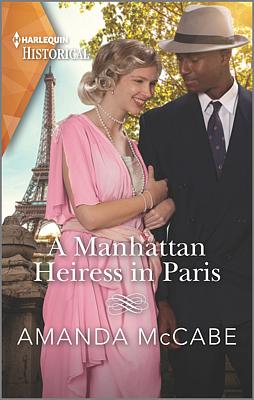

A Manhattan Heiress in Paris
Autore
Amanda McCabe
Letto da
19,4K
Capitoli
28
Step into the roaring 1920s Parisian music scene. Leaving Manhattan… For a secret Parisian affair… New York darling Elizabeth Van Hoeven has everything… except freedom. But now Eliza's traveling to study piano at the Paris Conservatoire and falling for jazz prodigy Jack Coleman in the process! A love like theirs is forbidden back home, and as they make beautiful music together under the Parisian lights, Eliza and Jack face a difficult choice: the life they've always known, or the possibility of a life they never could have imagined…
Prologue
Elizabeth Van Hoeven closed her eyes tightly and knelt down low in the bare, frost-rustling branches of the towering elm tree. If only she could turn into a tiny bird and fly away, invisible to her cousins, her brother, and her fearsome nanny, skating on the ice below! If she could escape their calls to always “have some fun,” “be sensible, quit dreaming.” She would fly up, up, up into the sky, then down, down, down, to Stratton’s Music Store, and play their pianos all day with no one to pester her. It was all she had ever wanted in her eleven years. To be with her music, lose herself in that stream of melody that could take a person out of their old, lonely lives.
To no longer be a Van Hoeven of Fifth Avenue. No more Vacani’s Dance School, no more deportment lessons. No more afternoons marching around Central Park.
But she was a Van Hoeven. She sighed, and sank lower on the branch. As a Van Hoeven, she always had to be polite and charming, to chat and smile and know how to run a large house—or three of them, as her mother did. Music was fine to practice, even a desirable accomplishment for a young lady, so she could play at parties and charity musicales. But it wasn’t meant for all the time. That was tipping dangerously over into being a professional. And she certainly could not play on a concert stage. Even at her age, she was supposed to make friends with suitable young ladies—and their soon to be eligible brothers. Astors, Schermerhorns, Vanderbilts, Whitneys.
Eliza huffed out a breath and kicked her kid boots against the tree. Her pale gold curls, always escaping from under her hat to tickle her forehead, blew out. She never knew what to say to those boys; her shyness overcame her, and when they did talk, the boys were usually so dull. They were nothing compared to the piano.
She gazed up into the pearl-gray sky, the sparkling snowflakes falling down to catch in her lashes, and she imagined she was a bird. What would her song be like? What notes would she string together? She imagined it in her mind, tapping it against the branch with her gloved fingertips...
Suddenly she seemed to hear a bird’s song on the cold wind. Not a real bird, and not something sentimental and treacly like her cousins would play, but something flowing and romantic, deep and stark, full of yearning.
Her eyes flew open at the sound, that song made so real. Was it...? No, it wasn’t her song, her imaginary birds. But it was real music, beautiful, glorious music, like none she had ever heard before. A horn, yes, but turned into real emotion.
She peeked below her tree, to a boulder at the edge of the ice, half hidden by her own wooden perch. A boy sat there, maybe not much more than her age but much taller, lanky in his worn-out brown trousers and blue shirt, his patched coat. His face was hidden by a wide-brimmed felt hat, but she could see he played a cheap tin trumpet. It was battered and tarnished, yet it made such heavenly sounds. Sweet and rich and true.
She listened in astonishment. She so often heard such things in her own head, and then she couldn’t make them come out of her fingers to the piano keys. This boy could. He made the celestial real.
She was so wrapped up in that music that she almost tumbled from her perch. Her hand slipped, knocking a small branch to the icy ground at his scuffed boots. The stream of sound abruptly ended, and she felt bereft.
“That—that doesn’t sound like Mozart,” she dared to call out.
He glanced up, his expression startled, and she nearly gasped before she could catch it. Just like his music, he was astonishingly beautiful, with high, sharp, cutting cheekbones, full lips, and deep, dark gold-brown eyes beneath arching brows.
And he was someone she definitely wouldn’t be allowed to speak with, if she was caught. His skin was much too dark. But she somehow couldn’t turn away from those eyes.
He flashed a shy smile. “It’s not. I don’t know much Mozart. It’s a Coleman original.”
Eliza tilted her head. She knew the work of lots of composers, but no Coleman. Her curiosity, her need to know more about that song, overcame her usual timidness, her fear of speaking to boys. “I’ve never heard of Mr. Coleman. Did you learn it at music school?”
He laughed, a sound as rippling and deep as his music. “I’ve never been to any music school. I’m Coleman. I just play what’s in my mind.”
“You wrote that? All by yourself?” she said in awe. She was often assigned themes to try and compose little songs around, but they usually didn’t go the way she wanted. This boy seemed to be an angel of someplace else, a rare place of music she had never glimpsed. She envied him deeply, but she also wanted to know more and more. All that was in his head. “But you caught the way the birds sound exactly right. The way the birds feel.”
His smile widened, and he nodded. “It’s just like that. I want to make feelings real.”
“But if you don’t go to music school, however did you learn to play like that? I go to lessons and practice all the time, but I can’t do that.”
“You play the trumpet, miss?”
Eliza laughed. “The piano. A horn wouldn’t be ladylike to even try, so my mother says.”
He laughed, too, and she swung her feet happily to know she was the one who made him do that. She could go on listening to that sound all day. “Good thing I’m not a lady, then, because you could never fit a piano in my ma’s parlor. I like to hide in the stairway at Roseland and listen, when they don’t kick me out. Listen and copy and read. That’s how I figured out solfege.”
“You just—listen? And then can follow the tunes?”
He frowned in puzzlement. “Sure. It goes into my head and turns into a tune. Isn’t that how you do it?”
Eliza shook her head. It certainly wasn’t. “What was the name of your song? I’ve never heard anything like it.”
“‘Flight.’ I guess that’s not much of a title, but it’s what it’s about. How it feels to fly. To not really have a home.”
So that was why she sensed the sadness, the sweetness, the longing in the song. She nodded, and was about to ask him more, ask him his first name, when a sharp, unwelcome cry rang out. “Miss Elizabeth! Whatever are you doing up there? Come down at once! Your mother will be most displeased.”
Eliza sighed, and glanced up to see her nanny striding toward her like a battleship sailing on the horizon, large and billowing and strict and fearsome. Eliza scowled in frustration and worry. Why couldn’t she be allowed to do as she liked, talk to who she liked, for just two minutes without getting scolded at, yanked away?
She looked back down at the music angel, but he had vanished. It felt like something hollow, and cold as the ice of the skating pond, opened inside of her. She was alone again.