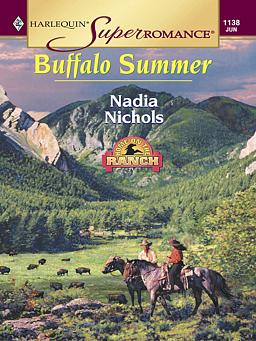

Buffalo Summer
Autorzy
Nadia Nichols
Lektury
19,7K
Rozdziały
15
Caleb McCutcheon is living his dream as owner of a large ranch in the Montana wilderness. But when the woman he loves tells him she can't be part of that dream, Caleb is determined to learn the real reason for her reluctance. Because he knows that without her and her five boys, his life will never be complete.
CHAPTER ONE
Oh give me a home where the buffalo roam…
—Brewster Higley, 1873
PONY YOUNG BEAR’S TRUCK was old. It had belonged to her older brother, Steven, who had gotten it from one of the elders, who had gotten it from some government program that found used trucks for needy people on the reservation. It was an ’83 Ford, standard shift, four-wheel drive. At one time it had been red. Now it was rust-colored, but it could still squeak out an inspection sticker if taken to the right place, and Pony always made sure she took it to the right place. It was cheap and reasonably reliable transportation, but this morning she wished that it didn’t look so battered, that the paint wasn’t peeling away to reveal big brown boils, that it didn’t rattle so loudly, that the tires weren’t bald.
Above all, she wished that she didn’t have to be driving to a ranch called the Bow and Arrow outside of someplace called Katy Junction, Montana, to beg for a job she wasn’t qualified for. But she needed the money to buy school supplies for the children. Without them the kids would be at a disadvantage, and that was just one more disadvantage they didn’t need.
Pete Two Shirts had understood this. Which was why he had come to the school yesterday afternoon to tell her about this job. She’d been sitting at her desk in the sudden quiet that always descended on the heels of the departing third-grade students when a man’s voice spoke her name from the doorway.
She glanced up, startled, and laid down a stack of papers, giving no reply to his greeting. Pete walked into the room in his lean, catlike way, long hair tied back with a red strip of cloth, dressed in his typical cowboy attire of blue jeans, boots, denim jacket and red plaid shirt. He kept his thumbs hooked in the broad leather belt at his waist sporting the big fancy silver rodeo buckle and stopped just short of her desk, gazing at her beneath his black, flat-crowned hat brim. “I came by to tell you about a good-paying summer job.”
She dropped her eyes, picking up the stack of papers and tapping them on the desk to straighten them. Anything at all to avoid looking at him. Pete reminded her of a time in her life that she would much rather forget. “So tell me,” she said, suddenly short of breath.
“I got a call this morning from Guthrie Sloane, the foreman of a rancher who’s looking for someone to help with their buffalo herd. It’s the ranch I worked at this past fall, when Sloane got crippled in a horse wreck and they needed temporary help. Over near Katy Junction.”
“I know the place.” She laid the papers down again and smoothed them with her hands, avoiding his eyes. “The Bow and Arrow. Steven told me about it.” Her heart beat painfully, and her body tensed with shame and guilt even after all these years. One summer, one night, and her life had never been the same. Would never, ever be the same…
“I thought of you,” Pete said.
“I know nothing of buffalo.” Her words were clipped and brusque.
“You worked for me one whole summer with the tribal buffalo herd. You know all you need to know. You can ride a horse pretty good, too. You need that money to buy school things for the kids.”
She snatched the stack of papers yet again and rose from her chair, walking to the window and staring out. Her heart was hammering and her mouth was dry.
“I told him I’d ask around for someone who could help out,” Pete continued. “It would be an easy job. You’d live right there, on the ranch. Room and board included. Caleb McCutcheon’s a good man and the buffalo herd is tiny, nothing like the size of ours.”
“I appreciate your coming,” she said. “But I am not interested.”
“Take the job, Pony. It pays more than what you make here as a teacher, or what you’d make hoeing weeds in some farmer’s field.” Pete Two Shirts turned and walked out without another word. She stayed where she was until the sound of his boot heels and the faint ring of his spurs faded from her burning ears.
One summer. One buffalo summer…
When she finally returned to her desk, the children’s papers she held in her trembling hands were hopelessly crumpled, and no amount of smoothing could flatten them. She wanted to ignore what Pete had said, but he was right. She needed the money. And if the job paid well, did she have the right to deny her students such a windfall?
Unlike many of the children she taught, Pony had been handed the best of everything, the best that any Indian born on the rez could ever hope to have. Her brother Steven had pushed her hard, pushed her to do well in school, pushed her to apply for colleges, and when the pushing had opened doors for her, he had made sure those doors stayed open by footing the bill for her education with the money he earned as an environmental lawyer. She’d graduated from one of the best schools in the country, had gone on to get her master’s degree in early childhood education.
Steven had sacrificed so much for her since the death of their parents, and she loved him fiercely. She’d loved him ever since she’d been a little girl and he’d tolerated her pesky company, defended her against his taunting friends, lifted her onto his broad shoulder and carried her when her legs grew tired. Later, as she grew older, he’d driven off unwanted suitors. He’d never asked for anything in return for being the best brother a girl could ever have. That was Steven’s way. Yet when he changed his name to a white man’s name and chose to live in the white man’s world, she couldn’t understand that his needs might not be the same as hers.
Her resentment toward the lifestyle he had chosen had limited her visits to his pretty little house in Gallatin Gateway with the name Brown stenciled in big block letters on his mailbox. It had taken her a long time to realize that her brother had the right to walk his own path.
Last night when she had had gone to see him to ask him about Caleb McCutcheon and the job at the Bow and Arrow, the neatly stenciled letters on his mailbox had read Young Bear. Unbeknownst to her, he had taken back his own name. His hair had grown long again and was drawn back the way he used to wear it. He had looked so good, so handsome, standing there in the doorway of his cozy little house, that she had been momentarily unable to speak, overwhelmed by a sudden and poignant surge of remorse that brought her to the verge of tears.
“Pony,” he said. “It’s good to see you. It’s been a while. Christmas, wasn’t it?”
She blinked the sting from her eyes. “It’s good to see you, too.”
He nodded. “Come in. It’s not a teepee but it’s comfortable.” He stood to one side for several moments, and when she didn’t move he reached out and drew her firmly inside, closing the door behind her. “I’m cooking supper. You can watch me and tell me all the things I’m doing wrong.” He turned and walked back into the kitchen, picked up the spatula he’d left on the counter and added strips of cooked chicken into the stir-fry mix that was sizzling in the wok. He shook in a generous splash of soy sauce, added a little more water and a small mound of freshly grated gingerroot. He stirred for a few minutes before turning off the gas burners beneath both the wok and a pot of steamed brown rice. “There’s plenty here for both of us,” he said, taking two plates from the cupboard.
“I’m not hungry,” Pony said, standing uneasily on the other side of the counter. Steven paused for a moment to look at her and then divided the rice between the two plates and spooned the stir-fry over the mounds. He carried the plates and silverware to the table, returning to the kitchen to strip two paper towels off the roll, grab two glasses from the counter and a quart of milk from the refrigerator. “Unless you’d rather have wine or a beer?” he said, pausing at the refrigerator.
“Milk’s fine.”
“Sit then, and eat. You’re too thin.” He dropped into a chair and Pony did the same.
“I came here to ask you about Caleb McCutcheon.”
“I know,” Steven said, pouring the milk. “Pete called me. He told me that he’d gone to see you at the school to tell you about the job.”
Pony wasn’t surprised that Steven already knew. Pete Two Shirts was his boyhood friend, and they still kept in close touch. “I know nothing about buffalo. The job would be a farce.”
Steven ate for a while then picked up his glass of milk and drank half of it. Finally he lowered the glass and studied her across the table. “You know enough,” he said. “McCutcheon would be lucky to get you. Now eat. This stuff is good for you. It’s not sage hen or buffalo tongue, but it’s healthy.”
She picked up her fork and stabbed it fiercely into a piece of broccoli. “Why do we always argue?”
“You’re mad because I don’t live on the rez like you do, because I don’t champion the Indian’s fights the way you do.”
“The way you should,” she said vehemently.
“The way you think I should,” he amended.
“Steven, you paid my way through college,” she said, leaning toward him. “You made it possible for me to do the things I’m doing now. Working with the children, teaching school and lobbying the Bureau of Indian Affairs, trying to make things better. If you and I don’t do these things, who will? The changes have to come from us.”
Steven finished his meal and glass of milk while she sat and watched him, the same piece of broccoli still speared on her fork. He wiped his mouth on the paper towel. “McCutcheon’s a good man. Go talk to him about the job.”
“Is he one of those rich movie stars?”
Steven laughed at her disapproving glare. “Caleb was a star, but not in the movies. He was a professional baseball player with the White Sox. He grew up as a poor kid in the slums of Chicago and pitched his way to the top of the world. People still sing his praises, and he hasn’t played for years. He had to retire when a baseball shattered his ankle during the World Series.
“Is he married?”
“Until recently. He was divorced last fall, shortly after he bought the Bow and Arrow. Seems his wife didn’t share his dream of living on a remote ranch.”
“Any children?”
“Nope.” Steven looked at his sister and grinned. “He definitely ranks up there as one of the most eligible bachelors in the State. If I were you, I’d hurry right over there.”
“I’m not looking for a man. I’m applying for a job.”
“Just filling you in on the particulars. No need to get testy.”
“Even if I go to talk to him and he offers me the job, what will I do about the kids?”
“How many are there now?”
“Five. Nana’s watching them tonight,” she said, referring to her aunt.
“Five.” Steven poured himself another glass of milk. He fixed her with a solemn gaze. “Pony, you can’t save the world.”
“I know that, but I can help make their lives a little better.”
“I’ll send you more money. I didn’t know there were that many kids. The last time we talked, you just had the two boys.”
Pony set her fork down abruptly and raised the folded paper towel to her eyes, holding it there for a long moment, hiding from him until he reached out and squeezed her arm gently. She lowered her hand and blinked rapidly. “I can’t turn them away,” she said in a voice tight with pain.
“I know.”
Her eyes stung. “And I can’t walk away and leave them for the summer. Nana can’t take care of all of them. There’s no point in even thinking about taking that job, even if it were offered to me.”
“I’m almost afraid to ask this, but these other three kids you’ve taken on…are they juvenile delinquents like the first two?”
“They’re not delinquents, Steven. They’re school dropouts that I’m tutoring. They’re just confused. They’re living in a mixed-up world and they don’t know where they belong.”
“Teenagers?”
Pony nodded.
“All boys?”
She nodded again. “The girls tend to stay with their families. The boys rebel against everything, especially their parents.”
Steven pushed his glass with one finger, back and forth. “Can any of them ride a horse?”
“They’re teenage boys. They can do anything.”
“Then go talk to McCutcheon,” Steven said. “Sell him a package deal. He gets you, and for the same price he gets five more hard workers who would be really good at pulling down miles and miles of rusty barbed-wire fence. Tell him the truth about the boys, about how you’ve taken them in. Talk to him, Pony. He’s a good man. Go tomorrow morning, first thing. Now clean your plate, or I’ll send you to bed right after supper with no dessert.”
She had spent the night at Steven’s little house and had risen before dawn to drive to Caleb McCutcheon’s ranch. The sun was just shy of peeking over the Beartooth Mountains when Pony turned onto the five-mile gravel road that headed into the foothills and ended at the Bow and Arrow. She downshifted and swerved to avoid a large pothole. She was nervous, and her driving reflected it. Caleb McCutcheon would look her up and down and try not to laugh. He would try to be polite, because Steven had said he was a good, kindhearted man. But he would think to himself, What’s this? A woman applying for a job managing a herd of buffalo? Ridiculous!
And he would be right.
CALEB MCCUTCHEON AWOKE in the early morning and lay in bed, hands laced behind his head, listening to the song of a white-crowned sparrow lifting sweetly over the rush of the creek. He thought about how much his life had changed. One year ago he hadn’t set eyes upon this place. He hadn’t yet met the full-blooded Crow Indian Steven Young Bear, the young conservation attorney who had introduced him to Jessie Weaver and had been instrumental in helping Caleb purchase her failing cattle ranch.
One year ago he’d still been married to a woman who’d held his heart from the first time he’d set eyes on her, when he was full of fire and his career as a professional baseball player for the Chicago White Sox still sizzled. He had pledged his allegiance to this sophisticated woman who had shepherded his rise to fame and guided him along the complicated paths of stardom. She’d stood beside him when fate had dealt its untimely blow to his career, and he’d undergone multiple surgeries on his ankle, and then drifted off when his name faded into history to find a more interesting life for herself.
Divorce was an ugly word, but he had never realized just how ugly until his wife had asked him for one. Their divorce this past November had been a staggering blow, although in retrospect he should have seen it coming. Rachael craved the bright lights and the big cities. Her life was lively and political and she traveled in the highest social circles, whereas he had followed his childhood dream into the backwater wilderness of Montana. It was here that they had parted company.
The winter that followed had been long and dark, and Caleb had spent countless hours in this cabin on the edge of the Beartooth Wilderness reexamining his life. He had no regrets about being in this place. In spite of the loneliness that at times overwhelmed him, he never tired of this land and its many moods, the vast and palpable silence that dwarfed the imagination, the thundering wind that blew tirelessly, the crashing roar or the gentle murmur of the creek. He loved this old cabin, hewn of big-mountain cedar over a hundred years earlier. Caleb had never felt so much at home as he did here. In time, he supposed, he’d learn to live with the loneliness. He’d made some good friends. He counted Guthrie Sloane, his twenty-nine-year-old ranch manager and Jessie Weaver’s fiancé, as one, and of course Jessie herself. Steven Young Bear, café owner Bernie Portis, the old ranch hands Badger and Charlie…all good friends. A man could do much worse.
Caleb’s lifelong dream of owning a ranch in the Rocky Mountain West had come true, but unfortunately the ranch hadn’t come with an operations manual, and his attempts to persuade Jessie Weaver to remain as manager were thwarted when she returned to veterinary school to finish her degree. It was Caleb’s great good luck that Guthrie Sloane, who had worked for the ranch and had loved Jessie Weaver since he was thirteen years old, had taken the job and was patiently teaching Caleb the ropes.
Jessie and Guthrie’s long-awaited wedding would take place this coming September, and for months already it had been the topic of conversation in Katy Junction. Caleb could certainly understand all the buzz. It was reassuring to know that true love still existed.
He rolled out of bed and walked barefoot into the kitchen, which was nothing more than a little nook off the living room. The cabin boasted three rooms: bedroom, bathroom and kitchen/living room. There was a sleeping loft above and a root cellar below. Though the place was simple and spartan, Caleb was very comfortable in these quarters and preferred living here than in the main ranch house. He put on a pot of coffee, threw a few sticks of firewood into the woodstove and opened the door to the porch. It was a few moments before sunrise, yet already he could feel the burgeoning energy of the season. The sounds and smells of springtime warmed his blood and charged his spirit.
There was so much to do, and it was a solid, satisfying feeling to fill the days with activities that meant something. Just splitting firewood was a joy to him. He devoted an hour a day to the task, keeping his woodpile tidy and arranging the split wood by size so that he could easily grab what he needed when he needed it.
But tending to his firewood was nothing compared to the daunting task of ripping down the cross fences that partitioned the land into separate pastures. The plan was to leave the pole corrals around the barns, the penning corrals and the boundary fences that would need to be strengthened to contain the small herd of buffalo that Pete Two Shirts had talked Caleb into buying last fall. All the rest of the barbed wire would be removed. The men would coil the wire as they took it down and reuse the newest of it to bolster boundary fences. Then they’d pull out the metal posts and cut the wooden fence posts off at ground level, so as to leave no holes for the animals to step in. It sounded simple, but there were over sixty miles of barbed-wire fence to deal with.
The sharp fragrant smell of coffee tantalized him, and he returned to the snug warmth of the cabin, closing the door on the cool mid-May morning. He poured himself a cup and carried it with him to the chair beside the window. He opened his notebook and stared at the scrawl of figures on the page. Took a sip from his cup and felt himself frown as he studied his jottings. Lord, what a huge job he’d undertaken when he’d accepted Pete Two Shirts’s suggestion that they bring the buffalo back to their home range.
Pete had assured him that the venture would be both environmentally beneficial and financially sound. But now that Pete had returned to his full-time job on the reservation managing the Crow buffalo herd, the project had suddenly become unwieldy. Huge. Almost terrifying. After all, Caleb was just a city boy—born and bred in the Chicago slums. What the hell did he know about two-thousand-pound animals that stood six feet high at the shoulder?
Caleb lifted his mug of coffee for another appreciative sip. Maybe Guthrie would scare up someone who would be interested in teaching them how to manage the herd. After readily admitting his own ignorance in buffalo husbandry, Caleb’s ranch manager had put the word out, but so far there had been no applicants. Not a single one. Guthrie had cautioned him against impatience, but Caleb was beginning to wonder if this buffalo venture might not have been too ambitious for a greenhorn wanna-be rancher.
Yet, as intimidating as the buffalo were, they had to remain. Somehow he had to make this plan work. There was bound to be some big, burly, ham-fisted, tobacco-chewing, burly buffalo-loving expert out there looking for a job in one of the prettiest spots in all of Montana.
Bound to be…
Caleb pushed out of his chair with a sigh and carried both the notebook and his cup of coffee as he left the warmth of his cabin and headed up to the main house.
His cook and housekeeper, Ramalda, didn’t like it when he was late for breakfast.
PONY CAUGHT her breath and hit the brake as the truck crested a rise. For a moment all she could do was stare as the sun’s first rays spilled over the rim of rugged mountains and laid their golden fingers across the valley floor. She’d learned about the history of the Bow and Arrow from Steven. The ranch had been around since the mid-1800s and was one of the longest surviving in Montana, an enduring testament to a Texan by the name of Weaver who had come here with a solid dream, a dream that had been good for the Crow. Weaver had been generous and had fed them in hard winters when the buffalo were gone. During the winter of starvation he had saved an entire village with his gift of cattle, and in return was given a young woman from that village to be his wife.
So the Bow and Arrow had been founded by a white man from Texas who had taken a full-blooded Crow as his wife, and his son from this union had married a Blackfoot, the sworn enemy of the Crow. And so Jessie Weaver, who had sold the ranch to Caleb McCutcheon, was of three worlds. Crow, Blackfoot and white. Pony had never met her but had wondered at such a legacy, for to carry the blood of three such disparate worlds could surely only create confusion. Yet Pony had heard only good things of this strong young woman.
Steven had told her how Jessie Weaver had lost the ranch to falling cattle prices and her father’s skyrocketing medical bills as cancer had slowly robbed him of life. How she had quit veterinary school in her third year to take care of her ailing father. And how, after her father’s death, Jessie could have sold the ranch to developers and made a tidy profit even after the debts had been paid, but instead chose to write conservation restrictions into the deed and sell the ranch to Caleb McCutcheon at a huge loss in land value. She’d sacrificed a great deal—including her long-term relationship with Guthrie Sloane—to protect the place she loved, and Pony could understand and sympathize. In the end, Guthrie Sloane had, too; he and Jessie Weaver had reunited and were getting married in the fall.
Sitting here in her rusty old truck, looking down the valley at this historic place, Pony felt a sense of wonder. To live surrounded by such beauty would surely give grace to the spirit. The Crow had first cast their shadows in this valley long ago, in the good years when the sun still shone upon them, in the years before the buffalo were gone. Her great-great-grandfather might have set his horse in this very spot and looked upon this same valley and felt the same way she did now.
She put the truck in gear and drove slowly, not wanting to miss anything. She parked briefly at the place where the road first paralleled the creek and stood on the banks, listening to the rush of cold mountain water—happy music rippling over the smooth rocks lining the shallows. The air was cool and sharp with the tang of the tall evergreens that grew here. When she climbed back into the truck she felt relaxed. The tension that had been building in her at the prospect of speaking to Caleb McCutcheon had mysteriously vanished, and as she drove past the old cabin and headed toward the main ranch buildings, a curious calm settled over her.
Maybe she would get the job. Maybe she wouldn’t. Whatever the outcome, she had made the journey, followed the path. She parked beside two other trucks, both Fords, both much newer than hers and she drew a steadying breath before climbing the porch steps of the weather-beaten ranch house. Hopefully Caleb McCutcheon himself would be available to speak with her. Pony knocked on the door.
Which was opened almost immediately by a very fat old Mexican woman wearing a large and shapeless housedress and apron. A red bandanna covered most of her white hair.
“Yes?” Her voice was gruff and her black eyes were not the least bit friendly.
“I’ve come to speak with Mr. McCutcheon about the buffalo,” Pony said.
The woman abruptly closed the door in her face. Pony waited, patient in the way she had learned to be. She looked down toward the pole barn and corrals. Horses grazed on piles of hay while curlews hopped amongst them on the ground, looking for something to eat. Below the barn, near the bend in the creek, she could see the roofline of the old cabin. Smoke curled lazily from the massive fieldstone chimney. Steven had told her that McCutcheon preferred to live in the original homestead but took his meals at the ranch house with the rest of them. She thought it was odd that he wouldn’t choose to live in the big house.
The door opened, and Pony swung around. A man stood in the doorway, one hand on the doorknob, the other holding a notebook, eyebrows raised in a mute question. He was tall, lean and athletically built, with sandy-colored close-cropped hair, a neatly trimmed mustache and clear eyes the color of prairie flax with deep crow’s-feet etching the corners. His face was wind-burned, rugged and purely masculine. He was unexpectedly handsome, and she felt her heartbeat skip as she looked up at him and tried to remember why she was standing on his porch.
“You’ll have to excuse Ramalda’s behavior,” he said, studying her with those keen blue eyes. “She doesn’t trust strangers, even small female ones.”
“Mr. McCutcheon,” she said, her voice sounding tense because all of a sudden it mattered very much that she get this job. “I am sorry to bother you, but I had heard that you were looking for someone to help manage your buffalo.”
“My buffalo?” If anything, her words seemed to confound him more than her presence on his porch.
“Yes. Pete Two Shirts told me this. I worked for Pete on the reservation with the tribal herd.”
His expression cleared somewhat at the mention of Pete’s name and he nodded. “Pete helped get me started with the buffalo,” he explained, “but when he returned to the reservation…” He paused for an awkward moment. “Well, to be honest, I guess I wasn’t expecting a woman. I mean, it’s just that…” He took stock of her again, his eyes narrowing in a critical squint. “Please,” he said, stepping aside and gesturing with the sheaf of papers. “Come inside.”
Pony felt a flash of anger and shook her head. “If it’s a man you’re looking for, Mr. McCutcheon, I will not waste your time or mine.”
She was surprised to see the color of McCutcheon’s face deepen. “I meant no offense,” he said.
“It’s all right. I understand completely,” she said. “Of course you would prefer a man to manage your buffalo herd. A man is so much stronger than a woman, and strength is very important when dealing with the buffalo, especially when you wrestle them to the ground to brand them.”
His forehead creased skeptically. “Brand them?”
“And a man rides a horse so much better than a woman,” Pony continued, “because a man is so much stronger, and a horse truly appreciates brute strength.”
“Now look…”
“Mr. McCutcheon, if you talked to Pete Two Shirts, he would tell you that I know my stuff. And I would tell you this. I have five strong boys who would do your bidding for the summer. They would cost you nothing more than room and board. I was told you have a lot of work. If you have buffalo, you will need good boundary fences. Six strands of wire at least six feet high. Panels seven feet high would be even better, with wooden corner posts sunk into four feet of concrete. Putting up sturdy boundaries takes a lot of time and work, but without them, your herd might run clear to Saskatchewan.”
“Look, why don’t you—”
“And you’re right about the branding, Mr. McCutcheon. You don’t brand buffalo. But you do need a good set of corrals with an eight-foot-high fence and an indestructible chute of welded pipe, because even though they don’t get branded, they do need to be tested for brucellosis, tuberculosis and pregnancy. They need to be wormed and vaccinated. I know how to design such a set of corrals and a good chute. I know how big and how strong the buffalo are, Mr. McCutcheon, and how wild.”
McCutcheon eyed her appraisingly. He ran the fingers of his free hand through his hair. “Please, come in and have a cup of coffee. We can talk—”
“I don’t drink coffee,” she said. “Why don’t you call Pete and ask him about me?”
He nodded. “Okay.” He hesitated. “Won’t you at least come inside while I call?”
“I’ll wait out here, thank you,” she said, not wanting to run into the unfriendly old Mexican woman.
He nodded again, clearly perplexed. “Who should I tell Pete I’m checking on?”
“Steven Young Bear’s sister,” Pony said.
McCutcheon’s blue gaze intensified. “That’s why you look so familiar. I’ll be damned! Why didn’t Steven tell me you were coming?”
“I asked him not to. I’ll wait here while you call Pete.”
McCutcheon shook his head with a faint grin. “I don’t need to call anybody. If you’re Steven’s sister, that’s good enough for me.”
Pony’s heart leaped. “Does that mean you will consider me for the job?”
“That means you’re hired, you and your five boys. There’s plenty of room for all of you here in the main house. When can you start?”
“In three weeks.”
“That long?” His face fell.
“I’m a teacher and school lets out in three weeks.” Pony held her breath, her heart hammering. Please, oh please…
McCutcheon nodded reluctantly. “All right. We’ve survived this long. I guess we can wait until mid-June. The job pays three-fifty a week, plus room and board.”
She could hardly have hoped for as much, and struggled to maintain a neutral expression. “I can only work the summer.”
“I’m hoping you can teach me and my ranch manager all we need to know in that time.”
“I am sure that I can.”
“Good. Then I guess I’ll see you in three weeks.” He put out his hand and took hers in a warm, firm handshake; a single up-and-down motion that made her fingers tingle curiously. She turned to descend the porch steps and was almost at her truck when his voice stopped her. “Ah…miss?” She turned and glanced up at him questioningly. “What’s your name?”
“Oo-je-en-a-he-ha,” she said. She stood for a few moments, watching him mentally grapple with the impossibility of it, and then, with a barely suppressed smile, she said, “But you can call me Pony, if you’d rather.”