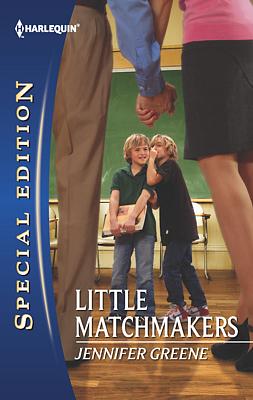

Little Matchmakers
Auteur
Jennifer Greene
Lezers
19,2K
Hoofdstukken
14
They were single parents who believed they were giving their sons all they could ever need. But a meeting with their boys' teacher had Tucker MacKinnon and Garnet Cattrell realizing what they really needed was each other. Since Tucker's boy craved a woman's influence and Garnet's son would benefit from some outside experiences, a trade seemed to be the perfect solution. So one day a week they'd swap kids. And maybe just see one another in passing. This was just for the boys' sakes, of course. But when two intelligent kids decide they want to be brothers, heaven help the parents who didn't see this plan coming. Because a couple of little matchmakers were about to launch Project One Big Happy Family.
Chapter One
Tucker MacKinnon took the sharp curves of Whisper Mountain at daredevil speeds. Typical of a June morning in South Carolina, the sun burned hotter than a bad temper and the humidity was claustrophobic.
His mood was just as miserable.
Anyone in the MacKinnon family could testify that Tucker had never owned a temper. He was the go-to guy in a tornado. He’d handled rattlers and black bears. Hell, he’d made a career of handling people no one else could get along with—kids with attitude, adults in trouble, personnel wars in small companies. Those challenges were downright fun. But not this.
Nothing was fun about this.
He braked for a stop sign at the base of the mountain, and then it was only a skip and a jump to the elementary school parking lot. His stomach immediately began pitching nerves. Today was the last day of school, as witnessed by the squalling behavior of honking cars and chattering parents. He had to scramble to find a parking spot. Kids were leaping and shrieking as they bounded out the door, free for the summer…except for the few hanging tight in the school entrance.
Those few kids had been singled out. They weren’t allowed to get their report cards until a parent talked to their child’s teacher.
Tucker’s ten-year-old son was one of those hovering in the doorway…until he spotted the familiar silver truck, and then he galloped straight for his dad. Will had his father’s genetic build, which pretty much meant he came out of the womb looking like a beanpole, long and lean. For certain he was the tallest kid in elementary school, but right now, his usually sun-brushed skin was pale, his first words gushing from a pent-up dam.
“I didn’t do anything, Dad. Honest. Whatever Mrs. Riddle says, it wasn’t me. It couldn’t have been me. I don’t even know what it’s about.”
“Hey.” Tucker cuffed an arm around his son’s neck. “Would you quit worrying? Whatever it is, we’ll fix it.”
“I keep trying to think what I did wrong. I’ve been racking and racking my brain. I can’t always answer her questions, so maybe that’s it. But she never calls on me when I raise my hand. She only calls me when I don’t. I mean, how could she be mad at me about that?”
Tucker had no idea why the infamous Mrs. Riddle had held back Will’s report card, but he was hoping—for her sake—that she had a damned good reason. He walked into the cool, dim hall, and felt his stomach churn another stress ball. Everyone in the MacKinnon family was a major academic achiever except for him. He’d never liked grade school. Or middle school. Come to think of it, he’d never liked school altogether—and schools had never much liked him. He was thirty-one now, of course. Only two things really mattered to him in life. His work on Whisper Mountain.
And above everything else, a hundred times over, was his son.
Mrs. Riddle had better not be unfairly picking on his son, or some major fur was going to fly.
“How about if you just hang by your old locker? Stay inside where it’s cool. And you’ll be able to hear me if I call.”
Will slumped off, and Tucker rounded the corner and trekked down the long hall to the last classroom. Not that Mrs. Riddle had a reputation for being a sharp-nosed martinet, but all the other teachers had ditched the place as fast as the kids. Her doorway was the only one with a pair of parents still waiting.
Right off, Tucker recognized the woman just ahead of him.
She was Petie’s mom.
He could only see the back of her. Didn’t matter. A bad marriage was supposed to cure a guy of believing in hopeless causes. Didn’t matter. His son was and needed to be his whole world right now.
For darn sure, that mattered. But that didn’t stop a guy from admiring the view.
Her hair—the color of lush dark honey, ribboned with sun streaks—swayed past her shoulders. He’d often seen her in the same “uniform”—a yellow polo shirt with dark green shorts. The top had a Plain Vanilla logo over the pocket. It was the name of her store, a fresh spice and herb shop tucked in a curve of Whisper Mountain. By any logic, the shop should have failed; the location was obscure, and who’d travel out of their way for a spice or two?
His opinion, not for the first time, had proven dead wrong. Everyone on Whisper Mountain knew the place, shopped there, heaped praise on her for what she was doing.
Tucker wouldn’t know tarragon from paprika, but that wasn’t to say he didn’t appreciate spice. The fit of her shorts, for example. The shape snugged over the cup of her fanny, and led straight down to unforgettable thighs and calves. She worked outside and it showed, from the sun-golden tint of her skin to her trim, tight body.
She had a major flaw, seeing that she was as short as a shrimp. He doubted she could reach five-three unless she was standing on a rock.
The rest of the package intrigued him every time he saw her. She was…interesting. Natural, earthy. No pretensions to her. Sensual.
A parent left Mrs. Riddle’s classroom—a mom, flush-faced and exiting at a fast jog. Petie’s mom drew a breath, and then headed into the classroom to brave the dragon, leaving him still thinking about her.
Her name was Garnet. Garnet Cattrell. She’d captured his attention last September, the first day of school, but he never seemed to capture hers. She always answered a “hi” with a “hi” back and a smile, but two seconds after initiating conversation with her, she always found a way to move off.
She wasn’t unfriendly exactly. It was more like…she didn’t see him. He could have been a lamppost. A brother. A catalog in the mail. An entity that was easily ignorable.
Naturally, Tucker had backed off. He was in no hustle to make any more mistakes with the female gender. Maybe she didn’t like six-three guys with blue eyes. Maybe she had an allergy to size-fourteen feet. Maybe his voice was too low, or his hands too calloused.
Whatever.
The only thing that mattered right now was her being here. Because if her kid had a problem with Mrs. Riddle, it must be time to start counting animals and climb on the ark. Armageddon couldn’t be far down the road.
Tucker leaned back against the cool cement wall, not planning on eavesdropping, but damn. It was so easy. Voices carried through the open door. Mrs. Riddle’s voice had a high nasal quality. Garnet’s—like the gem—had a rich, quiet softness to it.
“I can’t imagine what problem you could have with my Pete. As far as I know, he’s been getting all As—”
“Of course he is. He’s a very bright boy. I’m going to miss having him in my classroom,” Mrs. Riddle said stridently. “But I’ve called in all those parents who, I believe, need some guidance. Middle school is not an easy transition for some children. There are things you might try over the summer to help Peter adjust more comfortably.”
Tucker couldn’t hear—or see—Garnet bristle. But for the first time, he heard something stiff and testy in her voice. “Do you have some reason to think Peter won’t do perfectly fine in middle school?”
“I think he’ll do perfectly fine academically. But possibly not socially. Peter is an academic,” Mrs. Riddle said authoritatively. “But he’s left out whenever it comes to sports. Nor does he ever ‘hang out,’ as they say, with a male peer group.”
“But…he seems to get along with other kids. He’s never mentioned a problem with anyone. He just isn’t a highly social kid.”
“He’s an old soul,” Mrs. Riddle explained. “And his nature is on the quiet side. I understand all that. But I suspect you have quite a time getting his nose out of a book, or off the computer.”
Tucker heard nothing for a minute. Then Garnet again. “That’s true. But it’s not as if I haven’t encouraged him—”
“Mrs. Cattrell. I’m not criticizing you. And you can take my advice or leave it. But I strongly suggest that you use the summer to find some outdoor or athletic activity that he might like. Give him the opportunity to develop a skill in something outside the academic arena. It doesn’t matter which sport. The issue is widening his world, giving him confidence. Kids can become merciless in middle school. You don’t want Peter singled out.”
They talked for a few more minutes. Not long. When Garnet strode from the classroom…Tucker would have talked to her, said something. But she moved past as if not seeing him or anything else, her expression looking something like a kicked puppy. Stricken. Hurt. Worried.
And then, of course, it was his turn to get beat up.
Mrs. Riddle was holding court from behind a desk older than sin—the elementary school was less than ten years old, so she must have brought the scarred-up thing with her. Her hair was steel-colored, springy, her eyes a gray-blue, like flint. Nobody messed with Mrs. Riddle.
She started right in with the stick-up-the-behind tone of voice. “Mr. MacKinnon. For once, your Will had a decent semester.”
“All homework in on time. Studied for tests. Kept his nose clean.”
“Yes. Well, we won’t go so far as to call Will a saint, now, will we? But he’s a good boy. The other children all like him, particularly the boys. He’s a fine young athlete. I’ve enjoyed having him in my classroom. If I needed help with anything, I could always count on Will to volunteer.”
“Well…good.” Tucker scratched behind an ear. He wasn’t about to relax, but if all she was going to report was good news, he was even more confused why he’d been summoned in here.
“But here is the issue, Mr. MacKinnon. Will is going to enter middle school next year. And he has much more physical maturity than most boys his age. If he hasn’t noticed girls already, he certainly will soon.”
Tucker was still waiting for a headline. No news so far.
“Let me be frank, Mr. MacKinnon. I don’t know your situation, as far as Will’s mother, but I believe he seriously needs a helpful female influence.”
“Wait. Why?”
“Because he’s become afraid of girls. He turns beet-red when any of the girls talk to him. He walks into walls. He stumbles over his own feet. At the start of the school year, he was fine. But I believe some hormones have caught up with him at this point.”
“Well, yeah. I’m sure they have. But…”
“You work primarily with men, don’t you, Mr. MacKinnon? Men. Or boys. There are very few women in your business.”
“That’s true. But it’s not because I planned it that way,” Tucker said defensively. “It’s just that the nature of my retreat and adventure programs seem to appeal more to males than females. And it’s not as if there’s never a woman around—”
“Women who Will has frequent occasions to talk with? I don’t mean family. I mean women, where he’s had the opportunity to form some sort of relationship, even if it’s only casual.”
“Well, sure he has.” He hesitated. “I think. Well, maybe not.”
“I thought not. So my suggestion to you, over the summer, is to arrange some activities where Will is more exposed to some female presence. A sport that both genders play. Chores where both genders are involved. Something to ease that nervousness he feels around females.”
“Is he that way with you?”
Mrs. Riddle sighed, raising her eyes to the ceiling. “Mr. MacKinnon. Do I strike you as the nature of woman who would make an adolescent boy stutter?”
Tucker readily recognized there was no possible way he could answer that. Admitting she looked like an army tank didn’t seem the right thing to mention. She ruled with an iron hand. Kids came out of her class thrilled to be free—but by reputation, they all considered they learned the most from her compared to the “easy” teachers. Anyway…he had to admit he understood what her concern with Will was about.
Tucker abruptly recalled the last time they’d stopped for burgers and fries. Will had tripped over a chair looking at a pigtailed tween on the other side of the room. So yeah. The kid had turned into a bumbler with girls.
Tucker got his son’s report card and clipped out of the classroom, feeling edgy and frustrated. How was a father supposed to fix something like that? Sure, Will had a shy side with girls. But he was ten. Every boy had a bumbling stage around girls when they started adolescence.
Still, there was a nick of truth that bugged him. Will really didn’t get exposed to many females, because of their lives, and Tucker’s job, and where they lived. That never seemed to matter before. Will was a happy kid. Now, though, Tucker could see how a guy-dominated environment could add up for Will—particularly since the only relevant female in his life, his mother, was hardly a role model.
Still…how to approach this topic with his son? And what would he tell Will about the meeting with his teacher?
He whipped around the corner—and charged smack into someone leaning against the wall. Or…not someone. Her. Petie’s mom. Garnet.
* * *
While Pete needed a stop in the boy’s bathroom, Garnet leaned against the cool wall and closed her eyes. She replayed every second of her conversation with Mrs. Riddle. Then did it all over again.
The lump in her throat refused to disappear.
She’d always been a marshmallow. A soft, peace-loving marshmallow. Confrontations always gave her nightmares.
Still, where her son was concerned, Garnet could change from happy wallflower into riled-up mama porcupine in two seconds flat. Nobody hurt her son. It was hard for her to hear even the smallest criticism of Petie for the obvious reason.
He wasn’t just the best thing in her life. He was the best kid in the entire universe.
For Mrs. Riddle’s sake, the teacher was lucky she hadn’t picked on Petie.
Instead, she’d picked on Garnet.
Normally Garnet was braced for criticism. Lots of people had found fault with her—particularly in her own family. Lots of people claimed she’d disappointed them. But no one had ever suggested that she wasn’t a good mother. At least before today.
Garnet still had the lump in her throat, the stab in her heart. Mrs. Riddle hadn’t exactly said that she was an inadequate mom, but she’d implied it. A boy needed male role models. She’d failed to provide them. And that didn’t bite just because the teacher said it. It bit because Garnet had worried about the same darn thing for eons now.
Absently she lifted a hand and immediately discovered a ragged cuticle.
Dang it. She loved working with dirt. Dirt, herbs, spices, flowers, plants of all kinds. But she always wore gloves when she was working outside—not because she was vain about her hands, but because of this. The instant a nail split, or a cuticle got ragged, she couldn’t stand it. She had to fix it. She couldn’t think with a frayed cuticle.
She was just biting the offending cuticle when a Mack truck ran into her.
The air whooshed out of her lungs. Her head hit the cement wall at the same time the Mack truck tire connected with her foot…the vulnerable, naked foot in the green Teva sandals.
“Aw, hell. Aw, hell. I’m really sorry. I wasn’t looking—are you all right?”
If she were unconscious and in a coma, she’d have recognized that low, wicked baritone. Tucker. Tucker MacKinnon.
It just wasn’t fair. Being hit with a real Mack truck, she could have coped with. Freight train, no problem. Bulldozer, ditto. Anything or anyone but Tucker.
He was undoubtedly trying to help, by steadying her, then rushing his hands down her arms, his gaze searching, seeking any injuries. She certainly had some. The back of her head was gushing something warm and wet, and so was her right foot.
None of the injuries were lethal. She was just going to be stuck with a couple of bruises. He was big; she was small. That was the total equation. It’s just that if she had to have an accident, she wished it could have happened with anything but Tucker. Anyone but Tucker.
“I’m fine,” she said. Although temporarily she was pretty sure her right foot was broken in fifty or sixty places.
“You can’t be fine. You’re not fine. Damn. The back of your head’s getting a goose egg, and there’s blood.”
Undoubtedly. She’d scraped her head against the cement wall. Something had to give, and it hadn’t been the wall.
“Let me see.” His eyes were suddenly close enough for her to experience that electric-blue color close up. “The school’s so deserted I just wasn’t expecting anyone to be there. I was waiting for my son, thinking, not looking where I was going. Listen—”
After checking out her head, his hands cuffed her shoulders again. He was still squinting. Still searching for injuries. She was still dying, but more from embarrassment by then, particularly when he hunkered down.
“Broke your big toenail.” He winced in sympathy. “Just hope I didn’t break a toe. Or two.”
He had. But who cared? Once the football hero of the county—there was no one in the county who didn’t know the MacKinnon name—and he was kneeling at her feet. “I’m sure you didn’t.”
“How about if you just sit down right here, in the hall. I’ll run into the office. They have to have some Band-Aids and first-aid supplies around here.” Again, he tilted her head, not to look for injuries this time. He met her eyes. “Garnet, I couldn’t be sorrier.”
“It’s okay. Honestly. Don’t bother. I’ve got first-aid stuff at home.”
He’d always made her nervous. It wasn’t his fault, nothing he did. It was her. She’d always felt goofy around him. Drawing attention to herself over a hurt only made it worse.
“Nonsense. You don’t want to trail blood into your car. And I think we should get some ice on your head. Just hold up. I’ll be back in two shakes.”
He’d barely taken three strides before Pete charged out of the boy’s bathroom, saw her and sprinted over. He seemed to recognize Tucker as an afterthought, and immediately frowned. “Mr. MacKinnon. Did you hurt my mom?”
“No, Pete. Well, yes. I mean, I did, but it wasn’t intentional—”
“Pete, I’m totally okay.”
Pete, even if he was built on the small side, could turn more protective than a marine. He pushed his round glasses higher on his nose and faced Tucker. “Why would you hurt my mom? What happened?”
The commotion must have been heard from a distance, because from the office hall, Tucker’s tall son suddenly charged into view. “Dad. Hey. What’s going on. Mrs. Cattrell, how come you’re bleeding?”
“Your dad hurt my mom,” Petie informed him.
Will’s jaw dropped. “No way.”
“Just look at my mom if you don’t believe me. She’s bleeding all over the place.”
“But my dad would never do anything like that. That’s dumb.”
Tucker had to raise his voice to be heard. “Boys. Both of you. Go to the office. Ask for a first-aid kit and an ice pack.”
Both boys laid out an “okay” and galloped together down the side hall, looking a lot like Mutt and Jeff. Garnet wanted to echo again that she was fine, and just wanted to go home, but it was like arguing with a freight train.
Tucker hunkered down again. “I know. You’re going to live. But it won’t kill you to have those two places disinfected and covered up.”
“I know. I just hate—”
His tone changed, turned quieter. “Garnet. I heard what Mrs. Riddle said about your Petie. And this is obviously a poor time to pursue the subject. But I think we might both benefit from talking together.”
“Talk about…?”
“My Will. Your Pete.” He hesitated. “It’s probably easier for me to get away than you. I could steal an hour around seven tonight. You free then?”
Free was a relative word. Like the song said, freedom was just another word for nothing left to lose, and looking at Tucker, Garnet knew perfectly well that she had a ton to lose by spending any time with him. Her dignity…although she’d already lost most of that, by bleeding all over the school hall. Her pride…though, she still had her pride. Something she’d guarded tighter than gold for the last few years.
“I just want to talk about the boys,” he said. “A half hour? Your place?”
The boys. Truth was, she wouldn’t mind talking about Petie. If there was an alpha male in a three-state radius, it was Tucker. After Mrs. Riddle’s comments, Garnet really wouldn’t mind hearing his opinion.
“A half hour,” she conceded uneasily.
He smiled. A smile that knocked her common sense to its knees.
And then the boys descended on them, carrying a pan of water, most of which sloshed onto the floor, an ice pack, a brown bottle of betaine and a giant first-aid box. The principal and school secretary trailed right behind the boys.
Garnet closed her eyes and wished she could click her heels together three times and land in Kansas. How much worse could a bad day get?