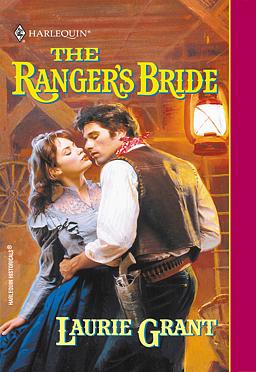

The Ranger's Bride
Auteur
Laurie Grant
Lezers
15,5K
Hoofdstukken
30
Rede Smith didn't think so, yet the Texas Ranger hadn't counted on the brave and beautiful Addy Kelly, whose tender mercies and intoxicating touch gave him hope for a life free of the dark secret that plagued him. Respectable widow Adelaide Kelly had a secret: she was neither a widow nor respectable in small-town eyes. But the scandal her divorced status would create paled beside the shocking fact that she'd allowed the rugged Rede Smith into her home, heart and deepest desires.
Chapter One
Texas, 1874
He looked like an outlaw on the run, she thought, with his lean, sun-bronzed, beard-shadowed cheeks that hadn’t seen a razor in at least two days, his wide-brimmed hat pulled down low enough so he could see, but no one could really see him. She couldn’t determine whether his eyes were brown or as black as his soul inevitably was.
Or maybe he wasn’t an outlaw, but a gunslinger, a man who made his name by the speed of his draw. There was no gun belt around his waist, but the battered saddlebags he kept on his lap looked heavy and lumpy enough to conceal a pair of Colts. His long legs intruded into space in the crowded stagecoach that was rightly hers, causing her to sit slightly sideways so their knees didn’t bump. Sitting sideways, however, forced her either too close to the big sweaty man who kept giving her avid sidelong glances, or the weary-looking old woman who hadn’t said a word all the way from Austin. It was too hot on this early June midday to sit too close to anyone.
What would either an outlaw or a gunslinger be doing on the stage that ran between Austin and Connor’s Crossing? Wouldn’t such a man have his own horse and keep to himself, except when he was robbing or gunslinging or whatever such men did?
Perhaps, though, she was wrong about the man slouched opposite her on the swaying seat. God knew she had been wrong about men before—especially about her husband, Charles Parker. Ex-husband, she reminded herself. After the divorce she’d had her surname legally changed back to her maiden name, so it was time she remembered to think of herself only and always as Adelaide Kelly. It was imperative that no one in Connor’s Crossing ever discover that she was—gasp—a divorced woman. If they did, the respect that had been automatically extended to her as the widowed niece of the late Maud and Thomas Connor would automatically vanish.
Charles—her gambler ex-husband took himself way too seriously to refer to himself as Charley—was nothing like the man seated across from her. A head shorter than the enigmatic stranger and fanatically neat, Charles would never have appeared in public without the benefit of a shave. He would smell of bay rum, and his watch chain, a wedding present from Adelaide, would gleam across his brocade waistcoat—or it would have, if he hadn’t lost it in a game of monte. He’d get it back, he had assured Addy. By that time, though, she no longer believed his promises.
Addy knew now Charles had sniffed out the information that her family had money before he’d ever asked for that introduction three and a half years ago. But at the time, her head had been so turned by his fervent courtship that she had been deaf to her father’s skepticism and blind to Charles’s faults. It was only after she was Mrs. Charles Parker that she’d discovered that her husband had no assets of his own to speak of and that he’d only married her to get ahold of hers. The honeymoon had barely begun when he’d started going through her bank account at such an alarming pace that Addy’s father had counselled Addy to leave him. “It’s the only sensible thing to do, Adelaide, dear,” her father had said.
However, Charles was always promising he’d make it up to her if she just continued to have faith in him. Addy would see—he’d settle down and become a diligent employee at her father’s shipping firm and an excellent husband. But there was always another game, and he’d need to borrow her diamond and ruby earbobs as a stake. Oh, not that she’d need to fear their loss, for he would win this time.
She’d have saved time and heartache if she had left him early on, but pride prevented her from admitting her mistake. So she’d stayed with him for three years even after her inheritance was gone and they’d lost the house her parents had given them for a wedding present. There followed a succession of rented rooms, each one dingier than the last.
The last straw had been when he’d filched her plain gold wedding band off the nightstand while she was bathing and had lost it at poker. She’d gone back to her parents then, and allowed them to pay for her divorce. After all, it was not only the sensible thing to do, it was the only thing left to do.
But she couldn’t stay in St. Louis, Addy had decided. However glad she was to be free of Charles, a divorced woman was still a pariah in society. No, she needed to start over somewhere new.
Her widowed Aunt Maud had written offering her a home with her in Connor’s Crossing. Addy, who had visited there as a young girl and remembered both the house and locale fondly, accepted with gladness and relief. She would have to work for a living, but she had discovered, during those hard times with Charles, an unexpected talent as a seamstress.
She’d been packing to leave St. Louis when word arrived of Aunt Maud’s unexpected death. She had left Addy her house and its small acreage in Connor’s Crossing, on the Llano River on the western edge of Texas’s hill country.
Addy had lived in Connor’s Crossing for a few months now and had been accepted without so much as a ripple of suspicion, for her aunt and uncle had been liked and respected. Today she was returning to the town after a brief trip to Austin, where the selection of fabrics and sewing notions for sale was plentiful.
Suddenly, the stranger across from her straightened in his seat, interrupting her recollections. Lifting the heavy leather flap that kept out most but not all of the road dust, he peered outside, his eyes narrowing as the brilliant afternoon sunlight bathed his lean face. He was unaware of the obvious displeasure of the derby-hatted drummer next to him, who had been peacefully snoring until the lifted flap flooded him with blinding sunlight, and the bony middle-aged woman on his other side, who’d been whining about a migraine all morning.
Angling his head, the stranger peered around curiously. Addy could not see out the stage window because of the way he was holding the flap. He kept it shut on her side, but she supposed she should be grateful, for at least the dust wasn’t coming in on her. But the stranger stared out for so long with a vigilant, narrowed gaze that she finally asked, “Sir, is something wrong?”
It was the first thing she had said to him. A lady was not supposed to speak to a man to whom she had not been properly introduced, even if they were traveling many miles in the same uncomfortable small box.
He sat back and let the flap fall back in place before he answered. “Nope, not that I can see.”
She didn’t believe him, for he had shown no interest in their whereabouts heretofore.
“Oh. Well, did you hear something, then?” she persisted.
“Just wanted to have a look at the countryside, ma’am.”
She studied him for a moment; then, giving up on getting the truth out of him, said, “Excuse me, sir,” to the florid-faced big man sitting next to her and leaned forward to lift her side of the flap.
Rede Smith took advantage of her momentary distraction to appreciate the sweet line of her bosom as she bent from a trim waist to look out the stage window. He’d been covertly looking at her ever since she’d climbed into the stagecoach just ahead of him in Austin. He’d first been transfixed by the graceful sway of her silk bustle, but that was before he had been able to get a good view of her classic oval face with its soft, lush lips, pert little nose and round, green eyes.
He was careful not to leave his gaze on her long enough that she noticed. He had no desire to make her uncomfortable. There was already a wariness about her that didn’t subside except for a brief period when she had fallen into a doze, just outside of Round Mountain. Then he had let his eyes drink her in and savor her rosebud lips, the slenderness of her neck, the rich chestnut hair that framed her forehead and was evidently caught up at her nape in some sort of a twist.
He wished he had been sitting next to her, instead of across from her. Then he could have stolen closer while she slept. It would have been torture to feel the length of his thigh against hers, but still damn well worth it.
Rede, there’s just no use putting yourself through that for a lady. Ladies had no time for a man like him, a man with no permanent home and with a job that could put him on the receiving end of a bullet at any time. A lady wanted a man who was settled, with a little bit of land and maybe a thriving business to boot. A man who didn’t feel he had something to prove. A man who had not been already disgraced by the last name he’d been born with—a name his mother had changed as soon as she’d finally left James Fogarty.
He hadn’t answered the lady truthfully when she’d asked him what was wrong because he could not have said what had made him uneasy and given him that prickling along his spine. He’d been unable to identify its cause as he’d gazed out over the rocky landscape of the Texas hill country. He had seen nothing unusual—not even the telltale flash of metal that could indicate the presence of horsemen hiding in ambush.
He preferred the flatter terrain of farther south—it was harder for Indians or white rascals to hide in that country, where the tallest things in it were scrubby mesquite and knee-high clumps of prickly pear. Anything or anyone could hide in this rolling country of wide, juniper- and mesquite-covered hills and limestone outcroppings.
For the hundredth time he wished he wasn’t in this swaying, rattling box, and had his good roan gelding under him. But he’d known he had a better chance of sneaking into the area without the news reaching the Fogartys if he wasn’t seen riding into town on his roan. Word had a way of spreading fast, as if the wind whispered the news.
“Three Mile Hill,” the woman murmured as she let go of the flap and sat back on her seat. “I’ll be home soon.”
She had a pretty voice, Rede thought. Not high and shrill, or mannishly low, but pleasantly pitched. Not twangy-Texan, either, though it wasn’t nasal or clipped like a Yankee’s. She’d been raised somewhere else, somewhere in the Midwest, he guessed. He wished he could ask her, but knew he wouldn’t.
“You live in Connor’s Crossing?” the big man between her and the window asked her, exhaling down on her so gustily that a loose tendril at her forehead fluttered for a moment.
Rede saw her nostrils flare involuntarily, and guessed she had gotten a potent whiff of the man’s beer-and-onion scented breath. But her smile was polite as she nodded.
“Well, ain’t that nice,” the big man said. “Happens that’s where I’m headed. Gonna set up a business there. Mebbe I could come callin’ sometime, mebbe take you drivin’, soon’s I get me a rig and a hoss.”
“I’m sorry, but I’m a widow,” she said, with a meaningful glance at her clothing.
Rede had been so intent on the sweet curves of her body, he hadn’t noticed she was dressed in half-mourning, a gray dress banded in black. Such shades indicated the death had been some time ago, didn’t it? Several months, or was it a year or more?
He wondered how she had felt about her husband. Had she been devastated by his death? Did she still grieve? A man couldn’t judge by her answer to the big smelly man—most women would have used any excuse not to have that one come calling.
Rede felt a flare of anger, not only that the man had been such an insensitive idiot, but also, he recognized, because the man had made overtures to the very woman Rede wanted himself. A part of him already thought of the woman as his.
If only things had been different. Idiot.
But not as bad an idiot as the big man. He couldn’t imagine the green-eyed woman would have consented to let the malodorous big man call on her even if he’d been the only gent left in Texas.
“Sorry, ma’am,” said the other man. “I jes’ saw you were wearin’ half-mournin’, and I thought maybe it’d been long e…” His voice trailed off, as Rede purposefully intercepted his gaze and narrowed his eyes in warning. “Sorry,” he mumbled.
“Ain’t this the road the Fogarty Gang used to rob the stage along, back before the war?” the drummer asked just then.
The woman’s eyes widened with alarm, and her face paled. Rede longed to slam his elbow into the skinny drummer’s ribs hard enough to make him lose his dinner, just for frightening her.
“But I heard they hadn’t been robbing stages around here for years,” she said. “Ever since—”
“They haven’t,” Rede said flatly, wanting to banish the furrow of worry from her forehead. “Not since m—since Jim Fogarty was hanged.” My father. My father died at the end of a choking rope—years ago.
James Fogarty’s execution for the killing of a stagecoach driver should have taught the rest of the gang a lesson, and it had—for a while. They had lit out to the wild Pecos country for several years. But recently they’d been inching back to their old locale, the limestone-studded hills of central Texas.
“Harrumph. They better keep their eyes peeled and the shotgun ready,” the drummer said, jerking his head to indicate the driver and the stagecoach guard riding up on top.
A lot of good that would do, if the Fogartys wanted to rob this stage, Rede thought, watching the color slowly ebb back into the woman’s face.
He wondered what her name was. Something prim and fancy, he thought. Not harsh, like Harriet, or dowdy-sounding, like Ethel.
Elizabeth, he decided. He wondered if she went by Beth or Liza.
Then all hell broke loose.